
Web
and Book design,
Copyright, Kellscraft Studio 1999-2007 (Return to Web Text-ures) |
Click
Here to return to
Autobiography of Benjamin Franklin Content Page Return to the Previous Chapter |
 (HOME)
|
|
XII DEFENSE OF THE
PROVINCE I HAD, on
the
whole, abundant reason to be satisfied with my being established in
Pennsylvania. There were, however, two things that I regretted, there
being no
provision for defense, nor for a compleat education of youth; no
militia, nor
any college. I therefore, in 1743, drew up a proposal for establishing
an
academy; and at that time, thinking the Reverend Mr. Peters, who was
out of
employ, a fit person to superintend such an institution, I communicated
the
project to him; but he, having more profitable views in the service of
the
proprietaries, which succeeded, declin’d the undertaking; and, not
knowing
another at that time suitable for such a trust, I let the scheme lie
awhile
dormant. I succeeded better the next year, 1744, in proposing and
establishing
a Philosophical Society. The paper I wrote for that purpose will be
found among
my writings, when collected. With
respect to
defense, Spain having been several years at war against Great Britain,
and
being at length join’d by France, which brought us into great danger;
and the
laboured and long-continued endeavour of our governor, Thomas, to
prevail with
our Quaker Assembly to pass a militia law, and make other provisions
for the
security of the province, having proved abortive, I determined to try
what
might be done by a voluntary association of the people. To promote
this, I
first wrote and published a pamphlet, entitled PLAIN TRUTH, in which I
stated
our defenceless situation in strong lights, with the necessity of union
and
discipline for our defense, and promis’d to propose in a few days an
association, to be generally signed for that purpose. The pamphlet had
a sudden
and surprising effect. I was call’d upon for the instrument of
association, and
having settled the draft of it with a few friends, I appointed a
meeting of the
citizens in the large building before mentioned. The house was pretty
full; I
had prepared a number of printed copies, and provided pens and ink
dispers’d
all over the room. I harangued them a little on the subject, read the
paper,
and explained it, and then distributed the copies, which were eagerly
signed,
not the least objection being made. When the
company
separated, and the papers were collected, we found above twelve hundred
hands;
and, other copies being dispersed in the country, the subscribers
amounted at
length to upward of ten thousand. These all furnished themselves as
soon as
they could with arms, formed themselves into companies and regiments,
chose
their own officers, and met every week to be instructed in the manual
exercise,
and other parts of military discipline. The women, by subscriptions
among
themselves, provided silk colours, which they presented to the
companies,
painted with different devices and mottos, which I supplied. 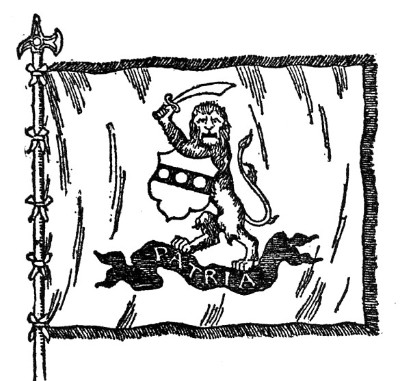 One of the flags of the Pennsylvania Association, 1747. Designed by Franklin and made by the women of Philadelphia. The
officers of the
companies composing the Philadelphia regiment, being met, chose me for
their
colonel; but, conceiving myself unfit I declin’d that station, and
recommended
Mr. Lawrence, a fine person, and man of influence, who was accordingly
appointed. I then propos’d a lottery to defray the expense of building
a
battery below the town, and furnishing it with cannon. It filled
expeditiously,
and the battery was soon erected, the merlons being fram’d of logs and
fill’d
with earth. We bought some old cannon from Boston, but, these not being
sufficient, we wrote to England for more, soliciting, at the same time,
our
proprietaries for some assistance, tho’ without much expectation of
obtaining
it. Meanwhile,
Colonel
Lawrence, William Allen, Abram Taylor, Esqr., and myself were sent to
New York
by the associators, commission’d to borrow some cannon of Governor
Clinton. He
at first refus’d us peremptorily; but at dinner with his council, where
there
was great drinking of Madeira wine, as the custom of that place then
was, he
softened by degrees, and said he would lend us six. After a few more
bumpers he
advanc’d to ten; and at length he very good-naturedly conceded
eighteen. They
were fine cannon, eighteen-pounders, with their carriages, which we
soon
transported and mounted on our battery, where the associators kept a
nightly
guard while the war lasted, and among the rest I regularly took my turn
of duty
there as a common soldier. My
activity in
these operations was agreeable to the governor and council; they took
me into
confidence, and I was consulted by them in every measure wherein their
concurrence was thought useful to the association. Calling in the aid
of
religion, I propos’d to them the proclaiming a fast, to promote
reformation,
and implore the blessing of Heaven on our undertaking. They embrac’d
the
motion; but, as it was the first fast ever thought of in the province,
the
secretary had no precedent from which to draw the proclamation. My
education in
New England, where a fast is proclaimed every year, was here of some
advantage:
I drew it in the accustomed stile, it was translated into German,1
printed in both languages, and divulg’d thro’ the province. This gave
the
clergy of the different sects an opportunity of influencing their
congregations
to join in the association, and it would probably have been general
among all
but Quakers if the peace had not soon interven’d. It was
thought by
some of my friends that, by my activity in these affairs, I should
offend that
sect, and thereby lose my interest in the Assembly of the province,
where they
formed a great majority. A young gentleman who had likewise some
friends in the
House, and wished to succeed me as their clerk, acquainted me that it
was
decided to displace me at the next election; and he, therefore, in good
will,
advis’d me to resign, as more consistent with my honour than being
turn’d out.
My answer to him was, that I had read or heard of some public man who
made it a
rule never to ask for an office, and never to refuse one when offer’d
to him.
“I approve,” says I, “of his rule, and will practice it with a small
addition;
I shall never ask,
never refuse, nor ever
resign an office.
If they will have my
office of clerk to dispose of to another, they shall take it from me. I
will
not, by giving it up, lose my right of some time or other making
reprisals on
my adversaries.” I heard, however, no more of this; I was chosen again
unanimously as usual at the next election. Possibly, as they dislik’d
my late
intimacy with the members of council, who had join’d the governors in
all the
disputes about military preparations, with which the House had long
been
harass’d, they might have been pleas’d if I would voluntarily have left
them;
but they did not care to displace me on account merely of my zeal for
the
association, and they could not well give another reason. Indeed I
had some
cause to believe that the defense of the country was not disagreeable
to any of
them, provided they were not requir’d to assist in it. And I found that
a much
greater number of them than I could have imagined, tho’ against
offensive war,
were clearly for the defensive. Many pamphlets pro
and con were publish’d on the subject, and some by good
Quakers, in
favour of defense, which I believe convinc’d most of their younger
people. A
transaction in
our fire company gave me some insight into their prevailing sentiments.
It had
been propos’d that we should encourage the scheme for building a
battery by
laying out the present stock, then about sixty pounds, in tickets of
the
lottery. By our rules, no money could be dispos’d of till the next
meeting
after the proposal. The company consisted of thirty members, of which
twenty-two were Quakers, and eight only of other persuasions. We eight
punctually attended the meeting; but, tho’ we thought that some of the
Quakers
would join us, we were by no means sure of a majority. Only one Quaker,
Mr.
James Morris, appear’d to oppose the measure. He expressed much sorrow
that it
had ever been propos’d, as he said Friends
were all against it, and it would create such discord as might break up
the
company. We told him that we saw no reason for that; we were the
minority, and
if Friends were
against the
measure, and outvoted us, we must and should, agreeably to the usage of
all societies,
submit. When the hour for business arriv’d it was mov’d to put the
vote; he
allow’d we might then do it by the rules, but, as he could assure us
that a
number of members intended to be present for the purpose of opposing
it, it
would be but candid to allow a little time for their appearing. While we
were
disputing this, a waiter came to tell me two gentlemen below desir’d to
speak
with me. I went down, and found they were two of our Quaker members.
They told
me there were eight of them assembled at a tavern just by; that they
were
determin’d to come and vote with us if there should be occasion, which
they
hop’d would not be the case, and desir’d we would not call for their
assistance
if we could do without it, as their voting for such a measure might
embroil
them with their elders and friends. Being thus secure of a majority, I
went up,
and after a little seeming hesitation, agreed to a delay of another
hour. This
Mr. Morris allow’d to be extreamly fair. Not one of his opposing
friends
appear’d, at which he express’d great surprize; and, at the expiration
of the
hour, we carri’d the resolution eight to one; and as, of the twenty-two
Quakers, eight were ready to vote with us, and thirteen, by their
absence,
manifested that they were not inclin’d to oppose the measure, I
afterward
estimated the proportion of Quakers sincerely against defense as one to
twenty-one only; for these were all regular members of that society,
and in
good reputation among them, and had due notice of what was propos’d at
that meeting. The
honorable and
learned Mr. Logan, who had always been of that sect, was one who wrote
an
address to them, declaring his approbation of defensive war, and
supporting his
opinion by many strong arguments. He put into my hands sixty pounds to
be laid
out in lottery tickets for the battery, with directions to apply what
prizes
might be drawn wholly to that service. He told me the following
anecdote of his
old master, William Penn, respecting defense. He came over from
England, when a
young man, with that proprietary, and as his secretary. It was
war-time, and
their ship was chas’d by an armed vessel, suppos’d to be an enemy.
Their
captain prepar’d for defense; but told William Penn, and his company of
Quakers, that he did not expect their assistance, and they might retire
into
the cabin, which they did, except James Logan,2 who chose to
stay
upon deck, and was quarter’d to a gun. The suppos’d enemy prov’d a
friend, so
there was no fighting; but when the secretary went down to communicate
the
intelligence, William Penn rebuk’d him severely for staying upon deck,
and
undertaking to assist in defending the vessel, contrary to the
principles of Friends,
especially as it had not been
required by the captain. This reproof, being before all the company,
piqu’d the
secretary, who answer’d, “I being
thy
servant, why did thee not order me to come down? But thee was willing
enough
that I should stay and help to fight the ship when thee thought there
was
danger.” My being
many years
in the Assembly, the majority of which were constantly Quakers, gave me
frequent opportunities of seeing the embarrassment given them by their
principle against war, whenever application was made to them, by order
of the
crown, to grant aids for military purposes. They were unwilling to
offend
government, on the one hand, by a direct refusal; and their friends,
the body
of the Quakers, on the other, by compliance contrary to their
principles; hence
a variety of evasions to avoid complying, and modes of disguising the
compliance when it became unavoidable. The common mode at last was, to
grant
money under the phrase of its being “for the
king’s use,” and never to inquire how it was applied. But, if
the demand
was not directly from the crown, that phrase was found not so proper,
and some
other was to be invented. As, when powder was wanting (I think it was
for the
garrison at Louisburg), and the government of New England solicited a
grant of
some from Pennsilvania, which was much urg’d on the House by Governor
Thomas,
they could not grant money to buy powder, because that was an
ingredient of
war; but they voted an aid to New England of three thousand pounds, to
be put
into the hands of the governor, and appropriated it for the purchasing
of
bread, flour, wheat or other
grain.
Some of the council, desirous of giving the House still further
embarrassment,
advis’d the governor not to accept provision, as not being the thing he
had
demanded; but he repli’d, “I shall take the money, for I understand
very well
their meaning; other grain is gunpowder,” which he accordingly bought,
and they
never objected to it.3 It was in allusion to this fact
that, when in our fire company we feared the success of our proposal in
favour
of the lottery, and I had said to my friend Mr. Syng, one of our
members, “If we
fail, let us move the purchase of a fire-engine with the money; the
Quakers can
have no objection to that; and then, if you nominate me and I you as a
committee for that purpose, we will buy a great gun, which is certainly
a fire-engine.” “I
see,” says he, “you have
improv’d by being so long in the Assembly; your equivocal project would
be just
a match for their wheat or other
grain.” These
embarrassments that the Quakers suffer’d from having establish’d and
published
it as one of their principles that no kind of war was lawful, and
which, being
once published, they could not afterwards, however they might change
their
minds, easily get rid of, reminds me of what I think a more prudent
conduct in
another sect among us, that of the Dunkers. I was acquainted with one
of its
founders, Michael Welfare, soon after it appear’d. He complain’d to me
that
they were grievously calumniated by the zealots of other persuasions,
and
charg’d with abominable principles and practices to which they were
utter
strangers.. I told him this had always been the case with new sects,
and that,
to put a stop to such abuse, I imagin’d it might be well to publish the
articles of their belief, and the rules of their discipline. He said
that it
had been propos’d among them, but not agreed to, for this reason: “When
we were
first drawn together as a society,” says he, “it had pleased God to
enlighten
our minds so far as to see that some doctrines, which we once esteemed
truths,
were errors; and that others, which we had esteemed errors, were real
truths.
From time to time He has been pleased to afford us farther light, and
our
principles have been improving, and our errors diminishing. Now we are
not sure
that we are arrived at the end of this progression, and at the
perfection of
spiritual or theological knowledge; and we fear that, if we should once
print
our confession of faith, we should feel ourselves as if bound and
confin’d by
it, and perhaps be unwilling to receive further improvement, and our
successors
still more so, as conceiving what we their elders and founders had
done, to be
something sacred, never to be departed from.” This
modesty in a
sect is perhaps a singular instance in the history of mankind, every
other sect
supposing itself in possession of all truth, and that those who differ
are so
far in the wrong; like a man traveling in foggy weather, those at some
distance
before him on the road he sees wrapped up in the fog, as well as those
behind
him, and also the people in the fields on each side, but near him all
appears clear,
tho’ in truth he is as much in the fog as any of them. To avoid this
kind of
embarrassment, the Quakers have of late years been gradually declining
the
public service in the Assembly and in the magistracy, choosing rather
to quit
their power than their principle. In order
of time, I
should have mentioned before, that having, in 1742, invented an open
stove4
for the better warming of rooms, and at the same time saving fuel, as
the fresh
air admitted was warmed in entering, I made a present of the model to
Mr.
Robert Grace, one of my early friends, who, having an iron-furnace,5
found the casting of the plates for these stoves a profitable thing, as
they
were growing in demand. To promote that demand, I wrote and published a
pamphlet, entitled “An Account of
the
new-invented Pennsylvania Fireplaces; wherein their Construction and
Manner of
Operation is particularly explained; their Advantages above every other
Method
of warming Rooms demonstrated; and all Objections that have been raised
against
the Use of them answered and obviated,” etc. This pamphlet
had a
good effect. Gov’r. Thomas was so pleas’d with the construction of this
stove,
as described in it, that he offered to give me a patent for the sole
vending of
them for a term of years; but I declin’d it from a principle which has
ever
weighed with me on such occasions, viz., That,
as we enjoy great advantages from the inventions of others, we should
be glad
of an opportunity to serve others by any invention of ours; and this we
should
do freely and generously. An ironmonger in London however,
assuming a good deal of my pamphlet, and working it up into his own,
and making
some small changes in the machine, which rather hurt its operation, got
a
patent for it there, and made, as I was told, a little fortune by it.
And this
is not the only instance of patents taken out for my inventions by
others, tho’
not always with the same success, which I never contested, as having no
desire
of profiting by patents myself, and hating disputes. The use of these
fireplaces
in very many houses, both of this and the neighbouring colonies, has
been, and
is, a great saving of wood to the inhabitants. 1 Wm. Penn’s agents
sought recruits
for the colony of Pennsylvania in the low countries of Germany. and
there are
still in eastern Pennsylvania many Germans. inaccurately called
Pennsylvania
Dutch. Many of them use a Germanized English. 2 James Logan
(1674-1751) came to
America with William Penn in 1699, and was the business agent for the
Penn
family. He bequeathed his valuable library, preserved at his country
seat,
“Senton,” to the city of Philadelphia. — Smyth. 3 See the votes. — Marg. note. 4 The Franklin stove is
still in use. 5 Warwick Furnace,
Chester County,
Pennsylvania, across the Schuylkill River from Pottstown. |
 Click the book image to turn
to the next Chapter.
Click the book image to turn
to the next Chapter.