
Web
and Book design,
Copyright, Kellscraft Studio 1999-2007 (Return to Web Text-ures) |
Click
Here to return to
Autobiography of Benjamin Franklin Content Page Return to the Previous Chapter |
 (HOME)
|
|
IV FIRST VISIT TO BOSTON SIR WILLIAM KEITH, governor of the province, was then at Newcastle, and Captain Holmes, happening to be in company with him when my letter came to hand, spoke to him of me, and show’d him the letter. The governor read it, and seem’d surpris’d when he was told my age. He said I appear’d a young man of promising parts, and therefore should be encouraged; the printers at Philadelphia were wretched ones; and, if I would set up there, he made no doubt I should succeed; for his part, he would procure me the public business, and do me every other service in his power. This my brother-in-law afterwards told me in Boston, but I knew as yet nothing of it; when, one day, Keimer and I being at work together near the window, we saw the governor and another gentleman (which proved to be Colonel French, of Newcastle), finely dress’d, come directly across the street to our house, and heard them at the door. Keimer ran
down
immediately, thinking it a visit to him; but the governor inquir’d for
me, came
up, and with a condescension and politeness I had been quite unus’d to,
made me
many compliments, desired to be acquainted with me, blam’d me kindly
for not
having made myself known to him when I first came to the place, and
would have
me away with him to the tavern, where he was going with Colonel French
to
taste, as he said, some excellent Madeira. I was not a little
surprised, and
Keimer star’d like a pig poison’d.1 I went, however, with
the
governor and Colonel French to a tavern, at the corner of Third-street,
and
over the Madeira he propos’d my setting up my business, laid before me
the
probabilities of success, and both he and Colonel French assur’d me I
should
have their interest and influence in procuring the public business of
both
governments.2 On my doubting whether my father would assist
me in
it, Sir William said he would give me a letter to him, in which he
would state
the advantages, and he did not doubt of prevailing with him. So it was
concluded I should return to Boston in the first vessel, with the
governor’s
letter recommending me to my father. In the meantime the intention was
to be
kept a secret, and I went on working with Keimer as usual, the governor
sending
for me now and then to dine with him, a very great honour I thought it,
and
conversing with me in the most affable, familiar, and friendly manner
imaginable. About the end of April, 1724, a
little vessel offer’d for Boston. I took leave of Keimer as going to
see my
friends. The governor gave me an ample letter, saying many flattering
things of
me to my father, and strongly recommending the project of my setting up
at
Philadelphia as a thing that must make my fortune. We struck on a shoal
in
going down the bay, and sprung a leak; we had a blustering time at sea,
and
were oblig’d to pump almost continually, at which I took my turn. We
arriv’d
safe, however, at Boston in about a fortnight. I had been absent seven
months,
and my friends had heard nothing of me; for my br. Holmes was not yet
return’d,
and had not written about me. My unexpected appearance surpriz’d the
family;
all were, however, very glad to see me, and made me welcome, except my
brother.
I went to see him at his printing-house. I was better dress’d than ever
while
in his service, having a genteel new suit from head to foot, a watch,
and my
pockets lin’d with near five pounds sterling in silver. He receiv’d me
not very
frankly, look’d me all over, and turn’d to his work again. The journeymen were inquisitive where I had been, what sort of a country it was, and how I lik’d it. I prais’d it much, and the happy life I led in it, expressing strongly my intention of returning to it; and, one of them asking what kind of money we had there, I produc’d a handful of silver, and spread it before them, which was a kind of raree-show3 they had not been us’d to, paper being the money of Boston.4 Then I took an opportunity of letting them see my watch; and, lastly (my brother still grum and sullen), I gave them a piece of eight5 to drink, and took my leave. This visit of mine offended him extreamly; for, when my mother some time after spoke to him of a reconciliation, and of her wishes to see us on good terms together, and that we might live for the future as brothers, he said I had insulted him in such a manner before his people that he could never forget or forgive it. In this, however, he was mistaken. 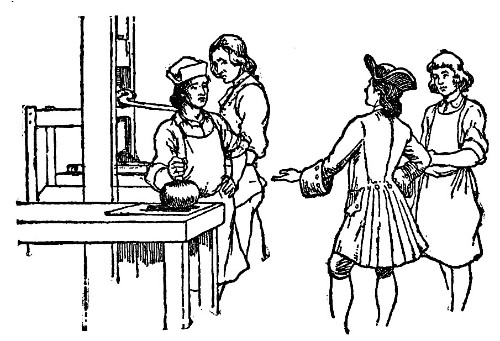 My father
received
the governor’s letter with some apparent surprise, but said little of
it to me
for some days, when Capt. Holmes returning he show’d it to him, asked
him if he
knew Keith, and what kind of man he was; adding his opinion that he
must be of
small discretion to think of setting a boy up in business who wanted
yet three
years of being at man’s estate. Holmes said what he could in favour of
the
project, but my father was clear in the impropriety of it, and at last,
gave a flat
denial to it. Then he wrote a civil letter to Sir William, thanking him
for the
patronage he had so kindly offered me, but declining to assist me as
yet in
setting up, I being, in his opinion, too young to be trusted with the
management of a business so important, and for which the preparation
must be so
expensive. My friend
and
companion Collins, who was a clerk in the post-office, pleas’d with the
account
I gave him of my new country, determined to go thither also; and, while
I
waited for my father’s determination, he set out before me by land to
Rhode
Island, leaving his books, which were a pretty collection of
mathematicks and
natural philosophy, to come with mine and me to New York, where he
propos’d to
wait for me. My father,
tho’ he
did not approve Sir William’s proposition, was yet pleas’d that I had
been able
to obtain so advantageous a character from a person of such note where
I had
resided, and that I had been so industrious and careful as to equip
myself so
handsomely in so short a time; therefore, seeing no prospect of an
accommodation between my brother and me, he gave his consent to my
returning
again to Philadelphia, advis’d me to behave respectfully to the people
there,
endeavour to obtain the general esteem, and avoid lampooning and
libeling, to
which he thought I had too much inclination; telling me, that by steady
industry and a prudent parsimony I might save enough by the time I was
one-and-twenty to set me up; and that, if I came near the matter, he
would help
me out with the rest. This was all I could obtain, except some small
gifts as
tokens of his and my mother’s love, when I embark’d again for New York,
now
with their approbation and their blessing. The sloop
putting
in at Newport, Rhode Island, I visited my brother John, who had been
married
and settled there some years. He received me very affectionately, for
he always
lov’d me. A friend of his, one Vernon, having some money due to him in
Pensilvania, about thirty-five pounds currency, desired I would receive
it for
him, and keep it till I had his directions what to remit it in.
Accordingly, he
gave me an order. This afterwards occasion’d me a good deal of
uneasiness. At Newport
we took
in a number of passengers for New York, among which were two young
women,
companions, and a grave, sensible, matronlike Quaker woman, with her
attendants. I had shown an obliging readiness to do her some little
services,
which impress’d her I suppose with a degree of good will toward me;
therefore,
when she saw a daily growing familiarity between me and the two young
women,
which they appear’d to encourage, she took me aside, and said, “Young
man, I am
concern’d for thee, as thou hast no friend with thee, and seems not to
know
much of the world, or of the snares youth is expos’d to; depend upon
it, those
are very bad women; I can see it in all their actions; and if thee art
not upon
thy guard, they will draw thee into some danger; they are strangers to
thee,
and I advise thee, in a friendly concern for thy welfare, to have no
acquaintance with them.” As I seem’d at first not to think so ill of
them as
she did, she mentioned some things she had observ’d and heard that had
escap’d
my notice, but now convinc’d me she was right. I thank’d her for her
kind
advice, and promis’d to follow it. When we arriv’d at New York, they
told me
where they liv’d, and invited me to come and see them; but I avoided
it, and it
was well I did; for the next day the captain miss’d a silver spoon and
some
other things, that had been taken out of his cabbin, and, knowing that
these
were a couple of strumpets, he got a warrant to search their lodgings,
found
the stolen goods, and had the thieves punish’d. So, tho’ we had escap’d
a
sunken rock, which we scrap’d upon in the passage, I thought this
escape of
rather more importance to me. At New
York I found
my friend Collins, who had arriv’d there some time before me. We had
been
intimate from children, and had read the same books together; but he
had the
advantage of more time for reading and studying, and a wonderful genius
for mathematical
learning, in which he far outstript me. While I liv’d in Boston, most
of my
hours of leisure for conversation were spent with him, and he continu’d
a sober
as well as an industrious lad; was much respected for his learning by
several
of the clergy and other gentlemen, and seemed to promise making a good
figure
in life. But, during my absence, he had acquir’d a habit of sotting
with
brandy; and I found by his own account, and what I heard from others,
that he
had been drunk every day since his arrival at New York, and behav’d
very oddly.
He had gam’d, too, and lost his money, so that I was oblig’d to
discharge his
lodgings, and defray his expenses to and at Philadelphia, which prov’d
extremely inconvenient to me. The then
governor
of New York, Burnet (son of Bishop Burnet), hearing from the captain
that a
young man, one of his passengers, had a great many books, desir’d he
would
bring me to see him. I waited upon him accordingly, and should have
taken
Collins with me but that he was not sober. The gov’r. treated me with
great
civility, show’d me his library, which was a very large one, and we had
a good
deal of conversation about books and authors. This was the second
governor who
had done me the honour to take notice of me; which, to a poor boy like
me, was
very pleasing. We
proceeded to
Philadelphia. I received on the way Vernon’s money, without which we
could
hardly have finish’d our journey. Collins wished to be employ’d in some
counting-house; but, whether they discover’d his dramming by his
breath, or by
his behaviour, tho’ he had some recommendations, he met with no success
in any
application, and continu’d lodging and boarding at the same house with
me, and
at my expense. Knowing I had that money of Vernon’s, he was continually
borrowing of me, still promising repayment as soon as he should be in
business.
At length he had got so much of it that I was distress’d to think what
I should
do in case of being call’d on to remit it. His
drinking
continu’d, about which we sometimes quarrel’d; for, when a little
intoxicated,
he was very fractious. Once, in a boat on the Delaware with some other
young
men, he refused to row in his turn. “I will be row’d home,” says he.
“We will
not row you,” says I. “You must, or stay all night on the water,” says
he,
“just as you please.” The others said, “Let us row; what signifies it?”
But, my
mind being soured with his other conduct, I continu’d to refuse. So he
swore he
would make me row, or throw me overboard; and coming along, stepping on
the
thwarts, toward me, when he came up and struck at me, I clapped my hand
under
his crutch, and, rising, pitched him head-foremost into the river. I
knew he
was a good swimmer, and so was under little concern about him; but
before he
could get round to lay hold of the boat, we had with a few strokes
pull’d her
out of his reach; and ever when he drew near the boat, we ask’d if he
would
row, striking a few strokes to slide her away from him. He was ready to
die
with vexation, and obstinately would not promise to row. However,
seeing him at
last beginning to tire, we lifted him in and brought him home dripping
wet in
the evening. We hardly exchang’d a civil word afterwards, and a West
India
captain, who had a commission to procure a tutor for the sons of a
gentleman at
Barbados, happening to meet with him, agreed to carry him thither. He
left me
then, promising to remit me the first money he should receive in order
to
discharge the debt; but I never heard of him after. The
breaking into
this money of Vernon’s was one of the first great errata of my life;
and this
affair show’d that my father was not much out in his judgment when he
suppos’d
me too young to manage business of importance. But Sir William, on
reading his
letter, said he was too prudent. There was great difference in persons;
and
discretion did not always accompany years, nor was youth always without
it.
“And since he will not set you up,” says he, “I will do it myself. Give
me an
inventory of the things necessary to be had from England, and I will
send for
them. You shall repay me when you are able; I am resolv’d to have a
good
printer here, and I am sure you must succeed.” This was spoken with
such an
appearance of cordiality, that I had not the least doubt of his meaning
what he
said. I had hitherto kept the proposition of my setting up, a secret in
Philadelphia, and I still kept it. Had it been known that I depended on
the
governor, probably some friend, that knew him better, would have
advis’d me not
to rely on him, as I afterwards heard it as his known character to be
liberal
of promises which he never meant to keep. Yet, unsolicited as he was by
me, how
could I think his generous offers insincere? I believ’d him one of the
best men
in the world. I
presented him an
inventory of a little print’-house, amounting by my computation to
about one
hundred pounds sterling. He lik’d it, but ask’d me if my being on the
spot in
England to chuse the types, and see that everything was good of the
kind, might
not be of some advantage. “Then,” says he, “when there, you may make
acquaintances,
and establish correspondences in the bookselling and stationery way.” I
agreed
that this might be advantageous. “Then,” says he, “get yourself ready
to go
with Annis;” which was the annual ship, and the only one at that time
usually
passing between London and Philadelphia. But it would be some months
before
Annis sail’d, so I continu’d working with Keimer, fretting about the
money
Collins had got from me, and in daily apprehensions of being call’d
upon by
Vernon, which, however, did not happen for some years after. I believe
I have
omitted mentioning that, in my first voyage from Boston, being becalm’d
off
Block Island, our people set about catching cod, and hauled up a great
many.
Hitherto I had stuck to my resolution of not eating animal food, and on
this
occasion I consider’d, with my master Tryon, the taking every fish as a
kind of
unprovoked murder, since none of them had, or ever could do us any
injury that
might justify the slaughter. All this seemed very reasonable. But I had
formerly been a great lover of fish, and, when this came hot out of the
frying-pan, it smelt admirably well. I balanc’d some time between
principle and
inclination, till I recollected that, when the fish were opened, I saw
smaller
fish taken out of their stomachs; then thought I, “If you eat one
another, I
don’t see why we mayn’t eat you.” So I din’d upon cod very heartily,
and
continued to eat with other people, returning only now and then
occasionally to
a vegetable diet. So convenient a thing is it to be a reasonable creature, since it
enables one
to find or make a reason for everything one has a mind to do. 1 Temple Franklin
considered this
specific figure vulgar and changed it to “stared with astonishment.” 2 Pennsylvania and
Delaware. 3 A
peep-show in a box. 4 There were no mints in
the
colonies, so the metal money was of foreign coinage and not nearly so
common as
paper money, which was printed in large quantities in America, even in
small
denominations. 5 Spanish dollar about
equivalent to
our dollar. |
 Click the book image to turn
to the next Chapter.
Click the book image to turn
to the next Chapter.