 Web
and Book design,
Web
and Book design, Copyright, Kellscraft Studio 1999-2007 (Return to Web Text-ures) |
Click
Here to return to Field Days in California Content Page Return to the Previous Chapter |
 (HOME) |
|
SOME ROCK–HAUNTING
BIRDS WHICH do
we enjoy
most, the good things we have long sought and at last have found, or
those that
fall in our way as surprises? For myself, I do not know, nor do I think
it
greatly matters. If the good things will only come, say I, let them
come in
whichever way they will; and, if they are kind enough to come in both
ways,
why, then may I have the grace to be doubly thankful. Here in
California,
certainly, speaking as a bird-lover, I have been blessed in both kinds.
Some
things I have earned, if I may say so, by diligent inquiry and seeking.
Others,
equally esteemed, have, as it were, stepped forth to meet me. “Behold
us,” they
have said. “You seem not to have been looking for us; maybe you have
never
heard of us; but here we are.” Pacific
Grove, at
which I tarried in preference to its older and more famous neighbor,
Monterey,
is in two capital respects an ideal place for a walking naturalist. It
is
situated on a peninsula, with the bay shore — a bay as beautiful,
especially in
the late afternoon, as anything earthly need be — on one side, and the
ocean
shore on the other; and between the two are miles — enough, and not too
many —
of a companionable pine forest; a forest, I mean to say, that is large
enough
and dark enough to be impressive, — a real forest, that is, — yet so
far open
to the sun, and so easily traversed, as to put a congenial stroller,
even
within the first day or two, on terms of something like old
acquaintance. Both
shores, too, are happily diversified; a bold, rocky, surf-pounded coast
for the
most part, with here and there short sandy or pebbly beaches. In the
pine woods
were many interesting things, with which I am not here concerned. The
beaches
brought me nothing, not so much as a single wader, I believe; but the
surf-beaten rocks, of which, in my ignorance, I had made no great
account, were
generous with surprises. I was fortunate, I suppose, in happening along
at
exactly the right minute to catch certain rock-haunting species in the
course
of their northward migration. It was on
the
fourth of March that I walked through the forest to the ocean, and
then,
turning to the right, sauntered slowly down the coast toward the
lighthouse.
Moss Beach was empty as usual, and I had gone some distance beyond,
over the
dunes, looking for nothing in particular (some of my best hours were of
this
complexion, for even a naturalist may now and then have a thought or
two
outside the range of his specialty) when all at once sharp outcries
were heard
just in front, and the next moment two sharp-winged birds wheeled round
a rock
and disappeared. My dreamy mood was gone in a twinkling. These birds
were
almost certainly strangers; and what were they? I followed
them,
practising all stealth, and by and by, to my delight, behold, one of
them stood
directly before me on the top of a rock, preening its feathers, in full
view
and the best of light — a sandpiper, with something of the look and
action of
both the spotted and the solitary; new, beyond question, and requiring
to be
scrutinized in every feather. Sometimes it nodded in the manner of a
plover;
oftener it teetered like a spotted sandpiper; while its legs were of a
color
almost lively enough — but shading too much to olive — for the bird
that we
know as “yellowlegs.” A long
while it
posed there, much of the time on one leg, the light favoring me so that
every
little while I could see its eye turn white as the nictitating membrane
— so I
believe it is called — was drawn over it. Then it flew a short distance
(this
was what I was waiting for), and I made sure that there were no white
markings
on wings or tail, a point of almost decisive importance, as of itself
it ruled
out three or four birds that, in the retrospect, — when skepticism,
given half
a chance, is sure to have its finger in the pie, — might be troublesome
as
complicating the question of its identity. This time, to my great satisfaction, it went down close to the surf, where the rocks were thickly matted with seaweeds, and began feeding, jumping into the air at short intervals, as a higher wave than common threatened to carry it away. Once it caught a fish, or other creature, of considerable size, and seemed not a little excited, beating its prize violently against the rock again and again, and finally swallowing it with difficulty, holding its bill open for some time in the operation. By this
time I had
come to a pretty strong conviction that the stranger must be Heteractitis, the wandering
tattler,
though I had no definite recollection of that bird’s plumage (a species
never
seen east of the Pacific coast), and knew absolutely nothing about the
kind of
places it frequented. The controlling consideration, in my present
state of
ignorance, was that the bird could be nothing else. My guess
proved to
be correct. Possibly I should not be mentioning it here, had it turned
out
otherwise. When I got back to the hotel, and brought my penciled
description to
the book, everything tallied, as we say. But the book, for lack of
knowledge on
the part of its author, it is to be presumed, had nothing whatever to
tell me
concerning the wandering tattler’s feeding-habits. Resort was had by
letter to
a man who would be able to enlighten me upon that point, and he replied
that Heteractitis
haunted the rocks, not
beaches nor flats. Here,
then, was a
bird I had never counted upon, an extra, as it were, thrown in for good
measure. Two mornings afterward I went through the forest again; but this time, on reaching the ocean shore, I turned to the left and walked as far as the Seal Rocks, so called, where all Del Monte and Monterey tourists who take the famous seventeen-mile drive (it was one of my good days in California when I first made the round on foot), stop for a minute or two to look at the seals, fifty or more of which, if the tide favors, may commonly be seen basking in the sun. The largest of the rocks, all of which are a little off-shore, is monopolized by flocks of sea-birds, pelicans and cormorants especially, which have whitened its whole surface down to high-water mark. 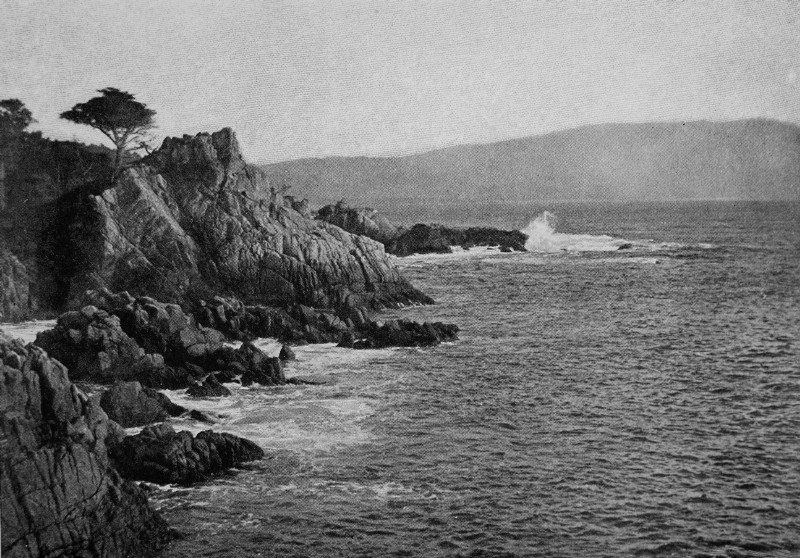 MIDWAY POINT, SEVENTEEN-MILE DRIVE, NEAR PACIFIC GROVE Photograph by Herbert W. Gleason I was
looking at
this rock, counting the cormorants and pelicans, and making out as well
as I
could the identity of the gulls, — the beautiful Heermann gull among
the rest,
— when I was startled by a set of loud, clear, piercing whistles, and
the next
instant saw four red-billed birds skimming over the water between me
and the
rocks. Another minute, and they had alighted on one of the smaller of
them, and
I was repeating to myself, in a kind of ecstasy, “Oyster-catchers,
black
oyster-catchers!” Their stout bright bills and their general figure and
attitudes, so like those of the Eastern bird, which I had seen a few
years
before at St. Augustine, Florida, could belong to nothing else. The feet
and legs
were of a lively flesh color, the head and neck black, or nearly so,
while the
wings, the most beautiful part of them (they were in splendid light)
were of
the warmest, silkiest, shining brown, verging upon chestnut; as lovely
a shade,
I thought, as I had ever seen worn by any bird. For a long
time I
kept my glass trained upon them, now prying barnacles, or things of
that
nature, off the rock, — sometimes putting themselves into odd positions
in
order to secure the needed purchase upon the shell, — now leaping into
the air
as a wave broke over their standing-place, and now taking a short
flight,
always with quickly repeated whistles of the loudest and clearest sort.
I had just
lost
them, — not entirely to my regret, a stitch in the side, from standing
so still
and holding the glass so motionless, making me glad of a chance to
stretch
myself, — when a little flock of smaller black-and-white birds came
down the
shore, uttering a chorus of rattling cries, and seemed to alight among
the
rocks just north of me. I gave chase, came up with them, and presently
discovered that I had found another novelty, — a bunch of black
turnstones;
sooty black, an odd and striking shade, and clear white, the whole
curiously
splashed and mottled, giving them, even with no brown markings,
something of
the cotton-print, patchwork appearance of our Eastern “calico-bird.” I was
still
felicitating myself upon this run of luck, when on the same rocks I
perceived
three birds of quite another complexion; rather plumper and larger than
the
turnstones, in general of a beautiful slaty-gray color, and of a
singular
“spotty” look, to use the word that came of itself to my pencil.
Without going
into particulars as to legs, bill, tail, rump, and so forth, all of
which were
religiously jotted down, suffice it to say that these I settled upon as
probably surf-birds, if, I said to myself, by way of caution,
surf-birds are
feeders upon rocks. For the birds before me kept persistently close to
the
water, on what looked at my distance like bare rocks, not offshore like
those
to which the oyster-catchers restricted themselves, nor covered with
seaweed
like those resorted to by the wandering tattlers. Once — but this was
on the
next day, and there were then four of the birds — they occupied
themselves a
long time on the face of a rock that inclined seaward, running up into
sight as
the higher waves chased them, and anon hastening down again as the
water
receded. The
turnstones,
having a way of their own, fed mostly from rocks nearer land, and
between
whiles walked about the beach, picking up morsels as they went. “The ox
knoweth his
owner, and the ass his master’s crib”; and so every kind of bird seems
to know
where the table is spread for it. The
surf-birds (as to
the identity of which, as well as of the wandering tattlers, I
afterwards
reassured myself by an examination of skins in the fine collection of
the
Academy of Sciences, at San Francisco) interested me the more because
of an
anecdote related to me a good while ago by a friend who for some years
had been
a bird-collector for the Smithsonian Institution, and in pursuit of his
calling
had traveled pretty well over the southwestern United States. On one of
his
trips to the Pacific coast, as I remember the story, he had finished
his stint,
packed his trunks, guns and all, and then, having an hour to spare,
strolled
out upon the shore. And there, to his unspeakable chagrin, were birds
of a kind
he had long looked for and never seen! Surf-birds, he said they were,
birds
that at that time I had never heard of. I forget the remainder of the story, if there was a remainder; but it impressed me as the height of a collector’s tragedy, that he should have missed his one opportunity to secure specimens so desirable. To this
day,
according to Mrs. Bailey’s “Handbook,” which is my vade mecum hereabouts, the
breeding-grounds of the species
are unknown, though an eminent authority upon the birds of the Pacific
coast,
Mr. L. M. Loomis, assures me that it is not rare during its migrations.
Only,
he adds, you must know how and where to look for it. Rare or not rare,
however
(“it has never been found in abundance,” is Mrs. Bailey’s way of
putting the
matter), I am glad to have seen it. I may almost say I am proud to have
seen it
— a bird which no man of science has ever succeeded in detecting at
home.
Somehow it is impossible not to feel a certain heightened respect for
birds
that have succeeded in keeping such a secret in despite of man’s
insatiable
curiosity. |
 Click the book image to turn
to the next Chapter.
Click the book image to turn
to the next Chapter.