 Web
and Book
design,
Web
and Book
design, Copyright, Kellscraft Studio 1999-2007 (Return to Web Text-ures) |
Click
Here to return to Field Days in California Content Page |
 (HOME) |
|
Field-Days in
California A CALIFORNIA BEACH OUR Santa
Barbara
beach, taken by itself, is not much to talk about. Whether for length,
breadth,
hardness, or cleanliness, you may readily find numbers to surpass it.
But for a
bird-student’s purposes it is a reasonably good beach, nevertheless; in
the run
of the year it will show him many a good thing, while for the simple
lover of
beauty it will hold up its end in any comparison. Immediately
at its
back, beyond the railway and the Cobweb of telegraph-wires strung
beside it,
rise the Santa Ynez Mountains, filling the horizon with a magnificent
curving
reach — a visible reach, I mean to say — of fifty miles, more or less.
Easterly, down the coast, where the range, seen from this point, seems
to jut
into the ocean, the lower peaks are of rarely picturesque shapes; and,
dressed
in the soft morning or evening light, especially, the whole serrated
range,
three or four thousand feet in altitude and covered with evergreen
chaparral,
is of a truly exquisite beauty. Its
neighborliness
— some of the higher summits being not more than five or six miles away
— and
its almost semicircular sweep make it in a peculiarly intimate sense
our own.
Live here for a year or two, and you will feel it so. It stretches its
arms
about the city and the beach, and, as it were, holds them in its lap. And then, straight out at sea, loom the islands, Anacapa, Santa Cruz, and Santa Rosa, all of which, standing in a line, are but severed parts of another mountain range, under water still except for these higher summits. Santa Cruz, the nearest and highest of the three and the one directly south of the city, is said to be twenty miles distant, though in a favorable light you might guess it to be less than half as far, and twenty miles long, with a maximum altitude of about twenty-four hundred feet. Scored from end to end with deep, rugged cañons, in which shadows nestle, especially when the morning sun strikes along it lengthwise, the reader must be trusted to imagine for himself how much it adds to the charm of our fair Santa Barbara world as one saunters along the edge of the breakers on a clear, sunny day, with the softest of airs moving in from the ocean, and the temperature graduated on purpose for human comfort, such a day as we have month-long successions of in every year. 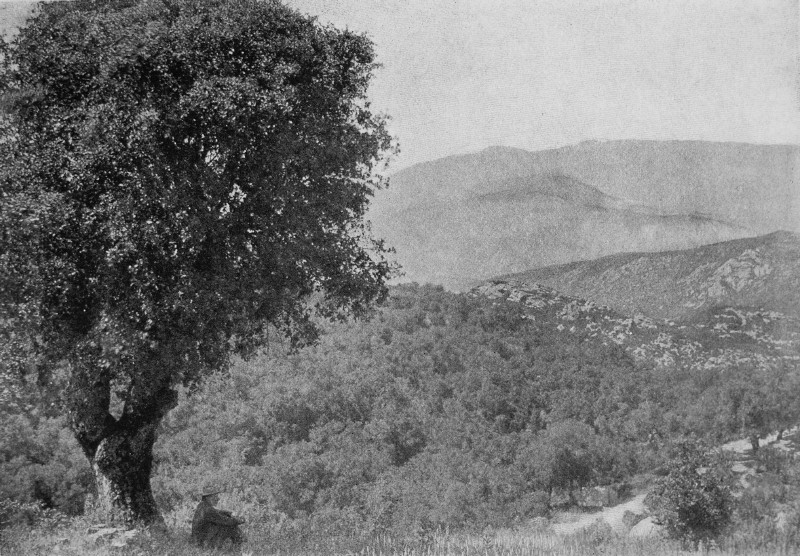 SANTA YNEZ MOUNTAINS FROM SAN MARCOS PASS, ABOVE SANTA BARBARA, Mr. Torrey in foreground It is
difficult,
perhaps impossible, to make some of our knowing Eastern friends believe
that
any spot in southern California can be comfortably cool in summer. “No
need to
talk to us,” they say with an air of finality, as if logic were logic
and there
were an end of it; “if it is warm there in winter, it must be
insufferably hot
in summer.” Well, it
is
moderately warm here in winter, so warm, at all events, that the
gardens, in
spite of frequent frosts (the roofs thickly white, it may be, morning
after
morning for weeks together) — the gardens, I say (and this is one of
the
California mysteries; I wish somebody would explain it), are bright
with a
profusion of delicate semitropical flowers, fuchsias, begonias,
poinsettias,
and a hundred more, all in the freshest of condition, the whole season
long;
and for all that, and though there is no gainsaying that logic is
logic, a
really hot day in summer is one of the rarest of happenings. Day after
day we
fortunate Barbaranos read of deadly heats throughout the East1
and
“Middle West,” and day after day and week after week, through June,
July, and
August, our better-behaved thermometers fluctuate between sixty and
seventy-five degrees, with now and then, not to be entirely out of the
fashion,
an hour-long mid-afternoon ascension into the lower eighties; and night
after
night, the mercury in the meantime having subsided into the sixties,
or, not
unlikely, into the upper fifties, we sleep soundly under a double
thickness of
blankets. For my own
part I
have spent my third summer here, and in that time I have endured — in
September
— one “heated term,” when for five days the sea-breeze failed us, and,
as if for
our sins, the dry, burning breath of the desert found its way over the
mountains; and even that visitation, unwelcome as it was, might
truthfully have
been called something like comfort in comparison with those periods of
day-and-night misery, so many of which I have sweltered through in my
old
Boston neighborhood. It is pleasant in one’s age to escape the
freezings and
thawings and, worst of all, the indoor confinement of a New England
winter; but
it is pleasanter still, if you leave the question to me, to escape
those
wilting, melting, vitality-destroying, homicidal heats of a New England
summer.
Dear old
New
England! say I. Dear old New England! For me there can never be any
other part
of the world to compare with it. All that I ever saw of it is precious
to me,
from the sands of Cape Cod to the mountains of New Hampshire. In my
hours of
recollection I protest with one of old, “I take pleasure in its stones,
and
favor the dust thereof.” But, alas!
the
implacable years are having their way with me; the almond tree begins
to
flourish; and I no longer relish the thought of those more rigorous
chastisements with which our dutiful Puritan mother seeks to toughen
her
children. Dear old New England! Thrice dear in absence. But, if I am
not yet a
lotus-eater, I have ceased to play the stoic. It is time to be
comfortable,
something tells me; and so, as bad boys were said sometimes to do in
other
days, I have run away from school. Men of
sixty or
seventy who proclaim that they feel just as young as ever they did are
mostly
liars, I think. Many years
ago,
when I was dreaming of a possible visit to the Pacific coast, a bit of
dialogue
was rehearsed to me by way of a deterrent consideration. A friend, who
has no
fondness for cold weather, though, being a more loyal Northerner than
some, he
will never run away from it, had been quizzing a neighbor recently
returned
from California. “Well, do
you like
wind?” asked the returned traveler. “No.” “Do you
like dust?”
“No.” “Do you
like
fleas?” “No.” “Then you
wouldn’t
like California.” A
discouraging
picture. And truthfully drawn, of that I make no question, according to
the
man’s lights. No doubt there are many parts of California — I myself
could name
one or two — which suffer grievously from all these plagues, as there
are many
which suffer from months of intolerable heat. But I am talking of Santa
Barbara, and here is my testimony: — In my
almost three
years of residence I have not seen so much as one flea, though I have
heard of
those who have had a less happy experience; I have been no more
troubled by
dust, for all the regular annual drought of seven or eight months, than
I have
been in many places in the East; while, as for wind, I have never lived
anywhere where there was not at least several times as much. In that
respect,
indeed, the place is nothing less than a wonder. To use the word of the
hour, I
must believe that it holds the world’s record. I remember
successive weeks and months in Massachusetts during the cooler season
when it
was almost impossible to hit upon a day at the seashore in which the
air would
be still enough to leave a man’s eyes clear for nice ornithological
observation
through a field-glass. Here, taking the twelve months together, there
may be
ten or twelve hours, mostly at night, of a really smart gale, and as
many
half-days of a moderately brisk wind, truly moderate, but extremely
disagreeable, if one must be out of doors, by reason of the dust it
raises. For
the rest of the time, the strongest movement will be a lazy breeze (two
or three,
or possibly five or six, miles an hour), barely sufficient, for the
most part,
to stir the leaves; and you may walk the beach, or recline upon the
sands, be
it January or July, with a clear vision and complete animal comfort. At all
seasons the
beach is an unfailing resource for the stroller. No matter how muddy
the
country roads may sometimes be in winter (in the adhesive adobe parts
of them
all but impassable on foot — I have lost a rubber overshoe in such
places more
than once), nor how dusty the worst neglected of them may become in
summer, the
beach is always at our service, since it is a wholesome quality of sand
to be
rain‑proof and sun-proof; at the worst of times neither muddy nor
dusty. For
myself I have had numberless good hours there, and not a few that might
truthfully be called exciting. If I had a
bank
full of money, I once in a while find myself thinking (and perhaps
wiser men
than I might own to the same sort of foolishness), I could do this or
that.
But, after all, what could I do so very much better, school being
dismissed,
than to go idling up and down this sightly beach, looking or dreaming —
and
enjoying myself — as the mood befalls? Happy is
the man (I
may have said it before, but no matter), happy is the man who has
acquired an
interest in the world out of doors. It is an investment good for both
body and
soul. “Give
a man a horse he can ride; For
“horse” write
“hobby,” and the rhythm may suffer, but the sense will not be damaged,
but
rather improved. And here
in this
favored region, where sea and land meet, with a mockingbird singing his
soul
out on one side of you and pelicans plunging into the water with a
mighty
splash on the other side, with the fairest and friendliest of sierras
compassing you about, the blue ocean outspread before your eyes,
carrying them
away and away till the blue heaven drops into it, with seaside verbenas
and
lovely constellations of yellow primroses overrunning the broken
gray-sand
windrows just beyond the reach of the breakers, with the breath of the
sea
filling your lungs, and the sun warming your blood, — with all this,
and the
hours your own, what kind of man must you be not to be glad of living? In the
round of the
year the beach, with the flats and pools immediately adjoining, is
visited — to
my own partial knowledge, that is to say — by eighty or ninety species
of
water-birds — waders, swimmers, divers, and the rest. Of all
these, none
are more engaging, or more constant, than the dainty little snowy
plovers; not
snow-white, to be sure, but of a shade light enough to render the name
sufficiently appropriate as such things go. Dainty I call them, and so
they
are; but there should be some more expressive word for it, if only I
could call
it up; so exceedingly quiet and neat in their dress; trig, shall I say?
with a
few touches of black — complexion-heighteners, “beauty-spots” — on a
ground of
gray and white. Every
Eastern bird-student
has them in his eye when he first comes to the “coast,” and glad enough
I was
to find them at home — “permanent residents,” as the stock phrase is —
in
goodly numbers here at Santa Barbara, where, after wandering up and
down the
State, I myself had elected to settle. It is much for a man to be sure
of good
neighbors. Every day
they are
here, and every day it is a pleasure to watch them; now running about
or
standing at rest on the gray, dry sand — too close a match in color for
even a
hawk’s eyes, one would think; now squatting singly, here, there, and
yonder, in
the footprints of horses, hardly more than the head showing, one of
their
prettiest tricks — you may sometimes see fifty at once cradled in this
cozy
fashion, for shelter against the wind, or by way of a more comfortable
siesta,
or, possibly, as affording a measure of concealment; and now scattered
in loose
order along the edge of the surf, picking up the day’s ration. An
extraordinarily light repast this would seem to be, or, like the
Israelites’
manna, one very easily gathered, seeing how small a share of the day
they spend
upon it. Nine times in ten you will find them doing nothing, in what
looks like
a reposeful after-dinner mood, strikingly unlike the behavior of the
common run
of birds, which seem for the most part to make the daily meal a sort of
continuous refection, an uninterrupted picnic, here a little and there
a
little, on strictly hygienic principles, from dawn till dark. As is true
of
plovers in general, the snowy (smallest of them all, as far as my
acquaintance
with the family goes) is amazingly sudden and spry in its motions, a
sprinter
of the first rank, starting at full speed, and scampering before you,
head
down, till its legs fairly twinkle, they move so almost invisibly fast;
and you
are ready to name it the beach-runner, as we call the big ground-cuckoo
of our
hillsides the road-runner. Make the course long enough, and the cuckoo
would
undoubtedly come under the wire a strong first; but even so a fairly
liberal
“time allowance” might award the prize to the smaller contestant.
Anyhow, it is
sport to see the nimble midgets run. The
snowy’s voice
is an additional item in its favor; a sweetly musical voice, the most
frequent
of its utterances being a quick, sudden whistle, — not too loud, but
full of
meaning, — which after a while becomes recognizable as distinct from
all other
beach sounds, though at first hearing there may seem to be nothing very
characteristic about it; just as you are able as a matter of course to
name
numbers of your friends on hearing them speak the merest word or two,
though
for your life you could never tell even yourself how you do it. If you are
fortunate enough to startle the bird from its nest, flat on the open
sand, and
stoop, as you will, to admire the prettily spotted eggs, packed so
cleverly,
the smaller ends together, on a loose layer, hardly more than a
sprinkling, of
bits of seaweed stuff, a nest impossible to take up until you have
first gummed
the parts together as they lie, the plover makes so gentle a
remonstrance that
you would never suspect it for such but for your own guilty
consciousness; all
in extreme and most refreshing contrast with the obstreperous behavior
of its
larger relative and neighbor, the killdeer. This,
also, is a numerous
year-long resident with us, every bird noisy enough for ten; with a
rasping,
ear-piercing, nerve-racking, in every way exasperating voice, the sound
of
which has often made me vote its possessor a nuisance, especially when
I have
been seeking a close interview with some rare and interesting visitor,
— a
thing to be accomplished now or never, perhaps, — and have been
thwarted at the
critical moment by the causeless outcries of this pestiferous busybody.
Father
Linnæus knew what he was about when he dubbed it vociferus. Nest or no
nest, in
season or out of season, it catches sight of you from afar; and up goes
its
voice, sharp as a razor and loud enough to rouse the neighborhood. Now
here,
now there, it runs, flies, and stands still by turns, screaming more
and more
wildly, till its voice literally breaks into shivers; and, although you
know
better, you begin to think that for once the creature must be in some
real
trouble. Such agonizing, brokenhearted shrieks cannot be all a
make-believe. And then
of a
sudden silence falls upon the scene. Nothing has happened; all things
remain as
they were; but for this time the play is played out. There is
no bird of
my acquaintance for which I entertain so hearty a dislike. “Animosity,”
I was
on the point of writing, but that seems an undignified expression as
between a
man and a plover. I should be sorry to have the species exterminated,
but so
far as my daily beat is concerned I would cheerfully see its numbers
diminished
by nine out of ten. Yet I
remember the time
in my Eastern days when the sight of a killdeer was cause for loud
rejoicing,
and its harshest cry a kind of music. Then it was a novelty; once in
many years
by some accident it came in my way; and rarity will always insure a
welcome,
or, at the worst, toleration. There is here and there a man (I can imagine such
a thing, at any rate) who does well enough for an hour now and then,
say once
or twice a year, but who would speedily become unendurable as a daily
intruder.
The
killdeer,
withal, is a fine, handsome fellow to look at, well set up, as we say
(and how
well he knows it!), with his bright complexion, his unrivaled twin
breast-bands, and his highly ornamental tricolored tail, of which
brilliant
appendage, by the way, he makes so splendid a use in courtship-time;
and, if he
possessed the very smallest gift of silence, or knew enough to make
himself
once in a while scarce, I should never think of grudging him his
multitudinous
existence. As it is, he is one of God’s creatures for which I have lost
pretty
much all relish. At certain times of the year hardly a day passes in
which his
ill-timed vociferations do not wear my patience threadbare. Both the
snowy
plover and the killdeer are to be found not only along the beach but in
the
“Estero,” so called, a ditch and tide-pool region, some acres in
extent, on the
landward side of the railway. This eyesore of a place, as the ordinary
citizen
would describe it, and properly enough from his point of view, sterile
(in
Spanish estéril), homely,
unclean, and at low tide not precisely
sweet-smelling, is a famous rendezvous for many species of water-birds,
and by
consequence a favorite resort for the local ornithologist. Distant be
the day,
say I, when the city fathers shall take it into their thrifty heads to
improve
it out of existence, to make room for another park, it may be, or an
additional
“residence district.” It is something better than a residence district
already;
a first-class caravansery, well patronized year after year by bands of
distinguished travelers on their way northward or southward as the
seasons
shift. They keep
it in
mind, it would appear, as a convenient spot in which to break their
long
journey; for even the stoutest pair of wings may without shame welcome
a
breathing-space here and there between the neighborhood of the North
Pole and
the southern parts of South America. It suits their purpose the better
that it
lies within the city limits, and except by stealth is not invaded by
shotguns.
Ducks of many sorts swim here in safety by the month together. If
ill-mannered
dogs find it amusing to pester them, as too often happens, they have
only to
circle about on the wing for a minute or two and come down again in a
different
pool or ditch, behind another curtain of reeds. They have
no minds,
of course, or none to speak of; great scholars have set our minds at
rest upon
that point, but by hook or by crook they manage to pick up a bit of
information
here and there, which is better than nothing; and by some means or
other — by
experience, perhaps, or possibly by hearsay, who knows? — they seem to
have
ascertained that this is a safe port; and, the living being good,
likewise,
here they remain, greatly to my satisfaction. This is in the wintry or
non-breeding season. None of them nest here, to the best of my
knowledge. Summer or
winter,
autumn or spring, there is always something stirring on the beach or in
the
Estero. Among shore-birds, especially, the semiannual migratory
movements
pretty nearly overlap each other. This season, for instance (1911),
only
seventeen days elapsed between the disappearance of the last
north-bound flyers
— a few northern phalaropes, as it happened — and the advent, on the
5th of
July, of the first autumnal south-bound travelers, a small flock of
least
sandpipers. And by way
of
illustrating the same point I may cite the case of the sanderlings as
observed
during the past year. Sanderlings, it should be understood, are natives
of the
extreme north, their breeding-range, as given by the latest authority,
being
“from Melville Island, Ellesmere Land, and northern Greenland to Point
Barrow,
Alaska, northern Mackenzie, Iceland, and northern Siberia.” A long
flight, at
the nearest, from southern California. Yet during the past year I have
noted
them on our Santa Barbara beach in every month except June! And even
that month
was missed by a matter of only four days; since a few birds were
observed as
late as May 28. So many
stragglers
are there tagging in the rear of the main army, and so surprisingly
brief is
the time that these natives of arctic and subarctic regions tarry in
what is to
them the home country. Why they should continue to travel so far to
make so
short a stay is a question which they may answer who can. A long way
from
Santa Barbara, I said. But that is the smallest part of the story; for
the
sanderlings that winter in southern California are the merest handful,
a few
hundreds or thousands out of millions; the overwhelming majority of the
host go
much farther south, some of the more adventurous as far as Patagonia; a
semiannual hegira for these diminutive creatures, but a few ounces in
weight,
sufficient to stagger the imagination if we were not so heedless of
such things
or so accustomed to the thought of them. But then,
we ought
to have discovered before this that neither power nor spirit is
according to
size, a consideration as true of birds as of other people. Witness an
extreme
case, the case of a hummingbird, a mite of flesh no bigger than a
lady’s thumb.
Hatched in Alaska, this enterprising atom will find its way to southern
Mexico
and back again to its birthplace before it is a year out of the shell.
Man is a
wonder, especially to himself; he is even beginning to fly, — and
incidentally
breaking his neck in the process. But let him look abroad; and, great
as he is,
he may see cause to be modest in his boasting. Why do the
sanderlings travel so needlessly far? we asked. And can any one tell us
why
small, frail-looking, weak-seeming bodies like the titlarks, after a
winter of
content on our Santa Barbara beach, betake themselves, as sure as the
spring
comes round, to some barren, hurricane-swept, almost uninhabitable
mountain-top, a thousand miles away? With a pair of wings, albeit not
of the
strongest, and the wide world to choose from, why should they settle
upon this
most forbidding and uncomfortable of all possible dwelling-places? As I
watched them,
or endeavored to watch them (for neither they nor I could stand still
enough
really to see each other), on the summit of Pike’s Peak, every one
crouching
behind its boulder, over the top of which it now and then peeped at the
solitary and unexpected human intruder, as there came a momentary lull
in the
gale, I marveled at their temerity in attempting to live and bring up
their
nestlings under such distressing conditions. At the
same time I
amused myself by fancying that I detected a possible explanation of
their
uneasy caudal habit. In such a wind, continuous for the most part day
after
day, no bird could be expected to hold its tail still. It must be
forever on the
tilt, like a rope-walker’s balance-pole. And an action of this kind,
early
acquired, might, I thought, easily develop into a chronic nervous habit
— a
tic, to borrow a pathological term — never to be got rid of. That was
fancy, and
may be allowed to pass. But the question why such a bird should be
contented to
live in such a place, and in no other, remains a fair one. Every kind
of
country, you may say, must have its own kinds of birds; matters are so
ordained; and so the naked summits of the Rocky Mountains have their
rosy
finches and their titlarks. I am glad they have them, but such a reply
is pure
assumption, and rather begs the question than answers it. For
myself, I
attempt no answer, though I am moved to suggest that a bird is
something like a
man, say what you will about our assumed human supremacy; and it is
conceivable
that a bird may sing as fervently as any Scotchman or Switzer, “My
heart’s in
the Highlands.” I myself
am neither
Scotch nor Swiss; I never saw so much as a distant mountain till I was
a man
grown; but if I could have my will, not a year should pass without my
knowing
at least once the exhilaration (there is nothing in the world just like
it) of
standing under the sky in some high place, the higher and more
lonesome, the
better. I remember days, a beggarly few, alas! on mountain-tops East
and West.
And among the brightest of such memories is that of my few hours on
Pike’s
Peak, when these fluttering, storm-tossed titlarks, twittering on the
edges of
snowbanks, were my sole but sufficient company. And if a
born
lowlander delights to spend a few hours now and then at such altitudes,
why is
it to be deemed altogether surprising that creatures to the manner
born, brave
and self-reliant souls, needing neither highway nor trail, accustomed
from the
shell to live in the “un-tented cosmos” and “travel the uncharted,”
should find
themselves drawn as by an irresistible attraction to spend the summer
there? It
heartens me to think of them thus holding true to the home-land year
after
year, let the wind howl about them as it will. And because I once saw
them
there I see them with the more pleasure, and the more respect, as they
flit
before me all the sunny winter long on our Santa Barbara beach. Three
quarters of
the time at sea-level, and the remaining quarter two or three miles
above it,
so unevenly do they divide the year; but measured by what is done and
enjoyed,
the one quarter may well count for more than the other three. And if
they are
ever touched with homesickness, I believe it is on our zephyr-kissed
southern
beaches and golf-links rather than on those tempestuous northern
mountain-tops.
It is good to think that for them as for us there are joys that count
for more
than comfort. It has
been noticed
that a man who courts solitude is apt to be more than commonly fond of
animal
society. He may have carried his peculiarity so far as to build a
hermitage in
the wilderness for the purpose of living apart from his fellows, but he
can
never have too much of the company of rabbits and squirrels. Rats and
mice even
are welcome; and if a partridge leads her brood past his door, he is
happy in
the recollection of the event for a week afterwards, and will give it a
paragraph later in his book, if he writes one. In short,
the
hermit has no objection to neighbors; only they must be of an
unobtrusive sort,
such as put him under no social obligations, and disturb neither his
idleness,
one of the most valuable parts of his estate, nor his employment. The
chipmunk does
not vex him with criticisms or empty talk, and the sparrow never wishes
to know
why he doesn’t go back to the town and live like other people; and if
he keeps
on reading or writing, or hoeing his beans, the partridge will never
dream of
taking offense. For a man of his temperament, you perceive, he has
contrived to
secure some of the chief advantages of both society and solitude. A
saunterer upon
the Santa Barbara beach has not retired from the world. He is seldom
out of the
sight of human beings. They are continually passing to and fro, more or
less
noisily, behind his back. But at the same time he is little in danger
of
missing a wholesome proportion of solitude. He may talk aloud, or break
into
song, and neither disturb others nor be himself disturbed. Even if he
carries a
field-glass, nobody is likely to ask him what he is looking at, or
(about the
commonest of questions), how far he can see with it. And
naturally in
such circumstances he is much alive to the fellowship of beach-haunting
birds.
Their affairs interest and amuse him. He sympathizes with them. As
Keats
expressed it so felicitously in one of his letters, he “takes part in
their
existence.” If their attention is mainly given to matters gastronomic,
he does
not mind, nor think the worse of them. He cannot sit at their table,
but he
looks on with pleasure, happy in their happiness. If they take no
thought for
raiment, and have neither storehouse nor barn, it is by no fault of
theirs.
They are probably better dressed than he is, more comfortably and in a
thousand
times better taste. Let them eat and be merry. Here, for
instance,
is a flock of sanderlings, a score, perhaps, or, not unlikely, a
hundred. The
tide is falling; they have had a long rest, sitting in a close bunch on
the dry
sand while the beach has been flooded; and now see how busy they are!
Every
time a wave recedes, down they run in its wake to seize any bit of
edible life
that it may have left behind. Till the last moment they stay, pecking
hastily
right and left in the suds, not to lose a morsel; and then, as the next
breaker
comes rolling in, back they scamper up the beach as fast as their legs
will
bear them. If they get their toes wet, it is no killing matter; but
they keep a
sharp lookout against anything worse than that. The most timorous of
screaming
human surf-bathers could not be more insistent upon that score. If you do
not enjoy
this animated scene, then it is hard to think what you are made of. All
their
movements are so quick, so eager, and so graceful! And the birds
themselves are
so pretty, snowy white, with black, or black and brown, markings. But they
are even
more engaging if you catch them at their bath. This they sometimes take
in the
uppermost reaches of the surf, a hurried and none too comfortable
operation, as
it looks, since they must retreat every time another wave comes in.
They much
prefer, I think, the edges of some still tide-pool, where they can dip
and
splash at their leisure. About the
bathing
itself, as far as I have observed, there is nothing peculiar; but after
it I
once saw them practising what was to me a trick as novel as it was
pleasing.
Standing on the sand, they sprang straight into the air again and again
to a
height of six or eight inches, shaking themselves vigorously while so
doing, evidently
for the purpose of drying their feathers. At the first instant I
thought they
might be catching low-flying insects such as swarm here and there about
patches
of seaweed or on the edge of shallow still water. “Bravo!” said I, when
I
discovered my mistake; “you have shown me something new.” On the
same
occasion I noticed, what I had often noticed before, their strong
propensity
for standing and running (hopping, I ought to say, I suppose, lest some
youthful critic, shocked at my ignorance, should esteem it his duty to
set me
right) on one leg. Sometimes half the flock will be thus engaged. And
the
wonder is that they get over the ground almost or quite as quickly on
one leg
as on two. At any rate, they keep up with the procession, — which is
the principal
aim of most of us, — no matter how fast it is moving. Just why
sanderlings, or any other birds, should habitually balance themselves
thus in
sleep or when at rest, is more than I have ever seen explained or been
able
myself to divine. A swan, say, with its big body and long neck, or a
tall
heron, born to go on stilts, or a caged canary — how have they come to
find
this unnatural-looking, awkward-looking, difficult-looking,
Simeon-Stylites-like attitude the acme of comfort? Fancy
yourself
trying it to-night instead of getting between the sheets. What long
hours of
peaceful slumber you would enjoy! Sleeping or waking, even if you are a
trained
athlete, I would not give you any great length of time in which to
maintain the
attitude, to say nothing of finding it conducive to repose. As for running on
one leg, that, so far as I know, is a trick peculiar to sanderlings. As
well as
I can recall, I have never found any other kind of bird attempting it;
except
of course, disabled individuals, which show plainly enough by their
awkwardness
that their one-legged performances, such as they are, are matters of
painful
necessity. Whether
sanderlings
have the happiness to feel a comfortable touch of pride in this
singularity of
theirs is a question to be left for such as possess a better, more
instinctive,
knowledge than I am favored with as to what goes on inside of fur and
feathers.
Sanderlings
as a
rule feed on the beach and nowhere else; but I once knew a small flock
to
remain for a week or two in a certain part of the Estero. “Those crazy
sanderlings” an ornithological friend of mine called them, seeing them
so
persistently out of their natural surroundings. For myself, I found it
difficult at first to feel sure that they were sanderlings. For aught I can
say, they may have been “bolters,” resolved upon saving the sanderling
nation
(one of Gilbert White’s words) by hatching a new party. Other
small birds,
semipalmated plovers, for example, while displaying a preference for
muddy
flats, still frequent the beach with a good degree of regularity. This
very
morning a flock of four ran before me down the sands for a mile, more
or less,
keeping about so far in advance, — twelve or fifteen yards, — and
picking up
their breakfast as they went, the beach being alive with sandhoppers.
On my
return, an hour later, I overtook them again; but now they had been
joined by
three least sandpipers, and within five or ten minutes, while I was
still
watching them, two stray sanderlings attached themselves to the group,
the
whole nine being sometimes within a circle of a yard in diameter. It seems
to be
characteristic of such diminutive travelers, if they become separated
from
their natural companions, to associate themselves with any little group
of
other species on which they may happen to stumble. Strange company is
better
than none, they think, as most of us must have thought before now on a
long
journey. The nucleus of this particular flock was the four plovers. To
my
knowledge they had been on the beach quite by themselves for an hour or
more. Then the
three
sandpipers joined them, and finally the two lonesome sanderlings
descried the
group, and said, “Come on! Here’s our chance.” By an
unusual
stroke of luck I had actually seen the company formed. At my last sight
of them
they were flying down the beach together, as if they had been hatched
in the
same nest. A very
different
bird, whose feeding-habits I have often enjoyed overseeing, is the
white-winged
scoter, a black duck marked by a sightly white patch on its wing.
Flocks varying
in number from half a dozen to twenty or thirty are always present,
summer and
winter alike, and, while more generally seen swimming a short distance
out,
between the breakers and the kelp, they seem to get much the larger
share of
their living in the shallow surf inside the last breaker. There they
may be
seen daily, bumping about on the sand, very ungraceful, but very busy,
and by
the appearance of things very successful. Their diet is mostly
crustacean. As
each wave comes in and breaks, they waddle with all speed into its
frothy
shallow, dabbing hurriedly right and left, nose under water, not
minding in the
least if the next billow tosses them ashore again (in fact, this is
much their
easiest way of getting there); and pretty often, often enough, at all
events,
to keep them in good heart and flesh, the wave brings them the tidbit
they are
seeking. The tidbit, I say, but frequently the wriggling captive —
crab,
shrimp, or what-not — looks a rather unwieldy mouthful as, with more or
less of
spasmodic tossings of the head, they finally worry it down. If a
horseman
happens along, they tumble hastily into the surf, and swim a little way
out,
diving through the higher breakers and riding the lesser ones, only to
return
and resume their meal as soon as the coast is clear again. I suspect
that they
fish mostly at a certain stage of the tide, but as to that I have made
no
conclusive observations. Another
duck, also
common here, wears the name of surf scoter, but I cannot perceive that
the
designation fits him better than his white-marked relative. It must be
a very
foolish or ill-brought-up bird, however, that has only one string to
his bow.
The scoter has at least two, for besides this raking of the surf he is
proficient at diving in deep water. I have watched him at it many a
time,
leaning over the railing of the pier for that purpose, directly above
his head.
Then he is anything but ungraceful. With a sudden tip forward and a few
vigorous strokes of his legs, down he goes out of sight, and stays
there for a
longer or shorter period (I have sometimes held the watch on him)
according to
the water’s depth. How often
this
deep-sea dredging, as we may style it, is rewarded I cannot say, but I
have no
recollection of ever having seen him bring any. thing to the surface. I
suspect
that the breaker’s edge is by much his most remunerative field. There I
have
seen him when he seemed in danger of acute indigestion, his luck was so
good,
and his greediness so uncontrolled. While
swimming
alongside the pier he is sometimes absolutely heedless of passers
overhead. I
have repeatedly seen boys — and men, also — stone him; and even when
the
missile strikes the water within a yard, the silly bird disdains either
to dive
or fly, but paddles slowly away while the boy laughs and continues to
pelt him
till he gets out of range. His manner
at such
times is the very perfection of stolid indifference. “Oh, go on,” he
might be
saying. “You couldn’t hit the side of a house.” And as a matter of fact
I never
have seen him actually struck. One
incident I
particularly remember. A young fellow who might have been a
professional
baseball player, from the accuracy of his aim and the strength of his
arm,
threw a large stone, which splashed into the water within a foot of the
duck,
almost under him, in fact. The man and his companions were noisily
amused, but
the bird continued on his moderate course as if nothing had happened.
The big
stone might have been a raindrop for all the effect it produced. If the
creature had been human, I should have set him down for a fool. And it is
well
within the possibilities, I suppose, that there are idiotic and crazy
individuals among birds as well as among men; birds, for example, that
fly by
the hour, day after day, against windows, as I have known an occasional
robin
and English sparrow to do, and will not be driven off, and this absurd,
unfrightenable coot. And if this is true, we are perhaps as far astray
in
judging of the mental capacity of birds in general from such examples
as we
should be to estimate the intellectual faculties of the German or any
other
race by what we see in their asylums for the insane and feeble-minded. Even in forming an opinion concerning so innocent a subject as the intelligence of birds and such like humble people, it becomes us to exercise a proper degree of modesty, and even (why not?) of Christian charity; the more as we are ignorant of their language (which accordingly, in our humanly arrogant mood, we brand as inarticulate), and know nothing of what evidence or explanation they might be able to adduce in contravention of our disparaging verdict. Of all things, being what we are, let us beware of infallibility. It is one of the most insidious of vices, as it is, also, one of the most ill-favored. It makes its home within us all unsuspected, so very cautious we esteem ourselves, the last persons in the world to be guilty of anything like presumption or dogmatism; and then, before we know it, we are delivering guesses for certainties, as if we were throned in the Pope’s chair and such a thing as error were impossible. No, no; for our own sakes, if for nobody else’s, let us take a lower seat. 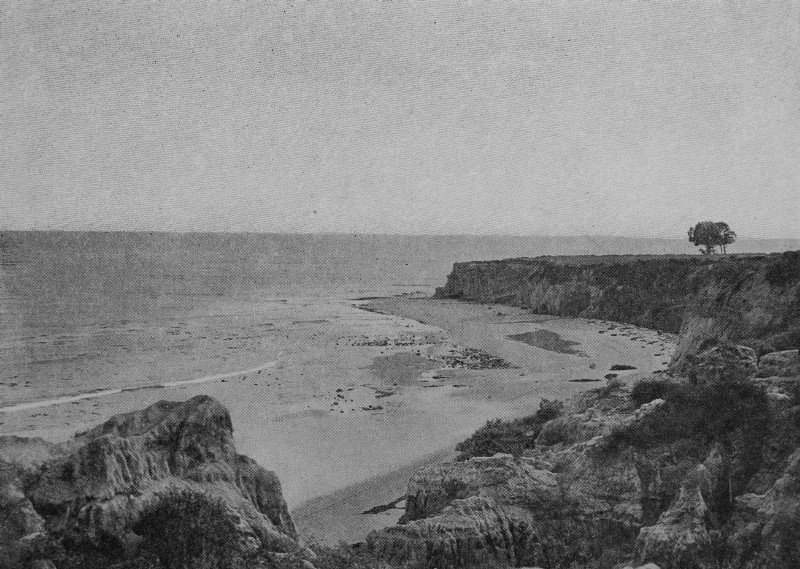 THE BEACH AT SANTA BARBARA Photograph by George R. King The two
scoters are
on our beach throughout the year; yet there is no reason to suppose
that they
nest within a thousand miles. In other words, all the hundreds or
thousands of
scoters that summer along the California coast are what our official
Check-List
describes as “non-breeding birds.” Concerning
this lagging
or non-migratory habit of theirs, two questions suggest themselves. In
the
first place, why should not these barren individuals, as we assume them
to be,
follow the tribal instinct and go north with their fellows in the
spring, even
though they are not to pair and raise young? — a question which,
properly
considered, might throw some light on the motive of birds in general in
undertaking their extremely long and expensive spring journeys. If it
is simply
a homing instinct, it is hard to understand why these scoters should
not remain
under its influence even after they have passed the age of procreation.
And,
secondly, it
would be highly interesting to know why this non-migratory,
non-breeding habit
should be peculiar to these two kinds of ducks. It is not unlikely, of
course,
that stray individuals of other species may now and then, for one
reason and
another, remain behind to pass the summer south of their natural
breeding-limits; but so far as the Check-List shows, our two scoters
are the
only ducks that do this with sufficient regularity, or in sufficient
numbers,
to make the fact worthy of mention. Scoters
(or coots,
as gunners call them) are by no means the only birds that patrol our
beach in
quest of crustacean dainties. Flocks of Hudsonian curlews may often be
seen
pursuing the same game, though with their different equipment they
naturally
follow a different method. They go about the business as our numerous
fishermen
do when in search of bait, not looking for it on the surface (though I
have seen
them doing that also), but probing for it. Down goes their long,
sickle-shaped
bill into the wet sand, frequently for only a fraction of its length;
and often
as not you may see it bring up a squirming something that looks like a
shrimp
or a prawn. This the
bird does
not at once swallow, as you might have expected it to do. Instead, it
drops its
prey upon the sand, picks it up and shakes it, drops it again, and so
on, the
unfortunate victim all the while struggling to get free, till suddenly
a final
jerk and a gulp, and it disappears down the long bill. Of the precise
reason
for all these preliminaries I am ignorant. Possibly the crustacean must
be held
in a certain position before it can be comfortably swallowed. Certainly
it is
not killed in the process, for it wriggles to the last moment. I have
known a
flock of fifteen curlews to take possession of a certain short stretch
of the
beach, with nothing but a few rods of low sand-hills between them and
the noisy
asphalt boulevard, and hold it for the greater part of a day, flying
out to sea
for a little distance when driven to it by too close a passer-by, and
immediately returning. That was a day, no doubt, when the fishing was
exceptionally good, and they were in the condition of a boy I once
knew, who could
not go home to dinner when the pickerel were biting among the lily-pads
over at
Reuben Loud’s millpond. On the
other hand,
I have seen within the same week a flock of eighty curlews on a
lonesome
stretch of beach beyond the city limits — and the city’s protection —
that
would not allow me to approach within two or three gunshots. The
difference in
numbers may have had something to do with the difference in behavior.
Fear is
contagious, as we all know. The larger the crowd, the quicker and
crazier the panic.
The more heads, the more speedily their owners lose them. Or it may
well enough
be that the second flock were shyer than the first because they had
recently
been molested by gunners. To be shot at once or twice from behind a
hedge would
have a tendency, I should think, to breed caution in the dullest minds.
Whatever
its cause,
such increase of suspiciousness, though it may annoy us for the moment,
is on
the whole a thing to be thankful for. It is a healthy symptom. The
birds will
live the longer for it, and there will be all the more feeders along
the beach.
I speak of
Hudsonian curlews. In all likelihood the habits of the larger
sickle-billed
species are similar; but birds of that kind are anything but common on
our
beach, and though I have now and then seen them, I have no knowledge of
my own
touching their table manners. And the
same must
be said of the godwits. I have watched them sinking their prodigiously
long
bills for their full length into the sand, but have never seen what
sort of
comestibles they bring up. They visit us oftener than the sickle-bills,
but in
nothing like the numbers of the Hudsonian curlews. It is not
many
years since we had on both our coasts a third species of curlew, the
Eskimo, so
called, or the dough-bird. Wonderfully fat we are told the birds were,
so that
they would burst open when they fell; greatly esteemed for the table,
as a
matter of course, and, equally of course, much sought after by
pot-hunters. Now
they are all dead. The sharpest-eyed of us will never see another.
Possibly the
Hudsonians have heard of their smaller brethren’s fate (though I don’t
really
consider this so very likely), and have taken the lesson to heart. May
their
shyness double itself, say I. If it does, we have only to buy stronger
field-glasses.
And the game will be worth it. Both
species of
North American turnstones, the ruddy and the black, may be found
hunting up and
down the beach in the course of their too infrequent semiannual visits,
and a
pleasing show they make of it. I was highly favored only the other day
by a
flock of four blacks, birds which summer in the far north, and in
September
wend their way southward. As soon as
I
discovered them, at pretty long range, I set about a more or less
cautious
approach, somewhat hasty at first, but at a slackened pace as I drew
nearer,
till at last I barely moved. They paid no heed, and presently I
perceived that
I had no occasion to go farther, as they were traveling in my
direction. I
stood stock-still, therefore, and soon they had come as near as I could
have
desired. They were
feeding
in three ways. Sometimes they followed the receding breaker, gleaning
from the
surface, as it seemed, such edibles as it had washed in. Mostly,
however, they
busied themselves upon the wet sand just above the last reach of the
falling
tide. Once they
found a
place where the shrimps or prawns were evidently more plentiful than
elsewhere,
and it was amusing to see how eagerly they worked, each determined to
get its
full share of the plunder; like children — as memory called up the
picture —
who, after a forenoon of disappointments, have come upon a patch of
thickly
covered berry-bushes. Thrusting their short, stout bills into the sand,
they
drew out their squirming prey, dropped it on the sand, picked it up and
shook
it, and dropped it again, till finally they had it in condition for
swallowing.
These manoeuvres they repeated, all in desperate competitive haste,
till the
beach within a circle a few feet in circumference was thickly dotted
with
minute hillocks of sand, such as I should never have attributed to the
work of
any bird, had it not been done before my eyes. Then the supply seemed
to be
exhausted, and — like the huckleberry-pickers — they moved on in search
of
another bonanza. At other
times they
resorted to patches of seaweed lying here and there a little higher on
the
beach, turning them bottom side up, or brushing them aside, to feast on
such
small game as had taken shelter underneath. Their action here was like
that of
a dog when he buries a bone by pushing the earth over it with his nose.
They
lowered their heads, and with more or less effort according to
circumstances
accomplished their purpose. If the
obstacle
proved too heavy to be moved in this manner, they drew back a little
and made a
run at it, as men do before a jump or in using a battering-ram. More
than once
I saw them gain the needed momentum by this means, and much I enjoyed
the sight
of their ingenuity. If they were not making use of tools, they were
coming
within an inch of it. They
quarreled now
and then over the business, and once two of them faced each other, bill
to
bill, like game-cocks, a most unusual proceeding among waders, firing
off
little fusillades of exclamations meanwhile. It is hard for animals of
any
kind, boys, dogs, roosters, or what-not, to carry on a fight in
silence. The
tongue must have its part in the contention. The turnstones’
disagreements were
of the briefest, however, slight ebullitions of temper rather than any
actual
belligerency. Once one
of them
squatted flat on the sand for a spell, an attitude which looked a
thousand
times more restful than standing on one leg. A sensible bird, I called
him.
Rather more sensible, perhaps, than a little green-backed crab that
just then,
or shortly after, sidled under the shank of my boot for shelter when I
prodded
him gently with a stick. Again and again he repeated this masterly
stroke of
strategy, about as clever, I dare say, as many of our human attempts at
concealment are likely to appear in the eyes of any higher
intelligences that
may be looking on. All in
all, the
turnstones must have made a substantial meal while I watched them. But,
whether
they did or not, they gave me a pleasant half-hour. I felt at its
conclusion as
a man does after a peculiarly agreeable neighborly call. My spirit was
refreshed. Good luck, say I, to all turnstones. May theirs be always a
full
table. I wish men did not find it amusing to kill them; but, alas! men
will be
men, and savagery, filtering down from long lines of barbarous,
skin-clad ancestors,
is slow in dying. Our
faithful Santa
Barbara fellow citizen, the great blue heron, may be seen any day
standing
motionless, a tall, gaunt, solitary figure, out on the kelp, half a
mile or so
from land; but I have only once in a long while detected him on the
beach.
There, knee-deep in the surf, leaning seaward, he is the very picture
of
fisherman’s patience and slow luck. My own patience has never lasted
long
enough to see him catch anything. At the
opposite
extreme of size are the little snowy plovers, which often join the
sanderlings
in their merry race with the breakers. The knot,
which is
known in books, no doubt correctly, as peculiarly a beach-bird, I have
never
seen there. The two examples that I have had the unexpected fortune to
find in
the Santa Barbara neighborhood, both autumnal beauties in lovely clear
gray and
white, were feeding on muddy flats. One of them (the first one), which
I kept
my happy eyes on for an hour, was scientifically collected, I regret to
say (it
was no fault of mine), in the same spot two days later. The season
of 1911
seems to have been an exceptionally prolific one in the knot’s local
calendar,
as, besides the two which came under my notice, I have heard of as many
others.
It did me good to see them, rare as they are on the Pacific coast. Very
quiet
and demure they seemed, mindless of everything except their daily
bread; but
creatures that journey on their own wings — not in flocks, but singly —
from
northern Ellesmere Land to southern Patagonia and back again every year
must be
endowed, not only with physical endurance, but with goodly measures of
that
higher than physical quality which, in people of our own kind, we
denominate as
courage, or, more expressively, as pluck. Hats off to them, say I. Twice only
in three
years I have seen a single Northern phalarope playing the rôle of
beach-bird.
Simple accidents both occurrences must have been, for at the same time
hundreds
(and one day a full thousand) were swimming in the shallow pools of the
Estero.
I say a thousand. There could hardly have been less than that. More
than two
hundred were counted in one small corner, and the total number was
conservatively estimated on that basis. A busy spectacle they offered
to any
one standing on the railway, their prevailing white color and their
intense
activity rendering them conspicuous, in spite of their small size, even
to
passengers in the trains. Willets
are
moderately common with us in spring and fall, and should have been
mentioned
earlier, in connection with the curlews and god-wits. They are among
the best
esteemed of our seashore visitors, but I have learned nothing of
consequence
about their feeding-habits. In company
with
three enthusiastic and widely experienced collectors I had gone to a
stretch of
unfrequented beach west of the city, and there at the last moment, on a
few
small tide-washed rocks, which had shown us nothing an hour before, I
discovered
what — looking at them as they stood directly between me and the sun,
with no
color discernible — I carelessly took for five turnstones. The
collectors,
whose guest I was, were beckoned to (as courtesy demanded), and within
five
minutes three of the birds were turned into specimens, and proved to be
surf-birds! None of my companions had ever seen one before (a live one,
I
mean); and, as may be imagined, even by a man who has never collected
anything
more than postage-stamps, or street-car transfers, they returned to the
city in
high spirits. My own
feelings
were naturally of a more subdued and mingled sort. It was a pleasure to
add so
fine a bird, one of the very few North American species whose
breeding-grounds
are still unknown, to my local notebook collection, which I could not
have done
but for the killing; and I sympathized warmly with my companions in
their
unexpected fortune. (“I never dreamed that I should ever see one,” said
the
youngest of the trio, half to himself, as we drove homeward; and none
of them
could talk of much else.) But I sympathized at the same time with the
poor
creatures at the other end of the gun. They had fallen martyrs to
science, and
their death was painless. Perhaps they had little to complain of. But I
enjoyed an interview
with a little flock of their kind far more, and came away from it with
a better
taste in my mouth, a few years ago, about the rocks on the ocean shore
at
Pacific Grove, where the deadliest weapon the birds had to face was a
too
inquisitive field-glass. There is
life yet
in the homely old saying, “Let the shoemaker stick to his last.” A man
who
relucts at killing fishes was never born to be a bird-collector.
1 Five hundred and odd prostrations in a single day was the word a Boston newspaper brought me within a week. I have yet to hear of the first one in Santa Barbara; but, of course, logic is logic. |
 Click the book image to turn to the next Chapter.