 Web
and Book design,
Web
and Book design, Copyright, Kellscraft Studio 1999-2007 (Return to Web Text-ures) |
Click
Here to return to Everyday Birds Content Page Return to the Previous Chapter |
 (HOME) |
|
XIX WINTER PENSIONERS OUR northern winter is a lean time, ornithologically, though it brings us some choice birds of its own, and is not without many alleviations. When the redpolls come in crowds and the white-winged crossbills in good numbers, both of which things happened last year, the world is not half so bad with us as it might be. Still, winter is winter, a season to be tided over rather than doted upon, and anything which helps to make the time pass agreeably is matter for thankful ness. So I am asked to write something about the habit we are in at our house of feeding birds in cold weather, and thus keeping them under the windows. Really we have done nothing peculiar, nor has our success been beyond that of many of our neighbors; but such as it is, the work has given us much enjoyment, and the readers of “Bird-Lore” are welcome to the story. Our method
is to
put out pieces of raw suet, mostly the trimmings of beefsteak. These we
attach
to branches of trees and to the veranda trellis, taking pains, of
course, to
have them beyond the cat’s reach (that the birds may feed safely), and
at the
same time well disposed for our own convenience as spectators. For
myself, in
addition, I generally nail pieces of the bait upon one or two of the
outer
sills of my study windows. I like, as I sit reading or writing, to hear
now and
then a nuthatch or a chickadee hammering just outside the pane. Often I
rise to
have a look at the visitor. There is nothing but the glass between us,
and I
can stand near enough to see his beady eyes, and, so to speak, the
expression
of his face. Sometimes two birds are there at once, one waiting for the
other.
Sometimes they have a bit of a set-to. Then, certainly, they are not
without
facial expression. Once in a while, in severe weather, I have sprinkled crumbs (sweet or fatty crumbs are best — say bits of doughnut) on the inside ledge, and then, with the window raised a few inches, have awaited callers. If the weather is bad enough they are not long in coming. A chickadee alights on the outer sill, notices the open win dow, scolds a little (the thing looks like a trap — at all events it is something new, and birds are conservative), catches sight of the crumbs (well, now, that’s another story), ceases his dee, dee, dee, and the next minute hops inside. 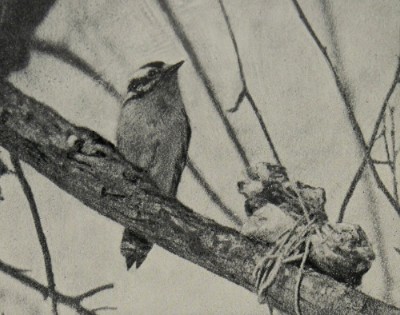 A DOWNY WOODPECKER 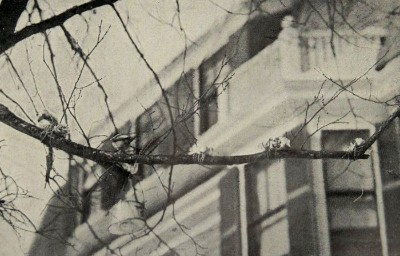 A BRANCH ESTABLISHMENT The crumbs
prove to
be appetizing, and by the time he has swallowed a few of them he seems
to
forget how he came in, and instead of backing out, as a reasonable
being like a
chickadee might be expected to do, he flies to another light of the bay
window.
Then, lest he should injure himself, I must get up and catch him and
show him
to the door. By the time I have done this two or three times within
half an
hour, I begin to find it an interruption to other work, and put down
the
window. White-breasted nut hatches and downies come often to the outer
sill,
but only the chickadees ever venture inside. These
three are our
daily pensioners. If they are all in the tree together, as they very
often are,
they take precedence at the larder according to their size. No nuthatch
presumes to hurry a woodpecker, and no chickadee ever thinks of
disturbing a
nuthatch. He may fret audibly, calling the other fellow greedy, for
aught I know,
and asking him if he wants the earth; but he maintains a respectful
distance.
Birds, like wild things in general, have a natural reverence for size
and
weight. The
chickadees are
much the most numerous with us, but taking the year together, the wood
peckers
are the most constant. My notes record them as present in the middle of
October, 1899, and now, in the middle of October, 1900, they are still
in daily
attendance. Perhaps there were a few weeks of midsummer when they
stayed away,
but I think not. One pair built a nest somewhere in the neighborhood
and
depended on us largely for supplies, much to their convenience and our
pleasure. As soon as the red-capped young ones were able to fly, the
parents
brought them to the tree and fed them with the suet (it was a wonder
how much
of it they could eat), till they were old enough to help them selves.
And they
act, old and young alike, as if they owned the place. If a grocer’s
wagon hap
pens to stop under the tree they wax indignant, and remain so till it
drives
away. Even the black cat, Satan, has come to acknowledge their rights
in the
case, and no longer so much as thinks of them as possible game. I have
spoken, I
see, as if these three species were all; but, not to mention the blue
jays,
whose continual visits are rather ineffectively frowned upon (they
carry off
too much at once), we had last winter, for all the latter half of it, a
pair of
red-bellied nuthatches. They dined with us daily (pretty creatures they
are),
and stayed so late in the spring that I began to hope the handy
food-supply
would induce them to tarry for the summer. They were mates, I think. At
any
rate, they preferred to eat from the same bit of fat, one on each side,
in
great contrast with all the rest of our company. Frequently, too, a
brown
creeper would be seen hitching up the trunk or over the larger limbs.
He likes
pleasant society, though he has little to say, and perhaps found scraps
of suet
in the crevices of the bark, where the chickadees, who are given to
this kind
of providence, may have packed it in store. Somewhat less frequently a
goldcrest would come with the others, fluttering amid the branches like
a
sprite. One bird draws another, especially in hard times. And so it
happened
that our tree, or rather trees, — an elm and a maple, — were something
like an
aviary the whole winter through. It was worth more than all the trouble
which
the experiment cost us to lie in bed before sunrise, with the mercury
below
zero, and hear a chickadee just outside singing as sweetly as any
thrush could
sing in June. If he had been trying to thank us, he could not have done
it more
gracefully. The worse
the
weather, the better we enjoyed the birds’ society; and the better, in
general,
they seemed to appreciate our efforts on their behalf. It was
noticeable,
however, that chickadees were with us comparatively little during high,
cold
winds. On the 18th of February, for example, we had a blizzard, with
driving
snow, the most inclement day of the winter. At seven o’clock, when I
looked
out, four downy wood peckers were in the elm, all trying their best to
eat,
though the branches shook till it was hard work to hold on. They stayed
much of
the forenoon. At ten o’clock, when the storm showed signs of abating,
though it
was still wild enough, a chickadee made his appearance and whistled Phoebe
again and again — “a long time,” my note says — in his cheeriest
manner. Who
can help loving a bird so courageous, “so frolic, stout, and
self-possest”?
Emerson did well to call him a “scrap of valor.” Yet I find from a
later note
that “there were nothing like the usual number of chickadees so long as
the
fury lasted.” Doubtless most of them stayed among the evergreens. It is
an old
saying of the chickadee’s, frequently quoted, “Be bold, be bold, but
not too
bold.” On the same day I saw a member of the household snowballing an
English
sparrow away from one branch, while a downy woodpecker continued to
feed upon
the next one. The woodpecker had got the right idea of things. Honest
folk need
not fear the constable. |
 Click the book image to turn
to the next Chapter.
Click the book image to turn
to the next Chapter.