
|
Click
Here to return to Everyday Birds Content Page Return to the Previous Chapter |
 (HOME) |
|
XV
NIGHTHAWK AND WHIP-POOR-WILL 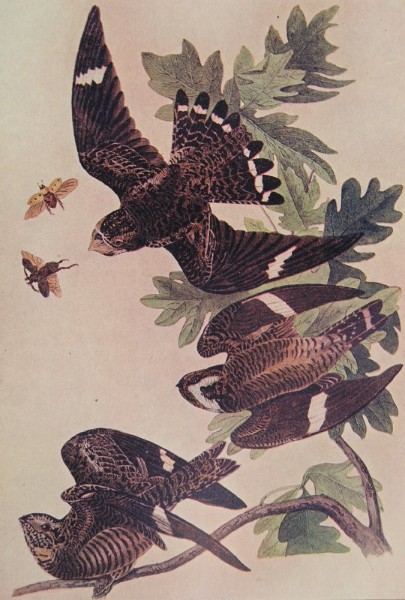 NIGHTHAWK RUSTIC
people are a
little shy of theories and “book-learning.” Not long ago — it was early
in
March — I met an old man who lives by him self in a kind of hermitage
in the
woods, and who knows me in a general way as a bird student. We greeted
each
other, and I inquired whether he had seen any bluebirds yet. No, he
said, it
wasn’t time. “Oh, but
they are
here,” I answered. “I saw a flock of ten on the 26th of February.”
Good-natured
incredulity came out all over his face. “Did you
hear them
sing?” he asked. “Yes,”
said I;
“and, furthermore, I saw some this forenoon very near your house.” “Well,” he
remarked, “according to my experience, it is too early for bluebirds.
Besides,
they never go in flocks; and when anybody tells me at this time of the
year
that he has seen a flock of bluebirds, I always know that he has seen
some blue
snowbirds.” He spoke
with an
air of finality which left me nothing to do but to smile and pass on. This
little
incident called to mind another, and that put it into my head to write
this
article. A farmer,
who had
seen me passing his house and loitering about his lanes and fields for
several
years, often with an opera-glass in my hand, one day hailed me to ask
whether
the nighthawk and the whip-poor-will were the same bird, as he had
heard people
say. I assured him (or rather I told him — it turned out that I had not
made
him sure) that they were quite distinct, and proceeded to remark upon
some of
the more obvious points of difference between the two, especially as to
their
habits and manner of life. He listened with all deference to what I had
to
offer, but as I concluded and turned to leave him, he said: “Well, some
folks
say they’re the same. They say one’s the he one and t’ other’s the she
one; but
I guess they ain’t.” Verily,
thought I,
popular science lectures are sometimes a failure. Not long afterward I
was
telling the story to a Massachusetts man, a man who had made a
collection of
birds’ eggs in his time. “Why,”
said he,
“aren’t they the same? I always understood that they were the male and
female
of the same species. That was the common belief where I was brought
up.” The confusion of the two birds is widespread, in spite of Audubon’s testimony that he had seldom seen a farmer or even a boy in the United States who did not know the difference between them. But, while they resemble each other closely, they are sufficiently unlike to be classified not only as separate species, but as species of different genera. As for the difference in their habits, it is such as any one may see and appreciate. The nighthawk, for all its name, is not a night bird. It is most active at twilight, — in other words, it is crepuscular instead of nocturnal, — but is often to be seen flying abroad at midday. The whip-poor-will, on the contrary, is quiet till after dark. Then it starts into full ness of life, singing with the utmost enthusiasm, till the listener wonders where it can find breath for such rapid and long-continued efforts. The nighthawk is not a musician. While flying it frequently utters a single note, of a guttural-nasal quality, almost indistinguishable from the so-called bleat of the woodcock; but, in place of singing, it indulges in a fine aerial tumbling performance, much in the manner of the snipe. This performance I have many times observed in early summer from the Public Garden in Boston. I have seen it also in September, though it is doubtless much less common at that season. 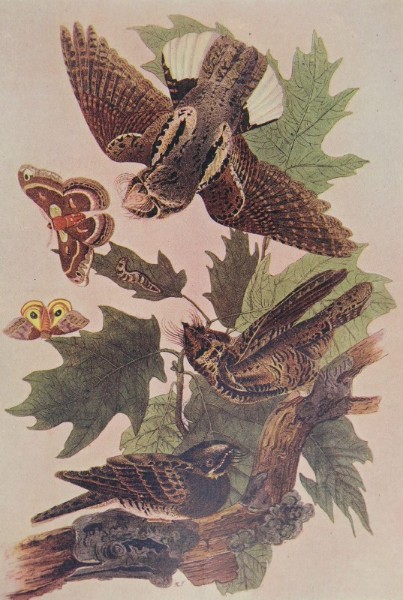 WHIP-POOR-WILL The bird
rises
gradually to a considerable height, and presently drops like a stone
almost to
the ground. At the last moment it arrests itself suddenly, and then is
heard a
very peculiar “booming” noise, whether produced by the wings or by the
voice, I
will not presume to say. The most
attractive
feature of the nighthawk, to my eye, is its beautiful and peculiar
flight — a
marvel of ease and grace, and sufficient to distinguish it at a glance
from
every other New England bird. It is a creature of the upper air, never
skimming
the ground, so far as I know, and as it passes overhead you may easily
see the
large white patch in the middle of each long wing — a beauty spot, by
the way,
which is common to both sexes, and is wanting in the whip-poor-will. The
whip-poor-will’s chief distinction is its song — a song by itself, and
familiar
to every one. Some people call it mournful, and I fear there are still
a few
superstitious souls who listen to it with a kind of trembling. I have
heard of
the bird’s being shot because the inhabitants of a house could not bear
its
doleful and boding cry, as they were pleased to consider it. To my ears
it is
sweet music. I take many an evening stroll on purpose to enjoy it, and
am
perennially thankful to Audubon for saying that he found the
whip-poor-will’s “cheering
voice” more interest ing than the song of the nightingale. It will
surprise
unscientific readers to be told that the nearest relatives of
whip-poor-wills
and nighthawks are the swifts and the humming birds. As if a chimney
swift were
more like a whip-poor-will than like a swallow! and, still more absurd,
as if
there were any -close relation ship between whip-poor-wills and
hummingbirds!
Put a whip-poor-will and a ruby-throated hum mer side by side and they
certainly do look very little alike — the big whip-poor-will, with its
mottled
plumage and its short, gaping beak, and the tiny hummingbird with its
burnished
feathers and its long needle of a bill. Evidently there is no great
reliance to
be placed upon outside show, or what scientific men call “external
characters.”
We might as well say that the strawberry vine and the apple-tree were
own
cousins. Yes, so we might, for the apple-tree and the strawberry vine are
cousins — at least they are members of the same great and noble family,
the
family of the roses! We shall never get far, in science or in anything
else,
until we learn to look below the surface. |
 Click the book image to turn
to the next Chapter.
Click the book image to turn
to the next Chapter.