
|
Click
Here to return to Everyday Birds Content Page Return to the Previous Chapter |
 (HOME) |
|
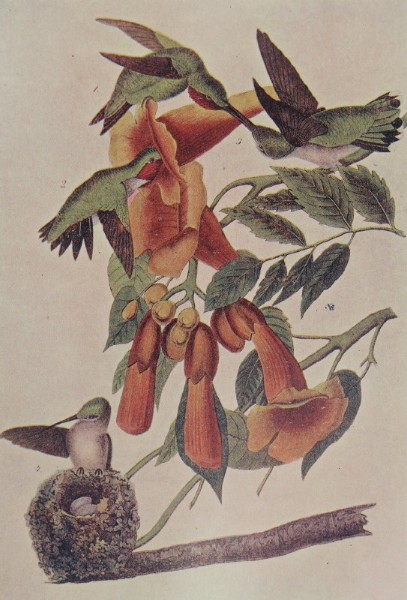
XIII THE HUMMINGBIRD
HUMMINGBIRDS
are
found only in America and on the islands near it. They are of many
kinds, but
only one kind is ever seen in the eastern United States. This is known
as the
ruby-throated hummingbird, because of a splendid red throat-patch worn
by the
male. To speak more exactly, the patch is red only in some lights. You
see it
one instant as black as a coal, and the next instant it flashes like a
coal on
fire. This ornament, — a real jewel, — with the lovely shining green of
the
bird’s back, makes him an object of great beauty. Every one
knows
him, or would do so only that some people confuse him with
bright-colored,
long-tongued hummingbird moths that are seen hovering, mostly in the
early
evening, over the flowers of the garden. The
ruby-throat spends
the winter south of the United States. He arrives in Florida in March,
but does
not reach New England till near the middle of May. Many
persons seem
to imagine that the hummer lives on the wing. They have never seen one
sitting
still, they say. But the truth is that hummingbirds pass but a small
part of
the time in the air. They are so very small, however, that they are
easily
overlooked on a branch of a tree, and the average person never notices
them
except when the hum of their wings attracts his attention. One of the
prettiest sights in the world is a hummingbird hovering before a
blossom, his
wings vibrating so fast as to make a mist about him, and his long
needle of a
bill probing the flower with quick, eager thrusts. All his move ments
are of lightning-like
rapidity, and even while your eyes are on him he is gone like a flash,
you
cannot say whither. The
hummingbird’s
nest is built on a branch of a tree, — saddled on it, — and is not very
hard to
find after you have once seen one, and so have learned precisely what
to look
for. Generally it is placed well out toward the end of the limb. I have
found
it on pitch-pines in the woods, on roadside maples, — shade trees, —
and
especially in apple and pear orchards. The mother bird is very apt to
betray
its whereabouts by buzzing about the head of any one who comes near it.
Last May,
for
example, I stopped in the middle of the road to listen for the voice of
a house
wren, when I caught instead the buzz and squeak of a hummer. Turning my
gaze
upward, I saw her fly to a half-built nest on a maple branch directly
over my
head. The nest
is a tiny
thing, looking for size and shape like a cup out of a child’s toy
tea-set. Its
walls are thick, and on the outside are covered — shingled, we may say
— with
bits of gray lichen, which help to make the nest look like nothing more
than a
knot. Whether they are put on for that purpose, or by way of ornament,
is more
than I can tell. The bird
always
lays two white eggs, about as large as peas. The young ones stay in the
nest
for three weeks, more or less, till they are fully grown and fledged,
and
perfectly well able to fly. I once saw one take his first flight, and a
great
venture it seemed. All these three weeks, and for another week
afterward, the
mother — no father is present — has her hands full to supply the little
things
with food, which she gives them from her crop, thrusting her long,
sharp bill
clean down their throats in the process, in a way to make a looker-on
shiver.
The only note I have ever heard from the ruby throat is a squeak, which
seems
to be an expression of nervousness or annoyance, and is uttered
whenever an
intruder — a man, a cat, or a strange bird — comes near the tree in
which her
treasures are hidden. Hummingbirds
sometimes fly into open windows and are caught. At such times they be
come tame
almost at once, but it is difficult, if not impossible, to keep them
alive in
captivity, and it is cruel to attempt it, except when the little
creature is
injured and plainly unable to look out for itself. A lady of
my
acquaintance discovered a hummingbird under her piazza. It had flown in
by
accident, probably, and now was darting to and fro in a frantic attempt
to get
out. The piazza was open on three sides, to be sure, but the frightened
bird
kept up against the ceiling, and of course found itself walled in. Fearful
that it
would injure itself, the lady brought a broom and tried to force it to
come
down and so discover its way out; but it was only the more scared. Then
a happy
thought came to her. She went to the garden, plucked a few flowers, and
going
back to the piazza, set them down for the bird to see. Instantly it
flew toward
them, and as it did so it saw the open world without, and away it went.
Another
lady wrote
me once a very pretty story of a hummer that came and probed a
nasturtium which
she held in her hand. It is
wonderful to
think that so tiny a bird, born in New England or in Canada in June,
should
travel to Cuba or Central America in the autumn, and the next spring
find its
way back again to its birthplace. |
 Click the book image to turn
to the next Chapter.
Click the book image to turn
to the next Chapter.