 Web
and Book design,
Web
and Book design, Copyright, Kellscraft Studio 1999-2007 (Return to Web Text-ures) |
Click
Here to return to Everyday Birds Content Page Return to the Previous Chapter |
 (HOME) |
|
VII THE SONG SPARROW
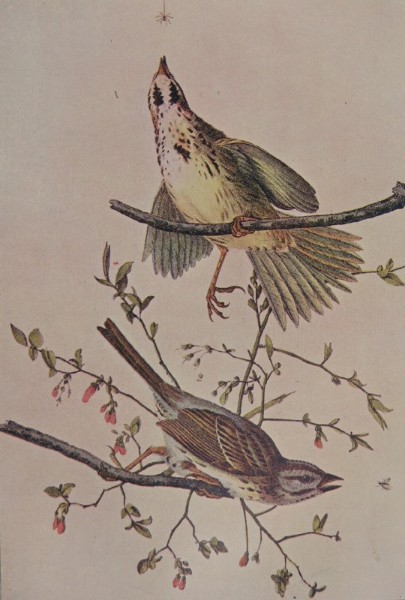
SPARROWS are of many kinds, and in a general way the different kinds look so much alike that the beginner in bird study is apt to find them confusing, if not discouraging. They will try his patience, no matter how sharp and clever he may think himself, and unless he is much cleverer than the common run of humanity, he will make a good many mistakes before he gets to the end of them. One of the
best and
commonest of them all is the song sparrow. His upper parts are mottled,
of course,
since he is a sparrow. His light-colored breast is sharply streaked,
and in the
middle of it the streaks usually run together and form a blotch. His
outer
tail-feathers are not white, and there is no yellow on the wings or
about the
head. These last points are mentioned in order to distinguish him from
two
other spar rows with streaked breasts — the vesper sparrow and the
savanna. By the
middle of
March song sparrows reach New England in crowds, — along with robins
and
red-winged blackbirds, — and are to be heard singing on all hands,
especially
in the neighborhood of water. They remain until late autumn, and here
and there
one will be found even in midwinter. The song,
for which
this sparrow is particularly distinguished, is a bright and lively
strain,
nothing very great in itself, perhaps, but thrice welcome for being
heard so
early in the season, when the ear is hungry after the long winter
silence. Its
chief distinction, however, is its amazing variety. Not only do no two
birds
sing precisely alike, but the same bird sings many tunes. Of this
latter
fact, which I have known some excellent people to be skeptical about,
you can
readily satisfy yourself, — and there is nothing like knowing a thing
at first
hand, — if you will take the pains to keep a singer under your eye at
the
height of the musical season. You will find that he repeats one strain
for
perhaps a dozen times, without the change of a note; then suddenly he
comes out
with a song entirely different. This second song he will in turn drop
for a
third, and so on. The bird acts, for all the world, as if he were
singing
hymns, of so many verses each, one after another. It is
really a
wonderful performance. There are very few kinds of birds that do
anything like
it. Of itself it is enough to make the song spar row famous, and it is
well
worth any one’s while to hear it and see it done. Nobody can see it
without
believing that birds have a true appreciation of music. They are better
off
than some human beings, at all events. They know one tune from another.
A lady
correspondent was good enough to send me, not long ago, a pleasing
account of
the doings of a pair of song sparrows, which, as she says, came to her
for six
seasons. “One
year,” she
writes, “they happened to build where I could watch them from the
window, and
they did a very curious thing. They fed the little birds with all sorts
of
worms of different colors until they were ready to leave the nest; then
the
male brought a pure white moth and held it near the nest, which was in
some stems
of a rosebush a few inches from the ground, on a level with the lower
rail of a
picket fence. “One of
the little
birds came out of the nest at once and followed its parent, who went
side wise,
always holding the dazzling white morsel just out of the youngster’s
reach. In
this manner they crossed the lane, climbed the inclined plane of a
woodpile,
and passed through a fence and across a vegetable garden into an
asparagus bed,
in which miniature forest the little traveler received and ate the
moth. “Another
nest was
built on the bank of a brook on the farther side of a road. Out of this
nest I
saw two little fellows coaxed with these snow-white moths, and led
across the
dusty road into a hedge.” One or two
experiences of this kind are sufficient reward for a good deal of
patient
observation. The singer of this pair of birds, my correspondent says,
had ten
distinct songs, one of them exceedingly beautiful and peculiar. The song
sparrow’s
nest is usually built on the ground, and the bird is one of several
kinds that
are known indiscriminately by country people as ground sparrows. Song
sparrows seem
to be of a pretty nervous disposition, to judge from their behavior.
One of
their noticeable characteristics is a twitching, up-and-down, “pumping”
motion
of the tail, as they dash into cover on being disturbed. People who
live in
the Southern States see these birds only in the cooler part of the
year, but
must have abundant opportunity to hear them sing as spring approaches. |
 Click the book image to turn
to the next Chapter.
Click the book image to turn
to the next Chapter.