 Web
and Book design image, Web
and Book design image,Copyright, Kellscraft Studio 1999-2007 (Return to Web Text-ures) |
Click
here to return to
The Country School Content Page |
 (HOME) |
|
VI SCHOOLHOUSE
ENTERTAINMENTS IN
the central villages of the country towns it is possible during the
leisure of
the winter months to
get up social diversions that are quite
grand. But to whatever dazzling height of attraction these may attain,
I doubt
if they ever have the charm and naturalness to be found in the
schoolhouses of
the outlying hamlets.
The characteristic gathering is one where, aside from the enjoyment
afforded by
the meeting of neighbors in friendly converse, there is a programme
including
recitations, music, and possibly a dialogue. The items of such a
programme are
handled with more style in the larger places, but in the ornate town
celebrations the individuality that glows from each participant in the
schoolhouse merry-makings is apt to get smoothed out into mannerism. Of
course, in certain ways the isolation of an outlying hamlet is a
handicap, and
it is apt to be a source of regret to the inhabitants. They are largely
dependent on themselves for diversion; and yet if this results in their
putting
forth extra efforts to make the local life pleasant and interesting,
the
isolation may be a blessing in disguise. In the attempt to brighten the long winter evenings, there are various social gatherings at the homes; but the schoolhouse is the place of meeting on the more important occasions, and the children of the school furnish the backbone of these rustic festivities. The literary material on which the children draw for subjects is often artificial or commonplace; yet they themselves are so sure to be entertaining and original that you readily forget the respects in which their performance falls short of a technical ideal. They each have a piece to speak; and in addition to that all of them together come out on the floor several times and form in rows with the teacher beside them, and sing such songs as they have learned. They depend a great deal on their their teacher; for she picks out the verses for them to memorize, drills them, and when they stand before the audience, she is near at hand ready to prompt when they forget the words. 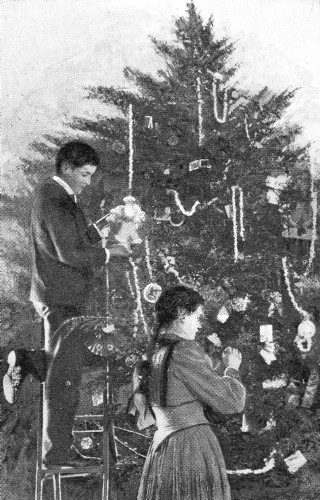 Trimming the Christmas tree. 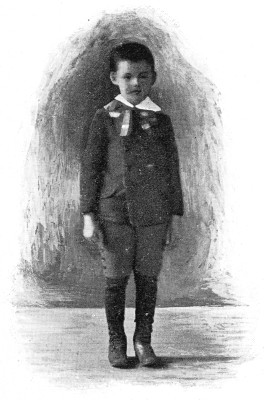 Speaking his piece. 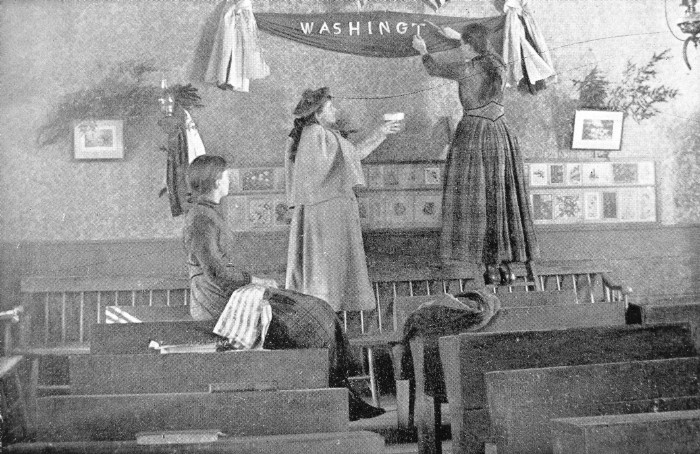 Schoolroom decoration. The
audience always takes special pleasure in listening to a spicy and
picturesque
dialogue; but space limitations and the difficulty of managing a lot of
children, full of excitement over the glory of the occasion, make it
unwise to
attempt anything very elaborate. It is not, however, easy to find
dialogues
that will fit the need of the schoolhouse either in matter or manner.
What is
wanted is something short, requiring few actors, and having a homely
quaintness
of expression and of situations that shall be pleasant and natural from
the
child’s point of view. Sometimes a dialogue from a book or magazine can
be cut
down and adapted; but the two little plays which follow were written
for the
occasions when they were acted, and they were produced with entire
success. By
that I do not mean there was no blundering. The mistakes and accidents
were
half the fun, and were applauded as heartily as that which was done
most
cleverly. Whatever the lacks of the performers, the dialogues
themselves are of
a sort that seemed excellently suited to the place. A corner of the
schoolroom
was curtained off and fitted up in the rude likeness of a room in an
old-fashioned
farmhouse. At the back of the apartment was an open fireplace made of a
dry-goods box, with the inside roughly painted to imitate
smoke-blackened
bricks. Several ancient chairs were scattered about, and there was a
cot-bed, a
bureau, lamp, and clock. The first of the dialogues was acted at a
Christmas
celebration, the other on the evening of Washington’s Birthday. The
former was
entitled CHRISTMAS
NIGHT CHARACTERS
Tommy
(pawing out the contents of a bureau drawer). Well, I don’t see where
ma put those
stockings. No, they ain’t here. Freddy. We’ll have to make the old ones do, then. I don’t know what Santa Claus’ll think of us for hanging up such things. See there, now! (Runs his arm into the long stocking, and his fingers come out sprawling through a hole at the other end.) 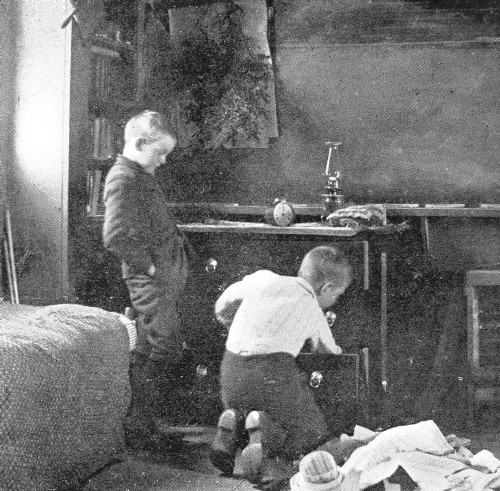 A hunt for stockings. Tommy. The presents that
Santa Claus puts in’ll all tumble
out at the bottom. Here, you stop that, Freddy! You’re tearing the hole
bigger.
Freddy. We’ll have to tie up
that hole to make the stocking
any good. Got any string, Tommy? Tommy. I guess so. (Pulls
a lot of things out of his pockets and puts them on the bureau.)
Yes, there’s some. Now you hold the stocking, and I’ll tie it up. Freddy
(as they do the tying). Tommy, what do you say to stayin’
up and ketchin’ old Santa Claus just after he has come down the chimney
and is
filling our stockings? Tommy. I don’t believe we
could do it. He doesn’t come
till twelve o’clock, and we’d get to sleep before then, even if we was
to try
our hardest to keep awake. Freddy. I’ll tell you how we can fix the business. There’s the alarm-clock. Set it to go off at twelve, and that’ll bring our eyes open in no time. We’ll turn the light down and go to bed with our clothes on, and so be all ready to pop out on the old fellow. 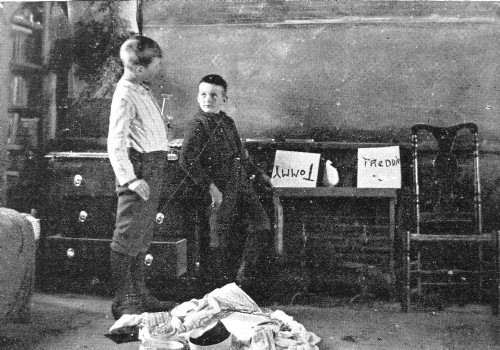 Making ready for Santa Claus. Tommy. Good for you, Freddy!
That’s just the thing. You
hang up the stockings and put up the signs we made, and I’ll wind the
alarm. (Freddy hangs the
stockings on some nails at either
side of the fireplace, and next to one pair of stockings adjusts a
placard on
which he has lettered his name, and next to the other pair a similar
placard
which bears Tommy’s name. Meanwhile, Tommy winds the alarm.) Freddy. But what are we going
to do with Santa Claus when
we ketch him? Tommy. I hadn’t thought of
that. We’ll have to make some
kind of an excuse, ‘cause he might get mad. Freddy. I know! We just want
to find out if there really is
a Santa Claus. We’ll tell him what Sammy Tompkins said about there not
being
any Santa, and he’ll say we did exactly right. Tommy. That’s so, I guess he
will. Well, turn down the
lamp and we’ll go to bed. There, crawl in. Now, let’s see who’ll snore
first. (Both fall to imitating
snoring and they laugh a
little and kick about, but soon quiet into sleep.) Santa Claus. (Comes in softly.) All right. Everybody sleeping. Well, well, stockings all labelled. That’s lettering! (Puts down his sack and from it fills the stockings. Just as he finishes doing this, the alarm goes on; that is, some one behind the curtain sets off a clock at the proper moment. Santa tumbles in great terror to the floor.) Great Cæsar’s cats! what was that? In all the ten thousand years, more or less, that I’ve travelled up and down this old world, I’ve never heard anything like that. Must have been a new invention or an earthquake. (Looks about fearfully.) 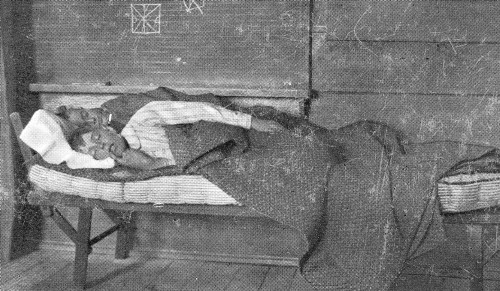 The boys go to bed. Tommy.
(He has risen on his elbow and speaks in a
whisper.) There’s
Santa. He acts kind o’ scared. Freddy
(also in a whisper). Now’s our time, then! Both
Boys. (They jump from the bed, dash across the
floor, and grab Santa Claus by the shoulders.) There, we’ve got you! Santa Claus. Why, what’s the matter? Hold on, hold on! 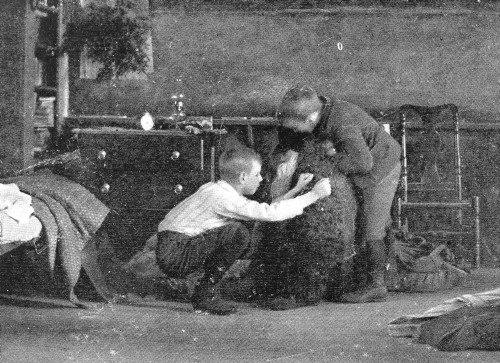 Caught. Tommy. Yes, we’ll hold on.
We’ve got you! Santa
Claus (getting up). Well, now, what are you boys
after, anyway? What was that noise I heard? Freddy.
(He hangs on to one of Santa’s hands, while
Tommy clings to the other.) Oh, that was nothin’. It was just one of
these little
alarm-clocks to wake up by. Santa
Claus. Was that all? I thought the earth had
cracked and
was going to pieces. But what has got into you boys to come pitching on
to me
the way you did? Tommy. Why, we just wanted to know if there was a Santa Claus or not. That’s all. Sammy Tompkins said there wa’n’t. But we knew there was. 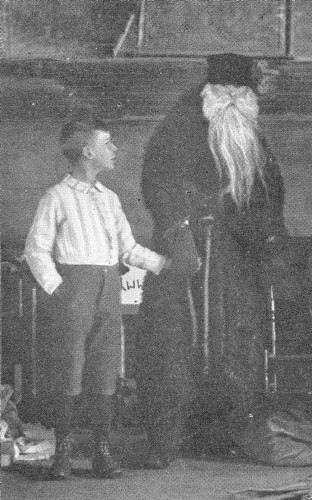 Santa faces the audience. Santa
Claus. Of course there is. Don’t you see all
those things
I’ve put in your stockings, and don’t you see that tree all loaded?
Well, boys,
I can’t stop any longer. (Shakes
hands.)
I wish you a Merry Christmas (turns
toward
the audience), and I wish you all a Merry Christmas. (Curtain)
The only things bought for the occasion were the beards of the two old men. The rest of the material for costumes was hunted up in home closets and garrets. Often there was no very close resemblance attained to the characters represented, but there was always a sincere attempt to get a distinct individuality, and the result was in every instance satisfactorily entertaining. The scene was made to bear some resemblance to an old-time farmhouse kitchen, with an open fireplace and straight-backed chairs. This setting, even in its crudities, was much to the liking of the children who were the actors, and they went through the play effectively, where they would have failed, had it been something finer that was outside the range of their experience. The touch of the grotesque in the names and conversation and general get-up of the old men appealed strongly to the children’s imaginations, as did also the masquerade costuming of the other characters. 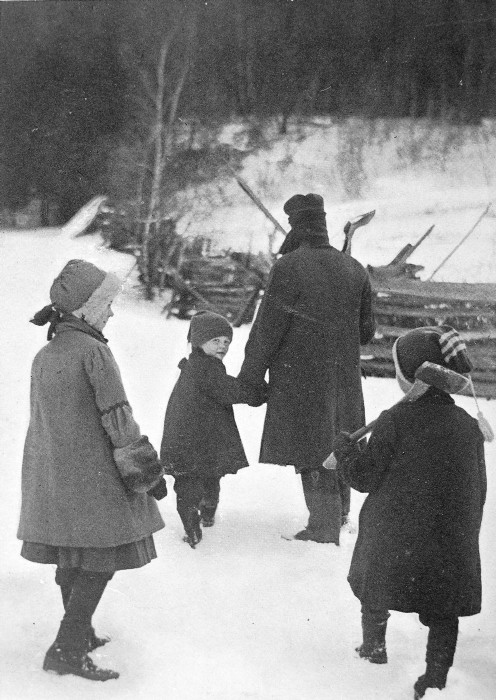 Going in the woods for the Christmas tree. Ephraim.
(Seated by his fireside reading a paper.
Yawns.) Oh
hum! I’m gettin’ sleepy so early. If the children wa’n’t away, I’d wind
the
clock and go to bed. (Slow, heavy
footsteps
are heard outside. Ephraim rises stiffly and stands expectant, while
Jabez
enters.) What! that you, Jabez? Glad to see you. (They shake hands, and Ephraim resumes his
chair.) Have
a seat, Jabez, have a seat. Jabez. Well, I will in a
minute, when I get warmed up.
Kind o’ shivery out to-night. (Takes
off his
hat and stands with his back to the fire.) Where’s Israel
and Maria?
Ephraim. Oh, they packed up
yesterday and went down to
Boston to spend a week visitin’ some of Maria’s relatives that live
there. Jabez. Sho! they did, did
they? Hadn’t heard of it!
Ephraim. Yes, and they perposed that the children should go over to
stay with
their uncles and aunts at the Corners so I could go to Boston, too. But
I told
‘em they wouldn’t ketch me kitin’ off so far at my age. Might get
killed or
something, you know. Jabez. That’s so! Don’t take
much to get killed nowadays.
Keeps you pretty busy, I s’pose, lookin’ after the children and all the
housework and barnwork besides? Ephraim. Well, the children
are gettin’ old enough to help
more’n you’d think — John, especially. He’s most as good as a man about
the
work outdoors. To-night they’ve all gone off somewhere. Jabez. Didn’t they tell you
where they was goin’? Ephraim. No. Said ‘twas a
secret. It’s some school party,
like enough. They hitched into the pung right after supper and off they
went,
the whole bilin’ of ‘em. I don’t know as I ought to ‘a’ let little Jim
and
Polly go; but John promised faithful to see to ‘em and get ‘em home
airly. Jabez. Well, they all
stopped over to our house. That’s
the way I happened to drop in. They kep’ at me to step over here an’
see you,
sayin’ you’d be lonesome and one thing and another, until I come. Ephraim. Ha, ha! they’re up to
some rinktum or other, I’ll
be bound. But set down, Jabez. Jabez. (Seating himself and holding out his hands toward the blaze.) Fire feels good a cold night like this. Ephraim. So’t does, and I guess I’d better be puttin’ on another stick. There ain’t many has these roarin’ open fires in these times. You ain’t had nothin’ over to your place but stoves these twenty years, have you? 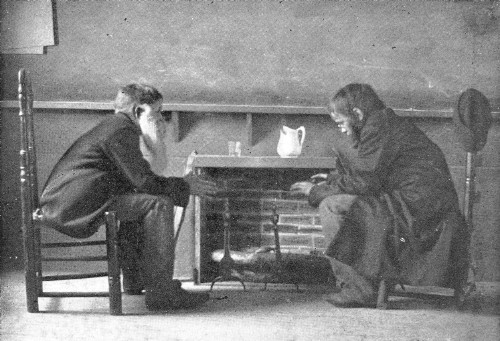 Comfort by the open fire. Jabez. No, all our
fireplaces was bricked up long ago.
What’s that? (Straightens up, and
looks
toward the window.) I thought I heard sleigh bells turnin’
into the
yard. Ephraim. Sounds like the pung,
but the children wouldn’t be
comin’ back yet-awhile. Jabez. I ain’t dressed up
for company! Ephraim. I ain’t neither, nor
the house ain’t! (Both get up
nervously. Outside there are cries of
“Whoa, whoa!” followed by a stamping of feet and then a rap at the
door.)
Well, there they be, whoever ‘tis! (Steps
toward the door, when a crowd of children in costume burst in.) John.
(Dressed as Washington.) Wish you both a Merry Christmas! Ephraim. Is that you, John?
What you up to anyway? ‘Tain’t
Christmas! Children. Well, it’s
Washington’s Birthday! Ephraim. Is it? I declare, I believe it is. I’d forgot. 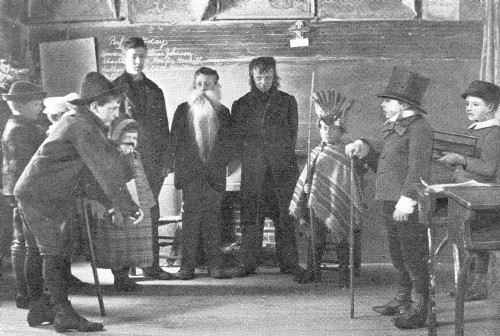 The children surprise their grandpas. Polly.
(Dressed as a little Eskimo.) This is a s’prise party, Grandpa! Jabez.
(Nudges Ephraim.) She’s a cute one. John. Yes, that’s what it
is, and we dressed up to
represent a few characters for you. We tried to make some poetry to
speak; but
when it rhymed it wa’n’t sense, and when it was sense it wa’n’t poetry.
So we
give that up mostly, and we’ll have to tell you straight out what we
are. Now,
I’m General Washington, the father of his country, first in peace,
first in
war, and first in the hearts of his countrymen. Susy. And I’m Martha, his
wife, mother of her country,
second in peace, second in war, and second in the hearts of her
countrymen.
That’s what John said. Jabez. Well, I don’t know
but you be! I hadn’t thought of
that. The
German. I came from Germany to help make this
great country.
The
Irishman. I came from Ireland to help make this
great country.
The
Italian. And I came from Italy to help make this
great
country. (Suspended from his
shoulders he
carries a box with a leg underneath, a cloth over the top, and a crank
attached
to make it look like a hand-organ. Turns the crank while some one
behind the
curtain plays “Yankee Doodle” on a comb or harmonica.) The
Dude. Where I came from there’s no one
knows, (After
he speaks he marches across the stage and
back, takes off his stovepipe hat and makes a low bow to the audience.)
Polly. I’m a little Eskimo From the land of cold and snow. All the children. We
all help make
the nation, Jabez. You done well,
children, and your grandfathers are
both proud of you, ain’t we, Ephraim? Ephraim. Sartain, sartain, we
are that, and I’m goin’ to
skirmish around in the buttery and see if I can’t find some
refreshments. But
first let’s join in a hearty cheer for Washington and Liberty! All.
Hurrah! Hurrah! Hurrah! (Curtain)
|
Web and Book design,
Copyright, Kellscraft Studio
1999-2007
(Return to Web Text-ures)