 Web
and Book design,
Web
and Book design, Copyright, Kellscraft Studio 1999-2007 (Return to Web Text-ures) |
Click
Here to return to The Country School Content Page Return to the Previous Chapter |
 (HOME) |
|
II OLD-FASHIONED
SCHOOL DAYS SUMMER THE summer term began the first Monday in May. In various ways it was different from the winter term. The teacher was not a man this time, but a young woman. There were fewer scholars, as the big boys were kept out to work on the farm; but Betsey Hale came trudging over from the farm each day with her dinner basket on her arm. Something besides food was in the basket now — that is, sewing; for this was one thing taught in summer. Instead
of the little white blanket which Betsey had worn in winter for a head
covering, she now had a sunbonnet made of copperas-colored cotton cloth
over
pasteboard. This pasteboard had been made at home by pasting a lot of
old
newspapers together, and it was apt to be rather limpsey. Her dress was
of
cotton, woven by her mother, in blue and white stripes, and very simple
in its
make-up. There were no buttons on it, and its only fastening was a cord
at the
neck. She wore shoes and stockings to-day, but later in the season,
when the
weather was a little warmer, she would go barefoot. The schoolroom had been trimmed with evergreens, and the wide mouth of the fireplace had been filled with boughs of pine and laurel. 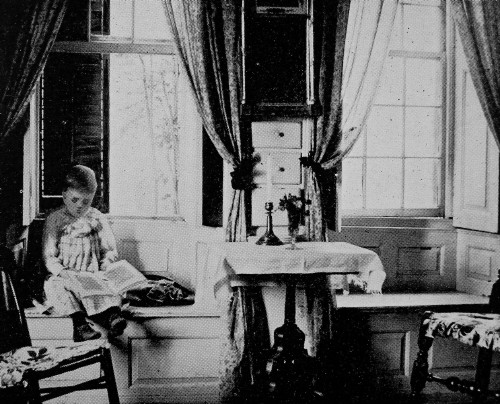 Learning her lesson at home. The
teacher had a pair of scissors dangling from her belt and used them to
point
out the letters in the Speller when the A-B-C class gathered about her.
A good
many small children came in summer who could not get to school during
the cold
weather — occasionally one not over three years old. Such a little
fellow would
very likely get to nodding, and the teacher would pick him up and carry
him to
the closet, where, on the bench with the girls’ dinner baskets, he
would have
his nap out. By and by he would emerge and toddle to his place, quite
bright
after his sleep. Most
of the little ones were dismissed early, and those who could handle a
needle
brought patchwork, so that, by reason of this employment and the
shorter hours,
they had a much more comfortable time of it than in winter. Older
scholars, besides patchwork, brought towels and tablecloths to hem.
Some of
them worked samplers. Betsey made quite a large sampler this term —
fourteen by
twenty inches. It was on green canvas, and the stitches were taken with
yellow
and red silk. First a checked border was made, then the alphabet in
small
letters was worked in across the top, next the figures and capitals,
and under
those a Scripture verse, “Remember thy Creator in the days of thy
youth.” Below
that came her name and age, and, at the bottom, flowers in a
flower-pot, a
small tree, a lamb, a dog, and a lion. These samplers, when elaborate, were often framed, and that was what was done with Betsey’s, after the summer term came to an end. Then it was hung at home in the “best room” — that is, the parlor. As there was in those days no indelible ink, all the clothing had to be marked by stitching, and the sampler showed how to make the letters. 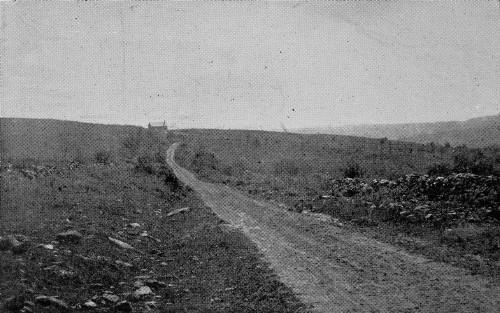 The road to learning. This
term school closed every other Saturday. In most towns, when they began
to
shorten the number of school days in a week, they first took off
Saturday
afternoon; but here the scholars had to come so far that it was thought
best to
give them a whole day every other week. On Friday or Saturday
afternoon, whichever
happened to be the last afternoon of the school week, the children
studied the
Catechism. It was a thin little book, divided into two parts. Part
First was
headed “Historical”; Part Second was the “Assembly Catechism.” The
historical
part had nearly two hundred questions and answers, and at the top of
each page
were two small square pictures portraying some Bible scene, and below
each was
a reference to the story it illustrated. Part
Second had in it one hundred and seven questions, largely doctrinal,
beginning
with “What is the chief end of man?” Once
a year, extending over three Sundays, the children said the Assembly
Catechism
in the meeting-house. Just after the sermon, the boys on one side, the
girls on
the other, they formed in long parallel lines in the middle aisle,
facing each
other, all very prim and solemn and scared. The minister came down from
the
pulpit overhung by the big sounding-board, and took his place in the
deacons’
seat, which ran along the front of the pulpit. The minister put the
questions
and the children answered in turn. First a boy, then a girl, would step
forth
from the lines, face the questioner, and give the answer, and this
solemn
routine continued till a response had been elicited from the last
little girl,
whose frightened murmur could scarce be heard a yard away. On the first Sunday the children answered as far as the commandments — forty-four questions; the second Sunday, they went on through the commandments to the eighty-first question; and the third time finished the book. Only those stood who could answer, and while the first day saw quite a crowd of children before the pulpit, on the final day the answers had become so difficult that only a few of the older boys and girls remained. 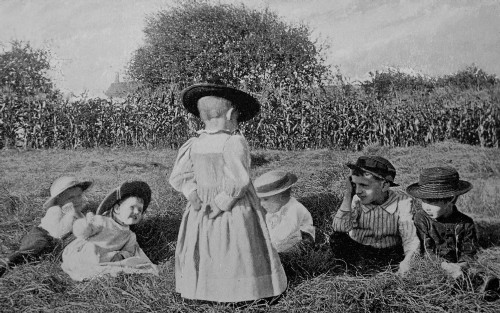 A play-school in the hayfield. There
were five days in the year which were recognized as holidays: Fast Day,
Independence Day, Training Day, Election Day, and Thanksgiving Day. The
second
was the only one which came within the bounds of either school term. It
was
celebrated rather quietly, and for the children was not especially
different
from any other week day when school did not keep, except that less work
was
given them to do. They had no torpedoes, firecrackers, or toy pistols,
and they
made little noise. Through all the hot weather, until the summer was nearly at an end, the school continued in session. On warm days the question, “Please, ma’am, may I go down and get a drink?” was a frequent one, and nearly all day one or another of the children could be seen on their way to and from the pasture hollow where the brook ran. They had no cup to drink from, unless they shaped a big leaf for the purpose. Usually they would kneel down on the stones and dip their lips into the stream, and with none of the fear, which might disturb the moderns, of swallowing water snakes, frogs, pollywogs, or like creatures that were possibly swimming there. 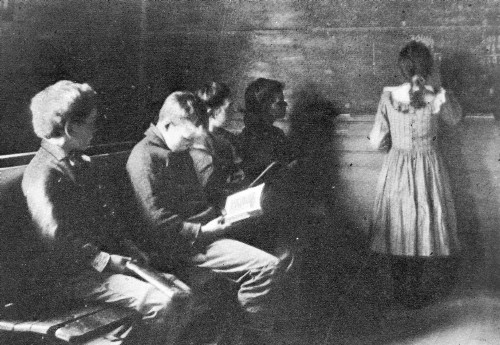 A recitation in arithmetic. The teacher often allowed some of the scholars to go out and study under the trees “when they were good.” Many a time did Betsey sit under the beeches in the grove behind the schoolhouse with book in hand; but the grove was not so good a study place as indoors, there were so many things about to see. The temptation was to fall to dreaming, to listen to the wind whispering through the boughs and to the faint murmur of the brook from the pasture hollow, to watch a wandering butterfly, the squirrels and the birds, or the leaves fluttering above her head, or to turn around to the gray tree trunk at her back and gaze in fascination at the ants journeying up and down the bark. Yet though these things interfered with her studying, the experience was so pleasant that she went out as often as the teacher would let her. The teachers were all quite strict and allowed small liberty, and their punishments for little misdemeanors were often severe. However, Betsey herself was naturally obedient and gentle, and she fared very well. Once, for making too much noise, she had to stand on the floor with her hands tied behind her; and again, for whispering, had to sit beside a great, coarse boy. These were the only serious punishments she ever received. 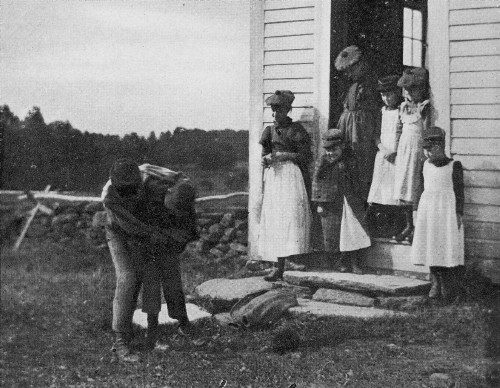 "Wrastling." One
winter term two of the big girls persisted in looking out of the
window, and
Betsey was quite frightened when the master shook a warning finger at
them and
said he would put them out through the window if they looked again.
This
teacher chewed tobacco, and had an odd way of holding his quid between
his
lower lip and teeth, making a queer lump on his chin. The two big girls
took
revenge on him by rolling up wads of paper and imitating the master
with his quid,
and he could not very well punish them without making himself
ridiculous. The
commonest form of punishment was feruling. The
woman teacher was addressed as “Ma’am.” When a scholar wished to speak
to her,
he would not raise his hand to attract her attention, but would either
go to
her, or speak right out. At close of school, as the children were
leaving the
room, the boys turned to the teacher, hats in hand, and bowed, and the
girls
courtesied, and each said “Good afternoon, ma’am.” The
children liked also to make their manners when they met some one on the
road.
Very likely several of the little girls would join hands and stand by
the
wayside and courtesy to a person passing, and then, if that person
smiled down
on them and said, “Nice children,” they were much pleased. In
summer, as in winter, the teacher boarded around. The summer teacher
was pretty
sure to be young, usually taught a few years, then married, and taught
no more.
Her pay was from a dollar to a dollar and seventy-five cents a week. As the term drew to a close the scholars began to learn “pieces” to speak on the last day. A good many learned hymns. Betsey studied this term a little poem of Mrs. Barbauld’s called “The Rose.” They did not write compositions. 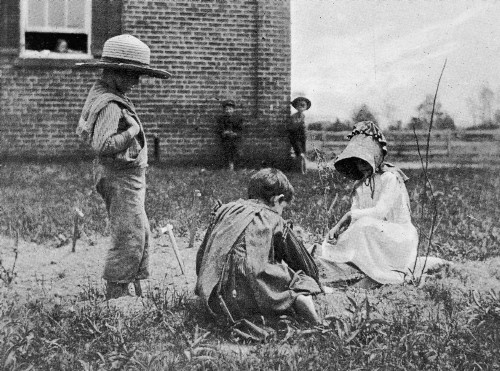 Planting flower-seeds. Last
day came this time on Thursday, in the middle of August. The sun rose
clear and
warm, the air was heavy and still, and the weather promised to be very
hot. All
the children came dressed in their best, which made the day seem like
Sunday,
and added to the feeling of strangeness and excitement which overhung
the great
occasion. Betsey
started at about the usual time. She was barefoot, but carried, besides
her
dinner basket, her best shoes and stockings in her hand, for she must
keep them
from the dew which dampened the grass and from the dust of the roadway.
As she
walked along she repeated over and over aloud the poem she was to
recite in the
afternoon. When she got to the schoolhouse, she wiped her feet on the
wet grass
and put on her shoes and stockings. The
morning session was short, and mostly occupied by reviewing for the
exercises
of the afternoon. Those children who lived close enough then ran home,
and the
rest went to the nearest neighbor’s and borrowed chairs, with which
they filled
the open space back of the teacher’s table. On the day previous they
had given
the room a great sweeping and scrubbing, and had torn down the dry
evergreens
from the fireplace and about the windows and replaced them with fresh.
Now they
put finishing touches to the trim, did various little things, and
finally were
ready to eat dinner. Meantime great clouds had gathered in the west and
had
rolled up across the sky, and presently the first big, threatening
drops of a
shower came pelting down. The children were obliged to eat their
dinners
indoors, and as the storm increased, it was a mournful little company
that
gathered at the windows, munching their bread and butter and watching
the
lightning flash and the sheets of rain drive past. But
just as they had concluded that “Last day” was spoiled, the storm
suddenly
ceased, and the water-drops clinging to the leaves and grasses danced
in the
breeze that blew, and sparkled in the sunlight, while the big
thunderheads sank
behind the eastern hilltops. Then the scholars thought nothing could
have
happened better. Those
that had gone home returned, and presently school commenced. The
visitors began
to arrive soon, and they kept coming till the room was pretty well
crowded. The
fathers and mothers were there, and some of the older brothers and
sisters; but
the two persons of most importance were the “school committeeman” and
the
minister. There was one school committee-man in each district, whose
duty it
was to hire the teacher, to see that the schoolhouse was kept in
repair, and
attend to like matters. The pupils were quite awestruck by the presence
of so
many of their elders, and felt that they must behave their best, and
their
hearts beat fast at the thought of saying their lessons before so many.
First,
the little ones were called out on the floor to recite. They said the
letters,
spelled a few short words, counted a little, answered a number of the
first
questions in the Primer, and some of the first questions in the
Catechism. Then
the teacher asked a list of questions about Bible characters, “Who was
the strongest
man? Who was the meekest man? Who was the wisest man? Who was the most
patient
man?” etc. Lastly, they were asked what town they lived in, the name of
the
minister, what State they lived in, the name of the Governor, what
country they
lived in, and the name of the President. The
next class, besides reading and spelling and a few simple exercises in
arithmetic, gave the abbreviations and the Roman numerals. The
oldest scholars, after reading and spelling, repeated what they had
learned of
the multiplication table, and gave the sounds of the letters, each
reciting in
turn. Here is the way the letter-sounding exercise began: “Long a,
name, late;
long e, here, feet; long i, time, find; long o, note, fort; long u or
ew, tune,
new; long y, dry, defy. Short a, man, hat. Broad a, bald, tall. Flat a,
ask,
part. Diphthongs, o-i, o-y, voice, joy; o-u, o-w, loud, now. B has only
one
sound, as in bite. C is always sounded like k or s, thus: c-a, ca; c-e,
ce;
c-i, ci; c-o, co; c-u, cu; c-y, cy.” So they would rattle it off to the end of the alphabet. Another thing the older scholars learned in school and recited last day was the names of the books in the Bible. 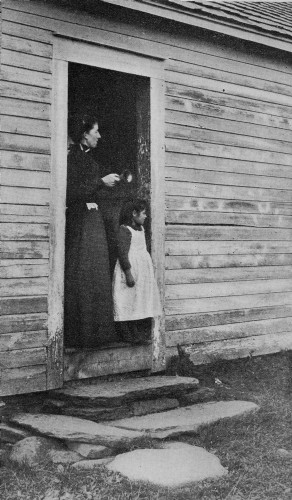 The end of recess. After
this class finished, the children were called on to speak their pieces.
One
after another the larger pupils came out before the company and said
the hymns
and poems they had learned. In starting to speak and in closing, the
boys bowed
and the girls courtesied. The
teacher had made a rose of thin paper for Betsey to hold while she
spoke her
piece, but, though she had it in her hand, she was so excited she
forgot to
hold it up for the audience to see. However, she spoke the piece very
prettily.
Meantime
the writing books and the ciphering books and samplers had been passing
from
hand to hand among the visitors, who examined them with considerable
care. Now
the teacher turned to the visitors, and said, if there were any remarks
to be
made, the school would be glad to hear them. Three or four of the men
got up
one after the other, and each said he had been much pleased with the
exercises.
“You are nice children,” one man declared; “you done well.” Another
said, “You have answered some questions which I presume a good many of
us older
people present couldn’t have answered.” Lastly
the minister rose. Save for his mild voice all was very quiet in the
little
room. The children with folded hands sat listening, and the older
people were
attentive too. Through the open windows came the wind in a gentle
current.
Outside, a multitude of insects mingled their voices in a continuous
murmur,
but among them, at intervals, sounded the strident, long-drawn note of
a
Cicada. The breeze made a light fluttering in the trees behind the
building,
and there, too, a wood bird was singing. By the roadside the visitors’
teams were
hitched, and, as the minutes drowsily sped, the children half
consciously heard
the horses stamping, and nibbling at the bushes. The substance of the minister’s remarks was that the scholars should be good children, should mind their parents, and not neglect their books in vacation, for, while “all work and no play makes Jack a dull boy; all play and no work makes Jack a mere toy.” At the close of the talk the company bowed their heads, and the minister offered prayer. This ended the exercises of the day, and the visitors passed out. 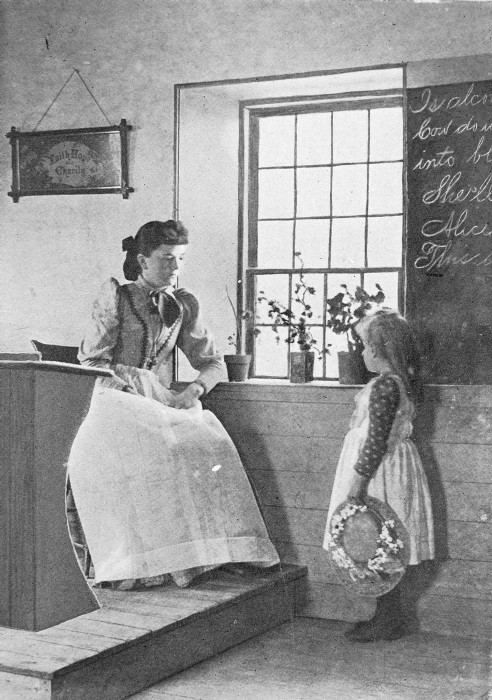 An excuse for being late. The
scholars still remained seated. It was the custom of the woman teacher,
at the
close of her term, to give the children some little presents, and now
was the
time for distribution. The eyes of the pupils had wandered many times
with
curious interest to the small package which had lain on her table all
the
afternoon. The gifts it contained were simple and inexpensive, but they
gave a
great deal of pleasure. Some of the children received a half yard of
bright-colored ribbon, one would get a man of sugar, another a more
substantial
man of tin. Again, it would be a picture, or a stick of cinnamon, or a
tiny
illustrated story book costing a cent or two. Then the scholars began picking up their books and other belongings. Betsey got her copy book and ciphering book and sampler from among those which had been passed about to show the visitors, her basket and bonnet from the closet, her Primer, Speller, Testament, and reading book, and her quills, plummet, ruler, and ink from her desk, and, thus loaded, passed through the schoolhouse door. Her folks had come with a team and were talking with some of the neighbors. She climbed into the wagon, and soon they jogged off toward home. 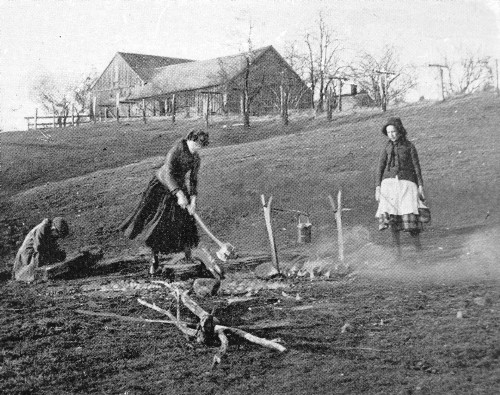 A holiday - playing at gypsies. Children
and visitors had all gone. Only the teacher remained. She had closed
the
windows, and now sat with her elbow on the table and her head on her
hand.
Through the door came the murmurous voices of the insects, the faint
ripple of
the brook over its stones in the pasture, and the dull tinkle of a
cowbell far
off. Presently a team came ratting along the highway and stopped before the schoolhouse. The teacher rose quickly, gathered up her few things, and went out. She lived six miles distant, and was now going home. Her father had driven over to visit the school, and since the close of the exercises he had been to her last boarding place to get the little hair trunk which was in the back part of the wagon. The teacher climbed in, the man clucked to the horse, and with the sun low in the western haze shining full in their faces, they followed the road along the level, and by its winding, bush-lined course were soon hidden from view. 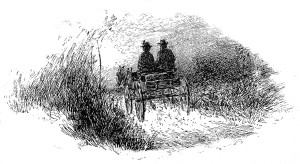 The teacher going home. |
 Click the book image to turn
to the next Chapter.
Click the book image to turn
to the next Chapter.