|
Click
here to return to
Castles of England and Wales Content Page |
 (HOME) |
| NEWCASTLE
POSSIBLY a
romantic
child can still invest the keep of Newcastle with all the glories of
flying
pennons, fair ladies, and knights-at-arms. But for those who have found
that
history is not a tale of the unceasing triumphs of idealists, there
comes a
weariness of Utopian chivalry. It may be that King Arthur was a “parfit
gentil
knight” indeed, but who King Arthur actually was no historian can say.
And
everybody knows that Henry II, who built the keep at Newcastle, was a
King of
some merit, of some talent, endowed like the rest of us with a
fluctuating tide
of virtues and vices. The ruins
of
Tintagel give licence to the imagination to reconstruct their airy
pinnacles,
their cloud-capped towers, in the most magnificent way conceivable. The
keep at
Newcastle is preserved before our eyes in a severely practical manner.
In its
position it is as if caught and held fast in a fork of railways. It may
once
have stood siege, it may once have been the prison of kings. But in
later days
it has served as a county gaol and it is the meeting-place of a society
of
antiquaries. As though, indeed, solicitous that a border hold should
come to
such base uses, a paternal railway company has erected, at suitable
positions
in the vicinity, tasteful walls capped by picturesque but useless
battlements.
The great keep, bereft of curtain wall and drawbridge, has had restored
to it
by a generation in love with the past some little of its ancient glory.
And,
indeed, in this Newcastle is more fortunate than Canterbury, whose keep
was
converted into a coal-hole to assuage, in some measure, the
archæological zeal
of a gas company. But do not
say
there is no Romance in Newcastle keep. The lonely cliff of Tintagel is
no more
romantic than the industrial town that has grown up around the fortress
of
Robert Curthose and Henry II. When knights-errant saw the pennons and
banners,
they knew whose castle they approached. So do we, by a low-hung cloud
of
trailing smoke, recognize the industrial town. There live
the
magnates of the new feudalism. Their castle is a factory, their crest a
hoarding, their motto a slogan. Bound by ties of “economic
self-interest,”
rather than by those of thegnhood or of sergeantry, an army of workers
garrison
their factories and accept their bounty; an army greater and more
dependent —
and bound not for a mere forty days of service, but until death — than
ever
gathered under the banner of a Neville or a Pole. In the new feudalism
as in
the old, it is the reliance of the weak upon the strong. The only
change is
that the military reliance has become an economic one. Is not
Romance
here? How spiritless in comparison are the green fields of Tintagel,
unused by
man and useless to him. In Newcastle there is life and history in the
making. In the
more immediate
surroundings of Newcastle keep there lies another equally vital
contrast. The
older feudalism, being the formation of local associations, was in
part, at
least, the result of poor communications. The king’s peace and the
king’s power
had a tendency to be restricted to the great high roads. The keep was
the local
defence or the local terror; when besieged it held out as best it might
until
its garrison starved or its besiegers withdrew. Its main characteristic
was
immobile strength. But it is
the improvement
in communication that has made possible the new feudalism. The local
associations become increasingly national and controlled by the State;
and in
war it is not the combatant with the strongest defence, but the
combatant with
the most effective communications that is victorious. Verdun would not
have
sustained siege any longer than isolated Mauberge if it had not had the
railways in its rear; and the industrial magnate knows that his
factories are
useless without his strategic railways to provision them with raw
materials. So the
lodger in a
slum and the worker in a factory need sigh no longer for green fields
and
ivy-mantled castle ruins in which to reincarnate all their fancied
heroes of
vanished centuries. Let them look up on high to the factory chimneys
against
the black pall of the firmament. Let them consider the railway lines,
how they
run here and there carrying the merchants and the merchandise that, to
them,
mean life and livelihood. Let them scorn the old feudalism of Tintagel
and
reverence the new feudalism of Newcastle. Is not this the whole of
their life,
and is not life Romance? 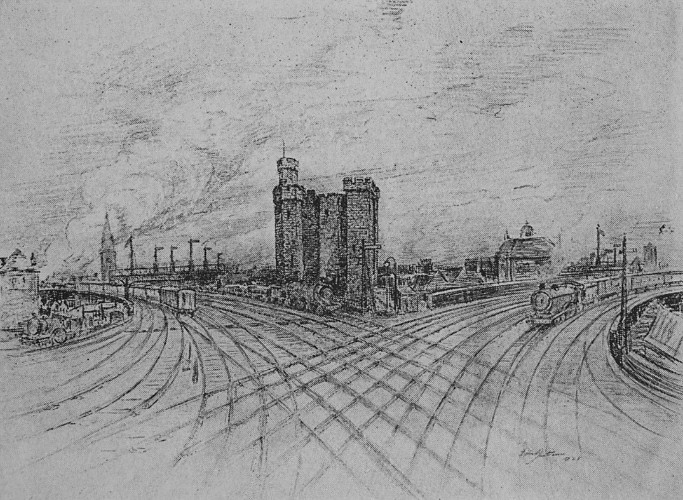 THE CASTLE, NEWCASTLE. |

Web and Book design,
Copyright, Kellscraft Studio
1999-2006
(Return to Web Text-ures)