 Web
and Book design,
Web
and Book design, Copyright, Kellscraft Studio 1999-2006 (Return to Web Text-ures) |
Click
Here to return to Castles of England and Wales Content Page Return to the Previous Chapter |
 (HOME) |
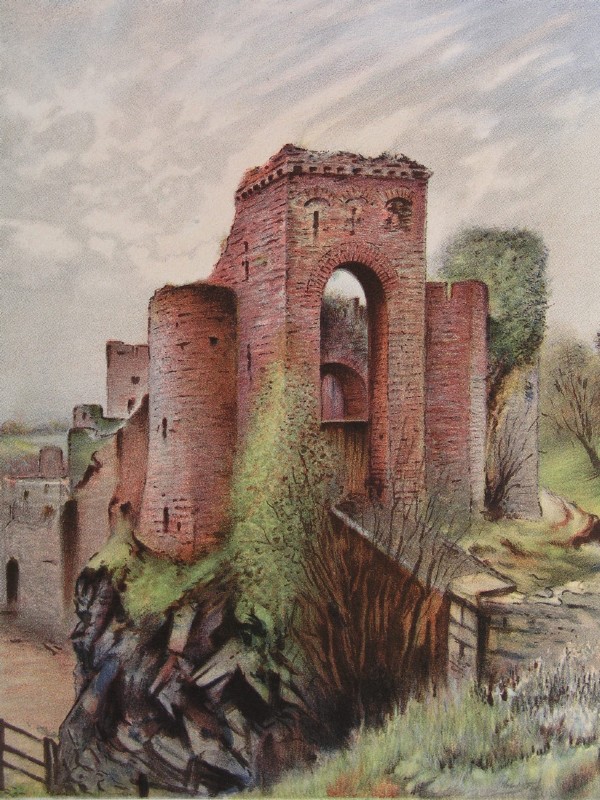 CHEPSTOW A TOWN
with the
Saxon name of Chepstow grew up under the shadow of a castle built by
the
Normans on the Welsh bank of the Wye, and was called by them Ystreigl
or
Striguil. There was a time when the great merchants of Europe could
talk of the
lordship of Striguil as a great centre of commerce. It held one of the
gates to
Wales; it contained a large part of the Wye valley, and the Wye valley
boasted
Tintern, an abbey under the patronage of the successive lords of
Striguil,
where the wool trade was carefully fostered by the monks. A book of
history
might not tell us more. First, the purely military outpost of the
Normans is
set up in 1067 as a bridgehead for further advances into Wales. The
Norman
scribe, true to the racial instinct for adaptation, copies down the
barbarous
Welsh name of the locality as it strikes his ear. Then the merchants
come, and
the English town of Chepstow (which means literally a place of trade, a
market)
grows great under the protection of the feudal magnates, outlives them,
and
finally extends its own name to the ruined walls of Striguil. It is the
emergence of England, made possible by an infusion of Norman strength.
The
powerless dragon of Wessex goes down in defeat at Hastings, and a few
centuries
later the battle cry of Agincourt is “St. George for Merry England.”
The point
illustrated at Chepstow could be easily proved: that the battle of
Hastings was
the decisive blow for the English conquest of England; it was the final
defeat
of the Northmen. The name
of
Striguil is probably derived from a Welsh verb meaning to wander, in
reference
to the winding course of the river. But a most interesting theory was
once
built up to show that the origin of the name lay in the Welsh Ystrad
Iwl; that
Chepstow was a Roman station to protect the river-crossing of the
Strata Julia.
Unfortunately there was never a Roman station at Chepstow, the Strata
Julia was
in another part of the country, and the Roman road to Caerleon and
Caerwent
passed over the Wye some little way up stream. The first military use
of the
site was undoubtedly made by William Fitz Osborn, Seneschal of
Normandy, Earl
of Hereford, who was made joint Justiciar of the kingdom with Odo of
Bayeux,
with instructions to build castles in suitable positions while William
the
Conqueror was visiting Normandy in 1067. Chepstow
(as the
castle will be called to avoid confusion) was built upon an ideal
river-side
position which it would have been folly to neglect. The old bridge of
the Roman
road was near enough to be afforded military protection, and as the
town grew
up a new bridge was thrown across the Wye a little below the castle.
The castle
was built upon a long and narrow platform along the Wye. On one side
sheer
limestone cliffs rose from the waters of the river, and on the other
side was a
steep gully or ravine running parallel to the stream. The town, a
walled
enclosure, grew up by the side of the ravine, affording additional
protection,
if it was needed, from that direction. The walls of the town are fairly
well
preserved, and Chepstow is a rare example of a castle associated with
the
fortifications of a town but lying entirely outside the town walls; a
disposition partly due to the nature of the site and partly to the fact
that
the castle was the original settlement. The platform of rock, some 250
yards in
length, and in breadth varying from 30 to 70 yards, rises towards the
centre
where the original Norman castle was erected. Chepstow
is long
and narrow, consisting of four adjacent wards, occupying the whole
length of
the tongue of land. On such a site the concentric form was impossible,
but
attack was only to be feared from east and west. The original castle
probably
took the form of a ward near the western end of the platform. A deep
ditch was
excavated from the ravine to the cliff on the west to protect an
elongated
enclosure with a massive and defensible hall at its eastern end.
Probably there
were also domestic quarters in wood, which have disappeared. The first
addition, in the twelfth century, was a large ward to the east of this,
and in
the next hundred years a barbican was built at the western end of the
castle,
and the strongest ward of all, with living quarters, gatehouse, and a
strong
tower, was added in the east. The
strength of the
castle is at once obvious to the visitor. The barbican, not a narrow
passage
but an enclosed courtyard, is fronted by a ditch, crossed by a
drawbridge.
Within the barbican, against the wall of the second court, is the old
ditch of
the Norman castle. The entrance of the barbican is protected by an
imposing
gatehouse with rectangular towers in two stories and the usual
apparatus of
gate and portcullis, battlement and loop. At the south-west angle is a
round
tower which was formerly connected with the enceinte of the town by a
wall
across the ravine of no great strength. Having taken the well-protected
barbican by assault an enemy would find himself confronted by the ditch
and
drawbridge protecting the second cross wall. The most
imposing
feature of the whole castle, and indeed one of the most remarkable
buildings in
any English castle, is the hall or keep at the end of this second ward
from the
western end. It is of the same class as the fine hall at Richmond, of
early
Norman work with twelfth and thirteenth century additions. Probably
(and here
as usual the experts differ) it was built immediately after the
Conquest, to
judge by the style of architecture, and the irregularities of its plan
and
construction. The ordinary visitor may leave on one side the
alternative and
equally attractive theories that a hall was converted into a keep and
that a
keep was converted into a hall. It may be considered a hall capable of
defence
like the similar buildings at Richmond and Durham. The
building
occupies the end of the ward, leaving a narrow gallery on the side of
the
river, closed by gates at either end, to connect the second and third
wards.
The basement of the building was used for stores, and its walls are
pierced
with loops to command the gallery. The Norman aula
in the upper story is now entered by a vice in the thickness of the
wall. The
fireplace must have been in the centre of the floor with an opening in
the roof
to allow of the escape of smoke. The hall shows its continued use, for
the
ornamentation is mostly Decorated. Norman windows have been blocked out
and
windows of the thirteenth century inserted in their stead, and a line
of
Decorated windows takes the place of a triforium in the Norman hall. At
one end
an arch has been built up dividing the hall into two unequal parts.
This
provided a solar for the lord and his friends, and the line of
Decorated
windows above the string course provided light for a broad wooden
gallery
running around the hall. The third
ward from
the west has no outstanding features, except a watch tower in the
southern
curtain projecting towards the ravine. From the top of this tower
signals could
formerly be received from a similar tower on a high hill across the
river. By
this means ships entering the mouth of the Wye could be seen long
before they
reached Chepstow, where the lord had the right to exact toll from them.
The
other tower still stands on Twt Hill —
which means look-out hill. There is a Twt Hill above Carnarvon, and the
name
remains in some English villages, such as Toot Baldon in Oxfordshire. In the
fourth or
lower ward the thirteenth-century builders erected their most elaborate
buildings and their strongest fortifications. The buildings have been
allowed
to fall into disrepair, and we can only see from their range and
variety, from
an occasional room or window, that they must once have been of
considerable
magnificence. They included a hall, an oratory, kitchens, and dwelling
rooms,
running along the cliff top over the Wye. The most interesting of the
surviving
portions is the vaulted cellar with a groined roof excavated below the
hall. A
door in the floor opens above a creek or recess in the cliff, and an
iron ring
shows that use was made of this unusual postern to draw up provisions,
messages, and spies. The Royalists besieged in this castle are recorded
to have
let a boat down to the river in preparation for escape; but a Roundhead
soldier
swam across the Wye with a knife in his mouth, cut the rope, and
brought away
the boat. The
landward walls
of this court are of immense thickness, even for their period. They are
built
up of an outer and an inner wall, with a filling of earth between,
making a
thickness of 20 ft. in places. The
splendid
gatehouse is in the north-east angle of the ward near the river. Two
drum
towers of unequal size defended a gateway with two portcullises, and a
projecting archway above commanded the space before the gate. Then, to
protect
the angle of the ward a strong tower of great strength was built,
comparable
with the Eagle tower at Carnarvon. It flanked the gatehouse on its
left, and
the ravine along the line of the south curtain, and to increase its
flanking
properties stone spurs were built up along its base in the form of
demi-pyramids dying away in the face of the tower. Its name is the
Marten’s
tower — so-called because Henry Marten, one of the regicides, having
been
spared the death penalty, was condemned to an easy imprisonment there
after the
Restoration. The
entrance to
Marten’s tower is from the ground level in the ward, protected by its
own gate
and portcullis. Besides an underground chamber there are three floors,
containing one room each, connected by a spiral staircase in the wall.
Where
the ram part wall communicates with the tower there is another door
and
portcullis. Jutting from the tower and rising above the level of the
ramparts
there is a square projection containing a small oratory. Marten’s tower
was
primarily a flanking tower, but it also served as the nearest approach
to a
keep that was ever attained in the concentric type of castle. Chepstow
belonged
to men who made their name in England, Wales, and Ireland. It soon
passed out
of the hands of the FitzOsborns. William was killed in Flanders, and
his son,
Roger of Breteuil, was deprived of his estates for conspiracy. The
castle was
granted to the founder of Tintern Abbey, Walter FitzRichard, of the
family of
Clare, and thence it descended to Gilbert and Richard Strongbow, the
powerful
Earls of Pembroke. For a time
Thomas
de Brotherton, a son of Edward I, held the castle, regranting it for
life to
the younger Despenser. To this period may be assigned the
reconstruction of the
hall, and parts of the lower ward. Subsequently the castle passed
through the
hands of Mowbrays, Herberts, and Somersets. The Dukes of Beaufort are
the
present owners. In the
Civil Wars
Chepstow was taken by assault, after a cannonade, by the
Parliamentarians. A
breach was made in the walls, and some forty of the garrison were
slain, but it
does not appear that very considerable damage was done to the old walls
of the
castle, which will last for many years to come. |
 Click the book image to turn
to the next Chapter.
Click the book image to turn
to the next Chapter.