 Web
and Book design,
Web
and Book design, Copyright, Kellscraft Studio 1999-2006 (Return to Web Text-ures) |
Click
Here to return to Castles of England and Wales Content Page Return to the Previous Chapter |
 (HOME) |
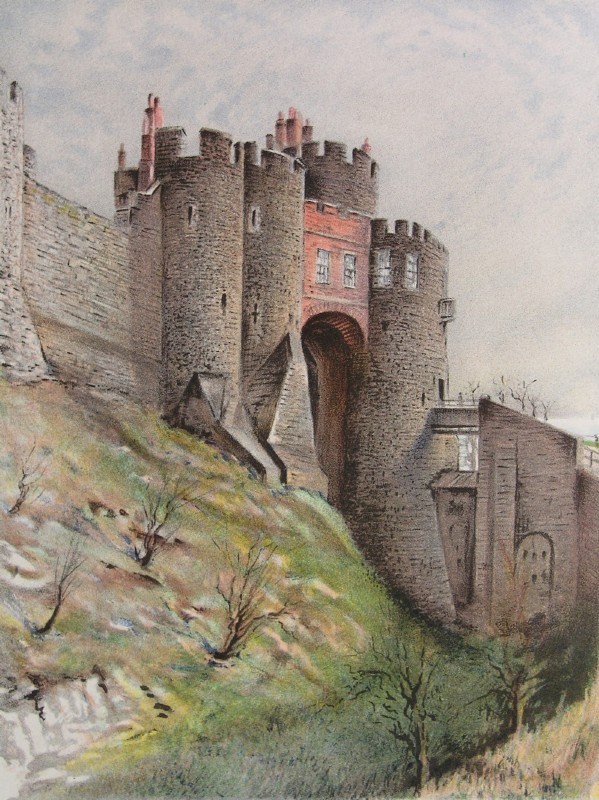 DOVER CASTLE. THE CHANNEL COAST THE
Kentish
promontory is the Achilles’ heel of England. There is no other strip of
coast
that gives to an invader such an immediate advantage over the whole
country as
that between the North Foreland and Beachy Head. Its possessor has the
opportunity to blockade London — the nerve centre of England — by
controlling
the Thames; he has cut the main communications with the Continent, and
he has
established his own, if the sea power which transported his army still
gives
him control of the Narrow Seas. This was
the
successful avenue of invasion used by the Romans and by the Normans.
Since the
Battle of Hastings every large scale attack upon England has been
abortive, but
the tents of Napoleon’s armée maritime were to be seen upon the
cliffs of
Boulogne in the last century, and, only that Deus afflavit et
dissipati sunt,
the captains of the Armada would have attempted to seize the same
important
part of England. This
history of
Kent and Sussex as the cockpit of England is not due to the historical
accident
that England’s invaders have come from Southern Europe and have
naturally
chosen the shortest sea passage. It is the result of strategic
considerations.
When the Dauphin of France invaded England on behalf of the Barons of
the
Charter, he was advised by his father, Philip Augustus, a brilliant
strategist,
to secure Dover at once and at all costs. But Louis turned to Dover too
late
and failed before its walls; and Philip, when the news was brought,
cried “Then
he has not taken one foot of English land.” 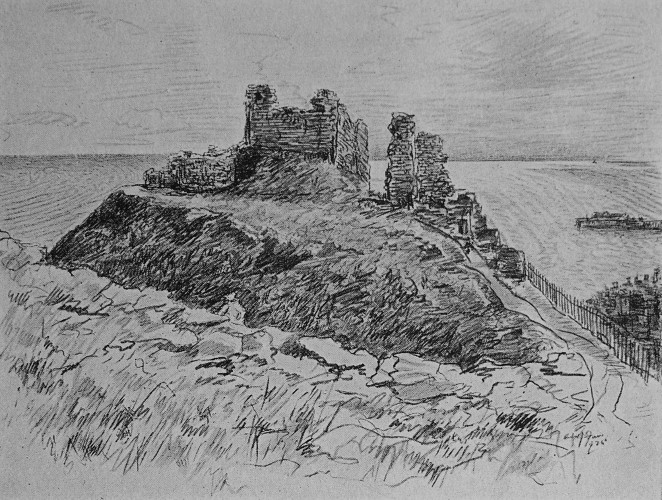 HASTINGS CASTLE. Acting
with the
same considerations, William the Conqueror did not strike directly at
London
after his crushing victory at Hastings. He marched, instead, along the
coast to
Dover, secured the hub of the Kentish roads at Canterbury, seized the
crossing
of the Medway at Rochester, and then advanced along the valley of the
Thames
for the blockade of London. Nor have England’s enemies come invariably
from the
South. Long before the Romans left the Britons to fend for themselves
they had
arranged a system of defence — the famous Saxon shore — against the
enemy from the
north who were to give England her name. The Roman defensive for
tresses did
not front Jutland and the mouth of the German rivers, but they were
arranged
along the south-east coast from the Wash to Beachy Head. They were true
castles, their walls thick and high, protected by a newly-invented
tactical
device, the bastion, on account of the increased importance of archery.
Of these
Richborough, in Kent, remains an unhappy relic, set on a knoll
overlooking
flat, marshy fields on every side. It once protected the sea channel
that
passed behind the Island of Thanet to Reculvers, but it has shared a
common
fate of Kentish ports in being widowed of the sea. For, owing to the
racing of
the tides through the Channel’s bottle-neck, the coast is blockaded
with shifting
sands, and one generation has before now seen the complete obstruction
of a
prosperous harbour. Richborough
Castle
is a heap of rubble, stripped of its ashlar covering, and still
preserving some
of the plan, though none of the appearance, it had in the days of
strength.
There are interesting contrasts in the neighbourhood of this ruin of
Rome. A
mile away is Sandwich, a famous port in the Middle Ages. To-day, if one
admires
the beautiful barbican of chequered stonework, one has seen the sum and
total
of the military remains of Sandwich. A red-sailed lugger may be
observed in the
middle of green fields, as it creeps up the winding channel from the
sea, and
it is difficult to realize that some poor, persistent fishermen still
take
pride in Sandwich as a port. Then, to crown the contrast, is the modern
port of
Richborough, the “mystery port “of the war, whence the train ferries
set out
for France. Already the channel that leads to it through Pegwell Bay is
silted
up, and the lonely bivouac of concrete huts and rusting ferries is a
curious
relic of spent energies. Perhaps Richborough will some day become a
centre of
commerce, but at present it is a fitting epilogue to the story of the
Roman
fort and the mediæval town. At
Pevensey and
Dover, however, are Roman fortresses that added to their military
history in
later centuries. Fronting the cliffs of France is a monument to commemorate the heroes of our generation who formed the Dover Patrol, and at the very heart of the castle is an even older monument with a similar significance. Nearly a score of centuries ago the Roman galleys made the perilous passage from Gessoriacum (Boulogne) to Dubris. At both ports lighthouses were erected to guide the mariners, and the Pharos of Dover still watches over the Channel. An ashlar coating was built around it; the ashlar decayed, but the green sandstone and tufa of the pharos is still sound; it was crowned with Tudor brickwork, and it bears the load. Flanking the lighthouse is a building which may have been a part of the fortifications. Its origin is lost in antiquity. It was certainly a Saxon church; it is the garrison church of St. Mary in Castra to-day, and there is a strong opinion that this building was used as a place of worship by the Christians of Roman times. Probably Dover can boast the oldest Christian church in England. Around it are Roman and Saxon fortifications — the Norman walls and towers, the fine keep of Henry II, with its perfect forebuilding, the great redoubt built after the Dauphin’s siege had demonstrated a weakness in the defensive plan. 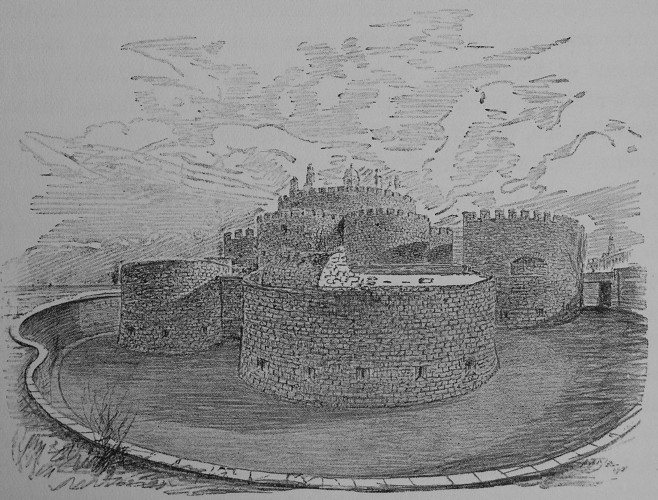 DEAL CASTLE. In all
things Dover
was England, and Shakespeare made its white cliffs the figure of his
country.
The names of its con stables included Godwin and Earl Harold, Hubert
de Burgh,
Stephen Langton, the King Maker, Henry VIII, the younger Pitt, and the
Duke of
Wellington. Matthew Paris spoke of the castle as the “key and lock of
the whole
realm,” and Sir Walter Raleigh wrote “A Discourse of Sea Ports,” with
the
intention mainly of advocating the improvement of Dover. “No
promontory, town
or haven in Christendom,” he wrote, “is so placed by nature and
situation both
to gratify friends and annoy enemies as Your Majesties town of Dover.”
In less
measure that is true to-day. The guns still point seaward, the bugles
call, and
the flag flies above the Roman and Norman stones of one of Europe’s
major
fortresses in the twentieth century. Pevensey
(like
Porchester, which guarded the great Roman harbour near Portsmouth) is a
mediæval castle built within the enclosure of a Roman coast fort. They
are
symptomatic of the Norman facility for adaptation and of their
assumption of
the Roman tradition. The walls of Pevensey enclose an area of nine
acres
wherein lay the settlement of Anderida. The Anglo- Saxon Chronicle
makes
special note of the destruction of Anderida in the fifth century, and
for six
hundred years its walls were desolate, until the Conqueror’s
half-brother,
Roger de Mortain, improvised a fortress there which proved to be
impregnable.
In those days the sea washed its eastern and southern walls, and at
high tide
flooded the marshy lands which lay around the other sides of the mound
on which
Pevensey stood. These natural defences were added to in the thirteenth
century
by an inner curtain wall around the actual castle in the south-east
corner, and
by an inner moat of some width. The kernel of the completed castle was
the
mound thrown up by Roger de Mortain surmounted by its strong Norman
keep. William
the
Conqueror landed at Pevensey, and in the next reign his son Rufus there
besieged his uncles Odo of Bayeux and the Earl of Mortain, who had
rebelled in
favour of his brother, Robert of Normandy; so Pevensey played a great
part in
the history of that vigorous family. For three months William’s direct
assaults
were unavailing, but he obtained the surrender of the garrison by
starvation
after an attempt at relief from the Norman fleet had been beaten off.
In 1147
Stephen was quite as unsuccessful in his bombardment of Matilda’s
supporters,
but he also compelled the surrender after a strict blockade. In 1264,
however,
after the battle of Lewes, the tables were turned. Simon de Montfort
besieged
Pevensey for eight months. He even reached the Roman walls. But the
defenders
maintained their supplies and communications from the sea until Simon
threw up
the attempt in despair and marched off to Kenilworth. Pevensey was true
to its
type: the strength of the castle was relative to the patience, not to
the
strength, of its besieger. Under the
Tudors
the castle was for the first time allowed to fall into decay, and it
shared the
fate of many a noble building in being used as a quarry by the
neighbouring
gentry. Not
everyone is
aware that the Protector Somerset desired to use the stones of
Westminster
Abbey for the building of Somerset House. With a like vandalism, which
can be
more readily excused, the squires set upon Pevensey, and one John
Thatcher, may
be especially held up for reprobation as the purchaser of six hundred
stone
loads of Pevensey and English history at the price of twopence a load.
It is
curiously symbolic that, except for its curtain wall, the mediæval
castle is a
be wildering ruin, its keep and its hall razed to the ground, while
the Roman
walls and bastions, robbed of their stone covering, indeed, “still wear
their
ancient countenance of strength and defiance,” to quote an
eighteenth-century
traveller. It is a strange consideration that after the lapse of so
many
centuries the Roman remains in England are a more valuable index to
their
civilization than the archæological survival of the Middle Ages. If no
documents survived from either period, we could more surely reconstruct
the
life of Roman Britain than the times of the Saxons, Normans, or
Plantagenets. The mediæval castle was ultimately as much an evidence of individualism in society as the nineteenth-century factory. The manufacturer has a monopoly of capital, and the castle builder had made a corner in power. The castles were (unlike the mediæval cathedrals) erected against the mob. But when the mob had control there was no need of a castle, and no opportunity for one to be built by an oppressor. The greatest safe guard of the southern coast in the Middle Ages was the fleet of the Cinque Ports, and because the monarchy realized this fact, the towns of that league had their own privileges of jurisdiction and taxation, making them to all intents and purposes a group of collective barons. They had their walls, but not their castles. So it is interesting to find that the monarchy turned its attention to the fortification of the Cinque Ports when it had become supreme over lords and people, an individualist monarchy — the Tudor despotism. A memorandum of Cromwell’s, dated 1533, is headed “Articles conceived for the defence of the towns of Dover, Sandwich, Deal, Folston, the Isle Tened (Thanet), and Hythe, and all the sea coasts about.” 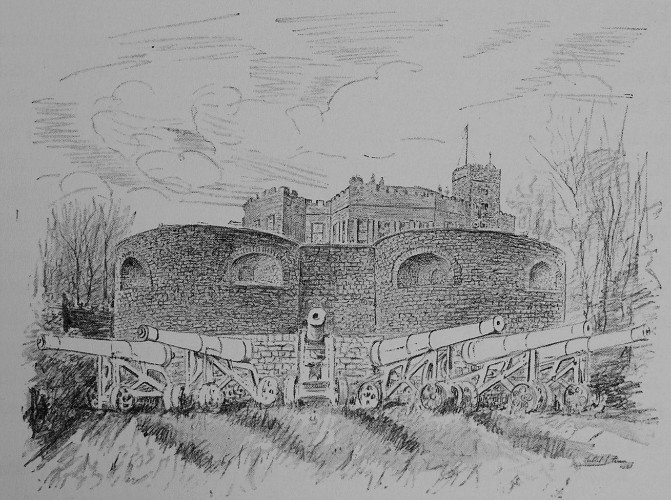 WALMER CASTLE. Dover had
always
been a royal castle. Fearing invasion from France or Spain, Henry VIII
built
additional castles and “bulwarks “from Tilbury to Portland, employing
as his
architect a Moravian, Stephen von Haschenperg. “The Almayn,” as men
called him,
was ingenious enough in the construction of twisting passages and
culs-de-sac
in which the struggling enemy could be grilled with boiling lead, but
castles
such as Deal, Sandgate, Walmer, and Camber, were small, and would
probably have
been of little value if brought to the test of war. Of them all Walmer
possesses the most interest as the residence of the Lords Warden of the
Cinque
Ports. Nelson used to land from his flagship in the Downs to consult
with Pitt
at Walmer, and the Duke of Wellington, as Warden, lived and died in the
castle. England’s safety has long been in her isolation and in her sea power. But we may see in the near future new defensive works erected on this vulnerable coast. For the aeroplane has narrowed the Narrow Seas and the long-range gun can span them. The modern progress in the art of killing has brought our statesmen face to face with the problem that England has a frontier equally with Germany, Belgium, or France. It may be that the Navy will play a less vital part in the future than it has done in the past. The problem of the south coast has almost become that of safeguarding, not a sea frontier, but a river frontier like the Rhine. 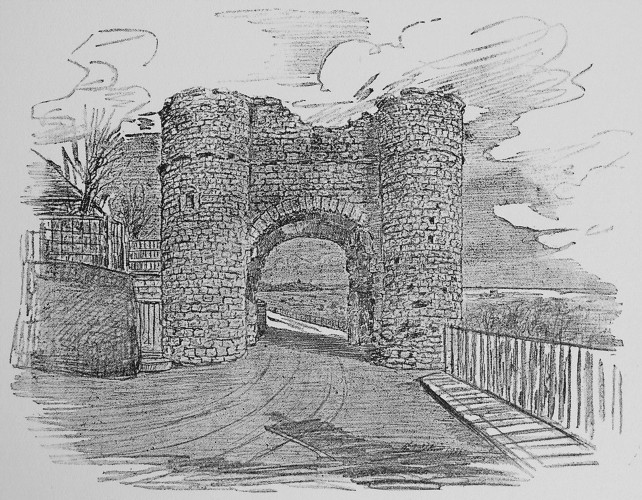 WINCHELSEA CASTLE. |
 Click the book image to turn
to the next Chapter.
Click the book image to turn
to the next Chapter.