 Web
and Book design,
Web
and Book design, Copyright, Kellscraft Studio 1999-2006 (Return to Web Text-ures) |
Click
Here to return to Castles of England and Wales Content Page Return to the Previous Chapter |
 (HOME) |
|
BAMBURGH THERE are
in
England many towns that have grown up around feudal castles, but
Bamburgh is
unique as a fortress upon the site of which was once “the mistress of
the
cities of Britain.” It might almost be said that, with the building of
the
Norman castle the glory of Bamburgh departed. For upon this volcanic
rock
jutting into the North Sea was a British stronghold, Dinguardi, which
became
the capital of the Northumbrian kingdom, Bernicia. Bebbanburh, as it
was
called by the Angles, held sway over the mingled fortunes of Bernicia
and
Deira, now the glory of a victorious nation and again the impregnable
refuge of
a broken people. The history of Bamburgh in that period mirrors the
defeat of
the Britons, the savagery of pagan Mercia under Penda, the extension of
Wessex
under Alfred’s house, and the low Danish ships driving in from the
east. This
barren
cliff-top, described by one chronicler as about the size of two fields,
was yet
the subject of a lamentation worthy of Jerusalem. “She has exchanged
her
ancient sabbaths,” wrote Reginald of Durham, “for shame and desolation.
The
crowds that flocked to her festivals are represented by a few herdsmen.
The
pleasures her dignity afforded us are now no more.” Indeed,
there was
an end to Ilium. At some period, which it is impossible to fix, the
inhabitants
of the shrunken capital built a new, inglorious Bamburgh, outside the
enceinte
of what is now the castle. This
“corner of
Northumberland defended on all sides by the sea and the marshes,” was
the last
refuge of the Conqueror’s enemies in the North. Fortified as it was,
even then
possibly with stone walls, careful strategy was needed to make it
surrender,
and he paid Bamburgh the compliment, shared only by Durham and York, of
leaving
it untouched when he laid waste Northumbria in 1070. A soldier’s eye
saw the
value of the site, and the history of Bamburgh as a castle began. Often
enough, of
course, the Normans used existing fortifications until the opportunity
arose
to build after their own manner — an
opportunity which in some cases did not present itself until the
twelfth
century. All that we know certainly about the date of its building is
that the
keep was an addition to a completed castle; not, as in the case of the
White
Tower, or the keep at Dover, a nucleus around which concentric
fortifications
were afterwards built. The keep was erected by Henry II in 1163, ten
years
before that of Newcastle. The plan
of
Bamburgh is long and narrow, with its north eastern side fronting the
sea. On
such a site there was no question of throwing up a mound to make a
fortress of
the mound and bailey type. Instead, three wards were built. The inner
or
eastern ward contained the halls, kitchens, vaults and living quarters
with the
twelfth-century chapel of St. Oswald, of which the carefully-preserved
foundations now remain. The keep at the eastern end of the middle ward
has
unfortunately lost some of its aspect as a fortress owing to an
eighteenth-century effort to convert it into a private residence. This
necessitated the piercing of the walls with large, unsightly windows,
and the
reorganization of its exterior plan. In the
basement of
the keep there is to be found a well, described in Anglo-Saxon times as
“most
sweet to the taste, most pure to see, which has been excavated out of
the solid
rock with marvellous labour.” Despite its importance to the castle it
was lost
sight of during the sixteenth century and only discovered by accident
in 1770.
Its depth is 150 ft. — the actual height of the rock above sea level at
that
point — which is truly “of a marvellus grett dypnes” for such early
work.
Another marvel in early times was the flight of steps cut out of the
solid rock
at the lower end of the castle to the north. Examination proves that
these became
the mediæval postern steps, but the indiscriminate renovators of the
eighteenth
century had no compunction in destroying them. In general, at Bamburgh,
although much is ancient, the visitor must approach warily each
“Norman” door
and “mediæval” tower. Bamburgh
has had to
stand the test of several sieges, but its impregnability was a byword
so long
as gunpowder was unknown. William Rufus, who besieged Robert de Mowbray
there
in 1095, was reduced to blockading tactics. He threw up a temporary
castle, which
he nicknamed “Malvoisin,” and which was so near the walls that William
is said
to have suffered from the taunts of the beleaguered garrison. And, in
the end,
Mowbray’s fall was due, not to a breach in the walls or to the failure
of food
supplies, but to his own capture after the sortie he made to get
possession of
Newcastle. In effect,
this was
a victory for the throne that only increased the reputation of
Bamburgh. For
William was wise enough to imprison Mowbray, suppress his earldom, and
make
Bamburgh a royal fortress. Thenceforward it was governed by Constables,
who
were royal nominees. Nevertheless,
its
very strength as a mediæval fortress can be looked at from another
aspect. The
object of the mediæval castle builder was to construct a place of
passive
strength, easily defended, and it can be said that, had six men of
their time
possessed modern rifles, they could have held the castle against all
comers. As
a royal stronghold, the history of Bamburgh was well documented, and
these
documents describe a line of incompetent and dishonest Constables, a
castle
largely ruinous and desperately devoid of ammunition. Three great
statesmen,
Henry I, Henry II, and Hubert de Burgh, devoted their attention to
Bamburgh,
but the state of the castle at other times is fairly shown by an
inventory of
1248, in which we are told that the garrison could boast only of two
hauberks,
three doublets, two helmets and eight iron caps “all old and
valueless.” There
were thirteen small ballistæ — no more than crossbows — and ten barrels
of
“quarrels” for them. And, carefully recorded like treasures of great
price, are
these tools: two crowbars and one broken iron hammer, six axes and one
pickaxe,
three worthless coppers in the furnace, three old brass pots, three
worthless
dishes and a gridiron. On another occasion all the provisions to be
found were:
four casks of sour wine, a pipe of Greek wine, “no better,” one jar
full of
honey and another with some honey in it. Again
consider the
structure of the castle. A Constable in the time of Edward III reported
extensive ruins: the lead was decayed and the beams were rotting; the
tower was
threatened with ruin; the stone roofs of the Davytoure and of the
Belletoure
had been carried right off by a tempest; all other parts of the castle
were in
great decay. Yet even in this ruined state, Scottish attacks were
beaten off
for three months during the year 1328, with what seems to us the small
loss of
five ballistæ, a bucketful of bolts, the one bow the castle possessed,
and all
of its five sheaves of arrows. Evidently mediæval castles were not
always the
perfect strongholds they were represented to be. Or rather the science
of
siegecraft, in England at any rate, was largely undeveloped. In this
connection
though, it must not be overlooked that the garrison was aided by the
services
of the crown tenants. Few sums of money are put down for repairs in the
Rolls
of the Exchequer. In fact,
repairs
might almost have been a means of revenue, for in 1170 the Thane of
Hepple was
fined five marks for refusing to lend his assistance. Francis Grose
conjectured
that the small stones used for the tower must have been brought on the
backs of
men and horses from a quarry three miles away. Although Bamburgh lacks in its history some of the dignity of Warwick or of Arundel, both seats of feudal dynasties, it is a place Where Sultan after Sultan with his pomp It is,
indeed, a
commentary on English history, the strength or the weakness of its
kings. Thus
the powerful Hubert de Burgh proceeded to Bamburgh, accompanied by
Brito the
Balister, and his eighteen comrades. In the same year the castle was
visited by
the young Henry III with an insignificant retinue. There is an echo of
Edward
I’s Welsh victories, when we find two princes from Wales confined in
the
castle, while Edward II is shown characteristically making a pretext of
imprisoning Piers Gaveston at Bamburgh to secure him from his enemies.
After
the Battle of Neville’s Cross, David Bruce, “who called himself King of
Scotland,”
was brought to Bamburgh and, ten years afterwards, Edward III there
completed
the final convention with Edward Balliol for the latter’s surrender of
the
Scottish Crown. The strong John of Gaunt restored it, and Harry Hotspur
was
made Constable as a reward for his share in the dethronement of Richard
II. Bamburgh’s
most
intimate connection with royalty was a tragic one; the unavailing
refuge of
Margaret of Anjou, it sheltered the unhappy Henry VI for some months,
finally
endured a famous siege, and, sorely battered, owned itself defeated by
the new
artillery. After Towton, Margaret of Anjou, assisted by Lancastrians
and French
mercenaries, made two attempts to maintain a pied-à-terre for
her husband in
that part of Northumberland guarded by Bamburgh, Alnwick, and
Dunstanburgh.
But she had to cope with Warwick the King Maker, and at one time was so
closely
blockaded at Bamburgh that she was forced to escape to a storm-bound
French
fleet, and finally reached Berwick in a fishing smack. In the meantime,
the
garrison, after eating their horses, surrendered to Warwick.
Nevertheless,
within four months, “by false collusion and treason,” Margaret again
had
possession of the castle, and with her was Henry VI. She failed to take
Norham,
was chased back to Bamburgh by Warwick, and so escaped again with her
son to
secure French aid, leaving Henry VI in safety. Probably the real
security of
Henry’s position lay, not so much in stone ramparts, as in Warwick’s
doubt
whether it would be to his own best interests to crush the Lancastrians
too
effectively. He withdrew southward, leaving Henry undisputed monarch of
a
little kingdom. To his liege subjects of Alnwick and Dunstanburgh the
royal commands
were issued; even upon the citizens of Edinburgh was conveyed a charter
granting trading privileges with the principality in Henry’s
possession, until
at last the danger of French intrigue forced Edward to march north and
scatter
Lancastrian court and kingdom to the winds of heaven. Bamburgh,
whence
Henry had been assisted to escape, sustained a siege which was a
strange
mixture of mediæval pageantry and modern science. The Warwick Herald
and the
King’s Chester Herald were despatched to demand the surrender from the
Constable “and other that held his rebellious opinion.” But he “had
clearly
determined within himself to live or die in the Castle.” So the heralds
departed after delivering a final warning against the destruction of
the
castle: “the which the King, our most sovereign lord, hath so greatly
in favour
seeing it marcheth so nigh his ancient enemies of Scotland, he
specially
desireth to have it whole, unbroken with ordinance; if ye suffer one
great gun
laid unto the wall and be shot and prejudice the wall, it shall cost
you the
chieftain’s head; and so proceeding for every gun shot to the last head
of any
person within the place.” So
“Newe-castel,”
“London,” and the King’s brazen gun,
“Dijon,” came into play. They so
“betyde”
the place that great stones flew into the sea, and Dijon shot through
Sir Ralph
Grey’s chamber oftentimes. The castle capitulated, and Sir
Ralph Grey was led
to Doncaster for execution, one of the chief counts against him being
that he
had “withstood and made fences against the King’s
Majesty and his lieutenant,
the worthy Lord of Warwick, as appeareth by the strokes of the great
guns in
the king’s wall of his castle of Bamburgh.” This
siege gave
Bamburgh a certain fame which it might otherwise have lacked. It is
widely
known, not as a royal town, nor as a castle merely, but as the
castle
upon
whose walls was triumphantly demonstrated the supremacy of artillery.
So
historians have said, forgetting that the growth of common law
destroyed more
of the feudal strongholds than did ever “London,”
“Newe-castel,” or “Dijon”;
forgetting also that Basing House, a fortified manor, held out against
the
improved cannons of a later century. The real interest of the siege and
of
Bamburgh is a more human one. The sight of that long-stretching
sea-wall and
the water-gate is a reminder of Queen Margaret bravely setting out to
prepare a
new attack on the usurper, of Henry in vigil for the help that never
came to
him on earth. There are memories here of kings in plenty, and anyone
who is
interested in such things will find a fount of interest in the history
of the
Anglian royal town — of Aidan, Cuthbert, Oswald of the Fair
Hand, and Queen
Bebba, whose name was given to the spot. Even the
enthusiastic renovations of the eighteenth century may be forgiven to
the
trustees of Lord Crewe, Bishop of Durham, whose aim it was to make the
castle
into a refuge for shipwrecked sailors. Lord Armstrong, the present
owner, has
done much to restore the characteristic features of its earlier
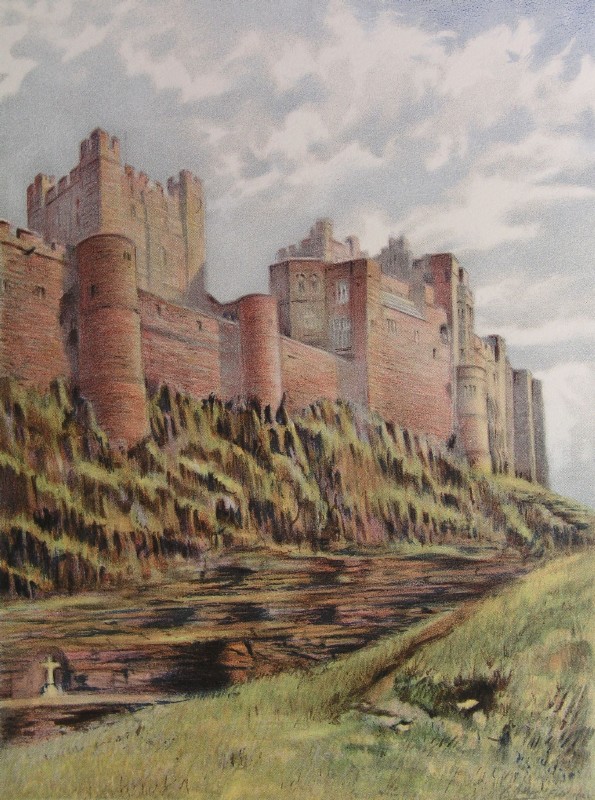
history. Bamburgh as a target for those strange new guns is of minor importance. It stands to-day a monument of men, not of things. It held the border of two nations that are now one on behalf of a monarchy that now rules an Empire. 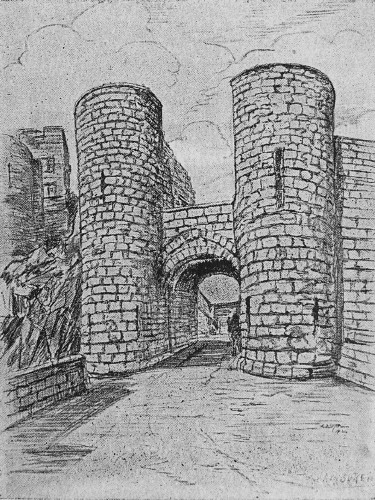 BAMBURGH CASTLE. |
 Click the book image to turn
to the next Chapter.
Click the book image to turn
to the next Chapter.