 Web
and Book design,
Web
and Book design, Copyright, Kellscraft Studio 1999-2006 (Return to Web Text-ures) |
Click
Here to return to Highways and Byways of California Content Page Return to the Previous Chapter |
 (HOME) |
| XIII
ON THE SHORES OF PUGET SOUND THE place where I stopped longest in the Puget Sound country was a scattered settlement of five thousand people which was old as age goes in the Northwest. Its most commanding height was crowned with a big school-building, and there were little church spires sticking up all about. “We’re supplied with pretty near every creed and denomination you can think of,” declared one citizen proudly. As I was rambling through the town on my first evening there a church bell that I judged from the sound was one size larger than a hand bell, began to ding-dong not far away. I was on the same street as the church and presently came to the edifice. Several boys were climbing up to look in the windows and then jumping down. “I see him!” they cried excitedly. “I see the crazy man!” The bell now ceased its clamor, and I concluded to attend service. I entered and found a Young People’s Meeting in progress. Outside I could hear the boys scuffling at the windows. After a while a man in the audience rose and left the room. He was shabbily dressed, his hair was tousled, his looks vacant and his step shuffling. He was the crazy man. Nearly all in the room turned to watch him go, and among the children there was much snickering which was long in subsiding. After the meeting came to an end there was a second meeting in a larger room across the hall for the entire congregation. The gathering was small, but the service had considerable vim in it. The singing, with the cabinet organ to lead, was particularly energetic, though the hard metallic tones of the voices savored of the uncultured wilderness. The region is still raw and youthful, and delicacy of feeling and expression will come later. The regular preacher was away, and a member of the congregation who had a knack for speaking took his place. He looked like a reformed bartender — stout figured, with a narrow forehead, a heavy mustache and a hoarse, loud voice. When he rose to begin his sermon he said, “There was an old farmer went to town to buy a clock, and the storekeeper showed him one, and says, ‘Here’s a clock that will run eight days without winding.’ “‘Gracious!’ says the farmer, ‘and if she will run eight days without winding how long will she run if you wind her?’ “Now, I ain’t been wound up for eight days myself, so there’s no knowing how long I’d run if I had been wound up. I’m goin’ to talk to you tonight about the Bible. The Bible ain’t just one book. It’s many books put together. How many books are there in the Bible?” 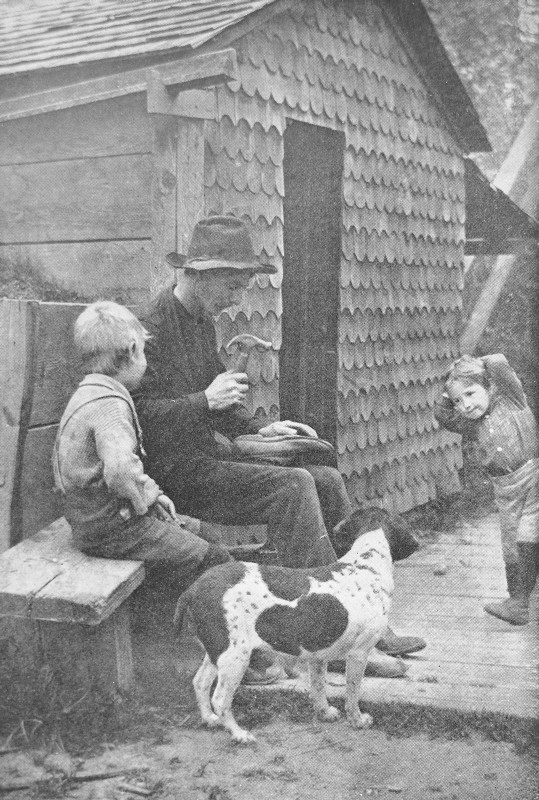 Mending a shoe
He paused, tipped his head on one side and raised his eyebrows inquiringly. There was a blank silence. “Don’t all speak at once,” he cautioned jokingly. “Sixty-six,” responded a faint voice in the audience. “Yes,” said the preacher, “and sixty-six books is a good big library; but if you was to go and collect all the books that have been written about the Bible or been inspired by it you would have thousands — ain’t that right? “The Bible wa’n’t given to the world all complete. It was given gradually — first a little for Adam, then more for Abraham and his family, and later still more for the Jewish people. But finally it was all given and was for the whole world. The climax of God’s work was to send Christ down here on the earth, and Christ came to save the people of his day, and he came to save you and I. This was a savage old world then. You take the thumb-screw and the stretchers and gulletin and the gladiator which was all a-flourishin’ — it was time for judgment, and the Christian religion was necessary.” At the close of the service the fact that I was a stranger led a number to shake hands and introduce themselves and say a friendly word. This reception was very pleasant, but the greetings were coupled with some extras I did not so much appreciate. One asked me if I was a Christian, another if I was a Baptist the same as they were, and they all wanted to know if I was going to settle there, and one tried his best to direct me to the office of a relative who was a real estate agent. Along the borders of the town ran a swift, deep river, and on its banks were sawmills and shingle mills. All through the day the air was shrilled with the sound of the demoniac saws and the panting of engines. Every mill had its great piles of sawed lumber about and its heap of burning waste constantly crackling and sending up a cloud of smoke. The region contains the finest and largest body of timber in existence, but it is fast going. “When I come here four years ago,” said one man, “nearly all the roads leading out of town was hardly wider than the wheel tracks and was closed in on both sides by heavy forest. You couldn’t hardly see daylight, but gee whiz! it’s a fright the way the forest has been cleared up, and now those same roads are lined with farms. In a few years more there’ll be none of the best forest left.” One afternoon I went back into the woodland to see some of it that had been untouched. I followed a logging railroad, starting at a spot four miles out of town where they dumped the logs from the cars into the river. I was soon in genuine Puget Sound forest where except for the railroad the woodsmen had as yet done no work. This particular section had been neglected because the trees were mostly hemlocks, timber which is comparatively valueless. But they were wonderful trees, straight as arrows, clean-stemmed, crowded, and astounding in their towering height. The fires had never run through them, and for once I saw woodland as nature intended it should be. No matter how fierce the winds might be that swept the tree tops they could not ruffle the forest depths. Here eternal quiet reigned. Here was always coolness and moisture and twilight, even at midday. Here grew the green mosses and tangled shrubbery, and great ferns of almost tropical luxuriance. Here lay the trees that had died and fallen, but which by reason of size and the dampness were many, many years in crumbling into mould. So encumbered was the ground with the rough, rank mass of decay and so thick was the undergrowth that one would find the task of pushing a way through well nigh impossible. The wilderness was sober and almost silent. Sometimes a bird sang, sometimes a squirrel chattered. In one glade a dogwood had opened some scattered blossoms, and I saw occasional wake-robins — wild lilies, they were called locally, and a few skunk cabbage plants, each thrusting up a great yellow flower from amid the green leaves. Presently I came to a chopper’s camp in a clearing. How sorry it did look! — a group of board shanties amid a stark, staring desolation of brush and a few standing dead trees, while back behind was nature’s green forest temple. Yet though nature had been ages in upbuilding, man would soon bring the slender pillars and graceful arches tumbling to earth, and their like would be seen no more in that place forever. I kept on, following the railroad in its sinuous way through the forest. Now, the land on either side had been cut over, and it was not long before I could hear on ahead the light steady blows of axes and at frequent intervals the throbbing and hissing of some horrible steam monster. This monster proved to be a donkey engine hauling logs to the loading place. It was firmly fastened to several standing trees and it dragged the logs by means of a stout wire cable. What a snorting, thunderous creature it was, and how startling the sudden screeches of its whistle. The very trees might well have fallen in terror at the racket it made. The energy it displayed was astonishing as it brought the great logs crashing through the woods over the hillocks and through the hollows, scraping off the bark and smearing them all over with mud. Once on the landing platform the log was released and by means of another cable the engine rolled it on to one of the waiting cars. A little farther up in the woods the men were felling trees. Two worked together. The trees grow very large at the base, and for the first ten feet taper rapidly. To save time they are cut well up above where the great sinews reach out to grip the earth. Six feet is perhaps a usual height, but I saw old stumps on the lowlands of twice that altitude. The cedar stumps continue sound indefinitely, and many years perhaps after the choppers have done their work and the fires have burned the brush, these stumps are cut into fifty-two inch lengths and split up into shingle bolts that look like short heavy pieces of cord wood. “But it ain’t first-class material,” explained one man. “The grain is any way and every way, and there’s a good deal of complaint about the shingles we’re turning out.” 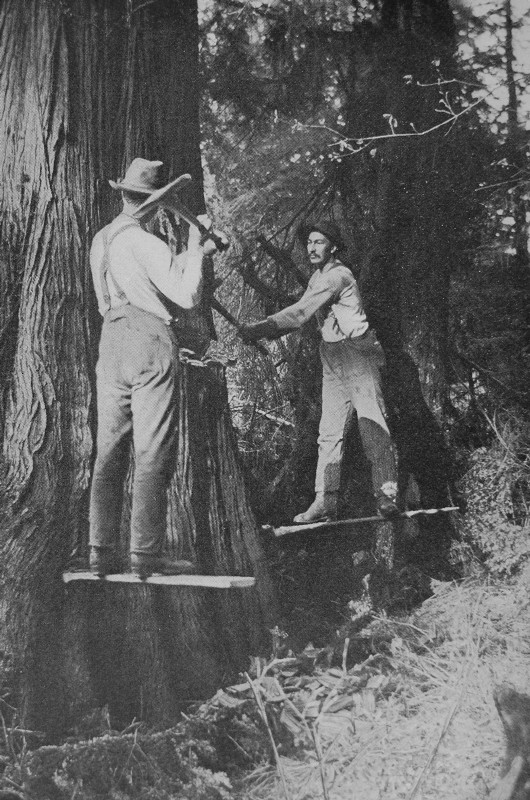 Starting to fell a giant cedar
When preparing to fell a tree each of the two choppers makes a notch on opposite sides of the trunk about three feet from the ground and inserts a short board that has on the end a sharp upturned edge of iron. The iron catches, and the board projects horizontally. On these supports the choppers stand, and they perhaps will cut other notches and insert boards and go up a stage or two higher. The task of severing the trunk is begun by making an undercut which will bring the tree down in a particular direction, and then they finish from the other side with a long saw. The trees sometimes have a diameter of a dozen feet. The cedars, in particular, reach a vast girth, and in the valley by the roadside was one with a circumference at the ground of sixty-three feet, and near by was another that had a gothic arch cut through it affording easy passage for a person on horseback. But the tallest trees are the firs. Two hundred feet is a very moderate height and some shoot up to above three hundred. The fall of one of the monsters, when the woodsmen have cut through its base, is something appalling. As the tree begins to give, the sawyers hustle down from their perch and seek a safe distance. Then they look upward along the giant column and listen. “She’s workin’ all the time,” says one. “Yes,” agrees the other, “you can hear her talkin’;” and he gives a loud cry of “Timber!” to warn any fellow-laborers who may be in the neighborhood. The creaking and snapping increase, and the tree swings slowly at first, but soon with tremendous rapidity and crashes down through the forest to the earth. There is a flying of bark and broken branches and the air is filled with slow-settling dust. The men climb on the prostrate giant and walk along the broad pathway of the trunk to see how it lies. What pigmies They seem amid the mighty trees around! The ancient and lofty forest could well look down on them and despise their short-lived insignificance; yet their persistence and ingenuity are irresistible, and the woodland is doomed. To the rear of those who do the felling are the buckers. They work singly and cut off the limbs and saw the trunks into lengths. They climb about in a chaos of wreckage, sometimes well up in the air, sometimes down on the ground out of sight. “When I hailed from the East out here,” said one worker, “and They put me to bucking, I thought that was a pretty lonesome job. It didn’t seem like a hull lot o’ fun for One man to start with a long wiggling saw cutting off a log seven or eight feet through. But that’s all right now I’ve got used to it.” Perhaps the best paid wilderness worker is the hook tender who attaches the donkey engine cable to the logs. His is a dangerous task and he is paid four dollars or more a day. The head fallers get three and a half, the second fallers three and a quarter, and the swampers who delve about clearing a path for the railroad receive two and a half. Every man comes to camp with his own blankets, and he pays five dollars a week for board. “There’s quite a rakeoff in that,” one man in the valley, who had himself been a chopper, explained to me; “but they have the best of food and a first-class cook. It would do your heart good to eat with ‘em. I’ve stopped at many a hotel, but never had food served yet that would come up to what they have in the logging camps. The lumbermen won’t stay no time at all unless they are well fed.” The buildings at the camp I visited in the woods had roofs and sides of a single thickness of unplaned boards. In the men’s home quarters were bunks in a double tier along the walls — mere boxes with a continuous seat down below along the front. Each man fixed up some shelves to suit himself around the inside of the bunk for containing his belongings, and on the floor underneath were thrown the surplus boots and other articles not especially valued. Every projection and cross piece was hung full of duds. In the middle of the room stood a stout stove and a long table. This building was home to the men the year through, for They continue cutting in winter and summer alike. Their chief recreation is to go to town on Saturday nights. As the man I have already quoted explained, “They’ve got mony, and they just blow it in. That there is the logger style of it. If they saved instead of spending they’d all be rich. There’s no places of amusement in the town. They can go to the library and sit down or go to a hotel and sit down, but that don’t suit ‘em. No, they either get drunk or go to church. Some take in both. I’ve seen ‘em at church pretty well loaded. “Now, I want to tell you, my friend, they wear good clothes when they go to town. Say! you’d take ‘em more for clerks and professional men than loggers. Of course some don’t give a cent how they dress, but that’s not usual. “Saturday nights ‘bout ‘leven or twelve o’clock you hear ‘em returnin’ along the road. Mostly they hire a rig and ride to the camp, eight or ten fellers to a team. Oh, they’re sporty! There’s nothing too good for the logger. Take ‘em as a whole they’re the best class of men I ever run up against. They’re all nationalities, some Americans, some Canadians and a good many Scandinavians. Yes, they’re pretty darn well mixed. The loggers are generous and always take up a collection if someone is hurt in the woods. That don’t happen often considerin’ the danger, but when a man does get it he gets it proper.” The region I was visiting was in many respects ideal farming country with its rich soil, near markets and facilities for transportation. The crops of potatoes and other vegetables and cereals are wonderful, and great quantities are produced of strawberries, raspberries and blackberries of the finest quality. However, as one local dweller said, “You can’t get anywhere but that there’s something wrong with the country, I don’t care where it is. It’s damp here, and that’s bad for the rheumatism; but the main thing I don’t like is that the land sells for more than it’s worth. Cleared farm land within three or four miles of the town goes at from a hundred to two hundred dollars an acre, and that’s too much.” I noticed in a circular sent out to advertise the region it was stated specifically that they have no mosquitoes and no thunderstorms. Like most circulars for Eastern readers sent from the Pacific Coast this describes a paradise which does not exist. They have both mosquitoes and thunderstorms in the Puget Sound country, though in most seasons and in most sections these are quite mild. “But the thunderstorms we had last summer,” said one informant, “was heavy and no mistake. They seemed to skip us right here though, and the ground got awful dry. I’d see a storm comin’ up black as tar, and it would make me boiling mad to watch it swing off over the hills where it wa’n’t needed and leave us as dry as ever.” Land that I called cleared seemed almost nonexistent. By keeping a sharp lookout I did now and then observe a clean field, but nearly all the farms were very much encumbered with stumps and brush. There are stumps even when the land is cultivated, black and massive, dotting the fields like gravestone memorials to the dead forest. Often stumps were standing in the dooryards close about the homes, some of them nearly as tall as the buildings. “I tell you what I seen,” a native remarked to me. “In my pasture there’s a hollow stump so big that sometimes five or six cattle will get into it as a sort of shelter. By gol! that sounds like a fish story, but it ain’t. “There’s so many stumps and snags and such a lot of brush in this country I sometimes think God Almighty never intended it to be cleared at all. In starting the work the first thing is the brush-cutting — slashing, we call it. The brush is left piled up in windrows, and when it’s dry you burn it; but it don’t burn clean and the fire leaves a lot of stub ends besides all the charred logs and other large pieces, so you are in a nice job. You can be just as black as you want to be in the picking up.” 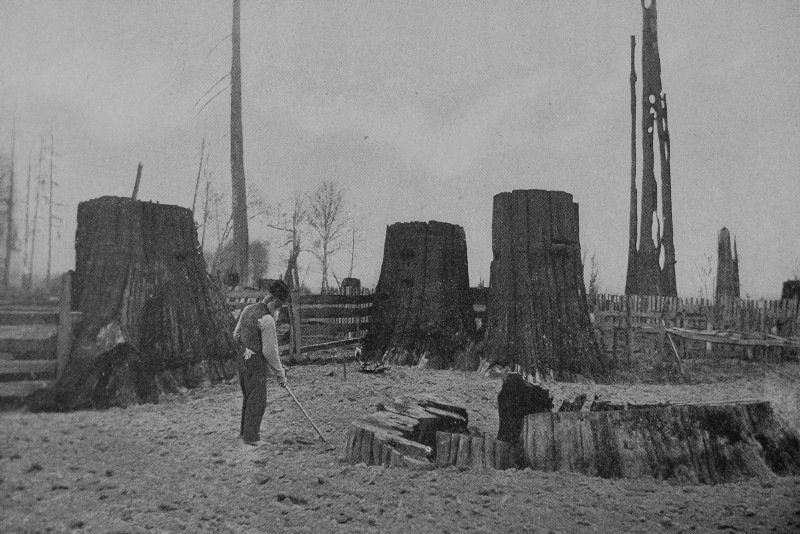 The stumps are the most serious part of the problem. The effort to obliterate a really big one by burning and hacking and digging may continue for years. To put a charge of powder or dynamite underneath is the quickest way. That breaks it up and loosens it. Then, by hitching horses on to the fragments, the great root fangs can be jerked forth from the ground, but there will still be an enormous hole to fill. The entire expense of clearing the land of both brush and stumps will average about seventy-five dollars an acre. I asked a man in the town if the farmers were prosperous. “Sure thing!” he replied. “They’re well fixed, and lots of ‘em have mony in the bank.” But those black spectral stumps lingered in my mind, and I could not dispel the feeling that the farmers were wrestling with the wilderness, and that their prosperity was of the future rather than of the present. Besides, their buildings were small and often poor, and I said so to the town man. “Well,” he responded, “in the East when a man has made mony, the first thing he does is to improve his surroundings so he can take some pride in ‘em; but here they don’t seem to care much about that. They’re content to live in shacks, and there ain’t much to their barns except a roof which is just good enough to turn water off.” One day I was caught by a light shower, and stopped at a wayside home. A woman and some ragged children came to the door and I was ushered into the best room. It was a battered, barren apartment with board walls and ceiling. The most notable articles of furniture were a stove, a sewing machine, and a sofa with an old quilt on it. The walls were adorned with three enlarged portraits staring out of heavy, dingy frames. The woman exhumed some photographs for my entertainment, wiping them one by one with her apron as she passed them to me. They were much the worse for wear. “This one is of a logging crew,” she explained; “and this here is of the last graduating class from the high school; and that there is of two of my nieces in Seattle. I been washing today,” she added with a sigh, “and I’m completely done out.” The shower was soon over. In a near field the man of the house was zigzagging around among the black stumps with a pair of old horses ploughing. He did not stop for the rain. When I started on I went through the field and spoke with him. He seemed to be in no hurry and he let his horses stand while he went and sat down on a pile of rubbish that he had cleared off the land and thrown in a great windrow to serve as a fence. Then he got out his jackknife and began whittling. “I landed here twenty years ago,” said he, “and I swore I wouldn’t stay if they was to give me the hull country, but now I’m content with a very little of it, and there never was better land anywhere than this right here. It can’t be discounted. The region was at first all covered with heavy woods. The river and the cricks was the thoroughfares, and there was swarms of Indians camped up and down ‘em. Timber wa’n’t worth what it is at present, and there’s been more spoilt here than a little. We’d pick out the finest trees, cut ‘em down, take the best part of each log and leave the rest. We didn’t use to look at hemlock at all. “The cutting-off of the country has made quite a difference in the weather. We’ve had a terrible fine winter and spring so far this year. But we used to have mist day after day. We called it Oregon mist — missed Oregon and hit here. It was thick enough to cut into chunks; yet you might be out in it all day and hardly get wet through. My gracious! the mist was so bad in July and August it was almost impossible to cure our hay. Late years, instead of mist we have rain, and then it comes off clear. “This is a great country for fish. Heavens and earth! when I come here we didn’t think much of salmon — They was too common. We appreciate them now. At this season they are a little scarce and you have to pay as much for ‘em in our town as in any old place; but, later, in the salmon run you can buy a ten or twelve pounder for fifteen cents. “There’s one thing I’m glad of — They say we ain’t in the earthquake zone, and yet I’m not sure about that. Back here in the woods is a bluff that’s full of petrified clams and other things which was once in the sea. How did that bluff get where it is unless it was hove there sometime? Earthquake zone be darned! You can’t tell me we ain’t in it when I’ve seen them petrified clams in that high bluff. 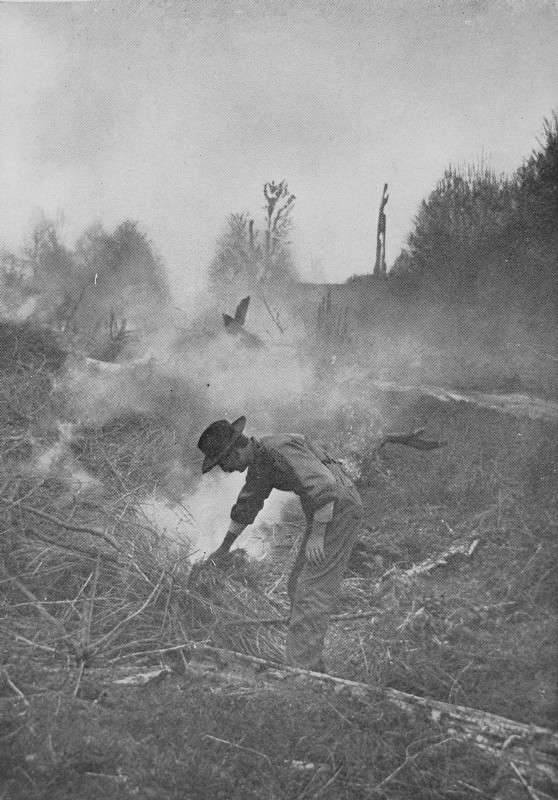 Burning brush
“I’ve got some first-class land, but I could show you other land in this region that’s as poor as this is good. I’ve had a chance to sample some of it myself. Once I bought thirty-five acres on the upland, and I had a blamed nice little farmhouse there and as fine a well of water as ever was outdoors. In the spring I started my crops, and everything looked as green and nice as it does here, but there was hardpan close below the surface, and in June my crops just pinched right off and died. The next winter a man come along and looked at the place thinkin’ of buyin’. We agreed on the price, and I was all in a tremble till I got the mony for fear he’d back out. He gave me eight hundred and fifty dollars and I bought down here. I can raise more on one acre of this land than he can on his hull place. “A good deal of the high ground is all right, and to hear the land agents talk you might think it was as good as this in the valley. You don’t get a fair idea from them. It takes this bottom land nearly all the time to do what they say land up there will do. My farm here gets along pretty well without fertilizer year after year, by rotating. On high ground, though, you’re obliged to enrich the soil if you want decent crops. “Not long ago a party of homeseekers come to our town from Minnesota, and they was met at the station by a lot of land-sharks who showed ‘em around. On the borders of the town I noticed one of the sharks pointing out a farm field and sayin’ to a visitor, ‘ Why, man alive! if you was to pay five hundred dollars an acre for that you’d double your mony in two years.’ “‘What’d I raise?’ says the homeseeker. “‘You could do it with potatoes,’ says the shark. ‘Our land’ll produce twenty tons to the acre.’ “Well, it wa’n’t my business to chip in, but I couldn’t help remarkin’, ‘Say, I can’t hit that. If you’ve got any such land to sell I’d like to buy it.’ “Hops have been a great crop here, but raisin” ‘em is just like gambling. The price goes up and down so uncertain that perhaps they’ll make you rich, and perhaps they’ll make you poor. There’s one valley I know of went into hops, and all but two men in that valley have lost their ranches. It was the same way with tobacco when I lived back in Wisconsin. At first we made big mony and thought we’d discovered a gold mine. Everybody went into it heavy, and pretty soon the price dropped way down out of sight. It was a pity, by gracious! You had the tobacco on your hands, and you couldn’t eat the stuff. All you could do was to chew it and spit it out, or smoke it; and my old dad was put right to the wall. “But then there’s things right here that don’t turn out any better. Two years ago I tried the poultry racket. I thought I’d go into the business in a large way and make some mony. So I bought an incubator and paid seventy-two dollars for it and set four hundred eggs. I got twenty-five chickens. Then I tried another four hundred eggs and got thirty chickens. That was enough for me and I put the incubator away. My hens do good work hatching, but in a few days after a hen brings off a brood, the weasels, skunks and rats get busy and you won’t find a confounded thing around the place only dead chickens. “I was some afraid when I settled here that the river would carry off all my land. The banks used to wash badly, but since the trees have been cut off the channel ain’t changed so much. You see a tall tree partly undermined by water would get weaving in the wind and loosen up a lot of soil that would wash away in no time then. You notice how high up off the ground my house is perched. That’s on account of floods. One November the water covered the second doorstep, but the flood is a great help to us fellers. It fertilizes the land. I thought it would ruin my potatoes that November. I had ‘em all in a pit with a tent-shaped roof over ‘em banked up with turf. When the flood was at its highest the top of the pit stuck out of the water like a muskrat’s house. I spoke to the neighbors, and they said, ‘The water’ll seep right off. Leave your potatoes alone. Don’t monkey with ‘em, and they’ll be all right.’ Well, it didn’t hurt ‘em a dog-gone bit, and I never lost a potato except some in the ground that wa’n’t dug. Those was just as mushy as if they’d been frozen. “In 1896 we had what we called the big he freshet. That there surpassed anything the old-timers had ever seen, and on the low grounds steamers ran all around out over the fences and rescued the people. It wa’n’t very nice to be tangled up with a flood like that. A good many buildings was carried down the stream and it got away with a terrible lot of stock. I’ve seen a pig floating along on a log in that flood just as calm and nice as if he’d been a frog, and it was a comical sight. There’s a queer animal — Mr. Piggy. You take one that’s in danger of drowning into a canoe, and it’ll lay just as quiet as can be. But as soon as you are near enough to the shore so it thinks it can spring to land, then look out for yourself. They say a pig don’t know anything, but they wouldn’t say so if they’d come as near getting a ducking as I have in the way I speak of.” Every dweller who had been for any length of time in the region had a similar fund of picturesque impressions and experiences. There were clouds mingled with the sunshine; yet I think no one who visits the Puget Sound country can fail to believe that there is before it a great future. The Sound itself makes a waterway marvelous in extent and navigable for the largest ships. The climate is peculiarly attractive. It does not entirely lack vigor, yet the cold is never extreme, and there is plentiful moisture. The streams flow throughout the year, and the supply of water for drinking is abundant and pure. Many great towns are growing up along the shore and they have back of them much land of wonderful fertility. Already a network of steam and electric roads have been built that reminds one of the populous sections of the East. As one man remarked, “You can start from here and go anywhere in the world — in any direction, and by land or water.” NOTE. — The Puget Sound country appeals to the traveller with exceptional force. The Sound itself is a magnificent waterway with its shore line of eighteen hundred miles; and the larger bordering towns are remarkably vigorous and modern and promising, while the tributary streams and fertile soil and fine forests prophesy a future of unusual prosperity and the maintenance of a very large population. The first white settlement dates back to 1828. Wars with the Indians retarded immigration, but in 1858 the discovery of gold at Frazer’s River brought an influx of 15,000 persons, many of whom became permanent settlers. Nevertheless, the census of 1870 reported a population of only 24,000. The two largest towns on Puget Sound are Seattle and Tacoma. The former, which was named after an Indian chief, was founded in 1852. The higher parts of the city command splendid views of the Olympic Mountains. These mountains are well worth visiting, for the scenery is notably striking, and there are magnificent forests and many glaciers. Tacoma had only 760 inhabitants in 1880. Many good roads lead to the “natural parks” that begin 6 miles south of the city. The parks are carpeted with flowers and contain numerous lakes. The nearest of the big snow-capped peaks of the Cascade Range is Mt. Ranier, 54,363 feet high. To visit it take the train to Wilkeson, 32 miles, and then go on by a bridle-path, 25 miles, to the base of the mountain. Like the other isolated peaks Of the range, Mt. Ranier is an extinct volcano. Two craters at the summit still give off heat and sulphurous fumes. |
 Click the book image to turn
to the next Chapter.
Click the book image to turn
to the next Chapter.