 Web
and Book design,
Web
and Book design, Copyright, Kellscraft Studio 1999-2006 (Return to Web Text-ures) |
Click
Here to return to Highways and Byways of California Content Page Return to the Previous Chapter |
 (HOME) |
| IX
A NEVADA TOWN WITH A PAST THE International Hotel where I stopped was a big six-story building, imposing in size and in many of its appointments, but all gone to seed. It had been a very grand affair when it was erected. Its broad stairways, its heavy woodwork, its great windows with their lace curtains, its black walnut bedsteads and marble-topped bureaus, upholstered chairs and Brussels carpets all had an air of antique luxury. Time was when an apartment cost from two to five dollars a night. Now the prices are fifty cents and one dollar, and everything is battered and worn, and the whole building is almost ghostly in its loneliness, so few are the travellers who stop at the once busy hostelry. A Chinaman is the landlord, and he goes himself to meet the trains and carry his patrons’ hand luggage up the steep hill to his hotel. The Palace, the Occidental and the other fine hotels have fared even worse than this one, and the streets are lined with buildings that in their day were genuinely impressive and probably as fine as any west of the Rockies. Virginia City is indeed a strange town — a living skeleton. In the height of its opulence it boasted a population of thirty thousand. Today there are less than one tenth that many, and dilapidation and ruin are seen on every hand. The chief streets terrace along a great hillside. Farther up the slope are wastes of sagebrush growing in stunted clumps a foot or two high and half hiding the earth with their gray twigs and foliage. Down below is a valley where the mines have dumped vast heaps of waste. The entire region is a wild upheaval of hills, and around the horizon are seen ranges of snowy-topped mountains. Once in a while a gnarled scrub pine or dwarf cedar occurs, but only a few feet high. Formerly scrub pines of fair size were plentiful on the hills; but they were practically all used for firewood long years ago. After they were gone some Chinamen ran a woodyard and sold pine roots. Probably one hundred and fifty donkeys were engaged in toiling about the uplands and bringing in the stumps and roots of the old scrub pines. This material, too, was exhausted presently, and now the fuel comes by train. If you look attentively you discover a little grass growing in the sagebrush. It gets a foothold about the roots of the brush and now and then starts a clump by itself. This is bunch-grass. The cattle relish it and they nose about after it where you would at first glance think they could find nothing more palatable than the bitter sage. As the season advances thousands of sheep roam over the country, though the grass is always too scanty to make the landscape green. In the town are a few poplar trees, and occasionally there are fruit trees in the gardens. But gardens are scarce and small. There is lack of soil and lack of moisture. The streets are rough and dirty, and as I walked about I was constantly encountering old tin cans and getting my feet tangled up in wires from the baled hay. On the main street in the busier portion is an almost continuous roofing over the broad sidewalks, and this serves the stores instead of awnings. The walks themselves are of plank that evidently date back into the town’s ancient history. The knots and spikes protrude and the rest is deep hollowed by the passing of countless feet. Often streaks of sagebrush grow alongside the gutters, and these tenacious shrubs establish themselves wherever else in the village there are spaces untrodden and uncared for. Buildings in good repair are rarities. Those out of plumb are common, and some lean against one another for support, or are braced by long timbers. There are tottering fences and ragged walls and broken roofs and smashed glass, and many windows and doors are boarded up. As I was rambling through the sagebrush below a house on the outskirts an old German came out and spoke to me. He was very friendly, and he became doubly so when he learned that I was from New England. “Dot New England haf caused me thirty-four years of trouble,” said he with a humorous twinkle in his eyes. “It vas dere I got mine wife. I suppose you people back East are thinkin’ we haf der world by der tail out here. I’m glad of dot. You used not to think we vas much. But the West haf been makin’ some progress dese late years. I think, though, all of us here are, you might say, impregnated with minerals, and we want to get rich too fast. It would be better not to grab so much for ourself. Yes, although bein’ of a fiery political nature, I want everyone to haf an equal share.” I resumed my walk and a little later stopped to chat with a small boy who was on horseback racing around a yard. He had an array of bottles and cans full of water set on a wall, and he would pick one up, canter to some other part of the enclosure and deposit it on a post. He said he was playing grocer and was delivering goods. I asked for directions to Gold Hill, and he slid off his horse and went along to show me the way. His name was Chester; “But the boys have got a nickname on me,” he confided, “and call me Figs. My father works in a mine, but on Sundays he goes prospecting.” The search for gold has resulted in tearing the country all to pieces. Everywhere the hills are dotted with prospectors’ holes. From any height you can see dozens — perhaps hundreds. They suggest the burrowing of woodchucks or prairie dogs. There is always quite a heap of dirt and broken rock on the downhill side. The region along the Comstock Lode abounds too in deserted shafts. Usually the spots where had been the buildings, and the machinery for working the abandoned mines, are now only marked by immense dumps of waste with possibly a few great foundation stones and irons. The shafts may be filled up, or they may be partially open. Figs pointed to one of these holes and said a boy pushed him into it and he had slipped and crawled in the darkness a long way. He thought he was lost and he cried; but at last he saw daylight ahead and he crept out at the bottom of the hill. Figs had a mania for throwing stones. He tossed them down vacant shafts and heaved them at cows, roosters, water-puddles and anything else that happened to catch his eye. He evidently did not find life dull. “On Saturday,” said he, “seven of us kids are goin’ to the reservoir pond to have a swim. We’ll like that — you betcher! There’s ducks on the pond, and a feller that lives near it shoots ‘em and lets us have ‘em three for a quarter. We’ll bring some home and have ‘em for dinner the next day.” 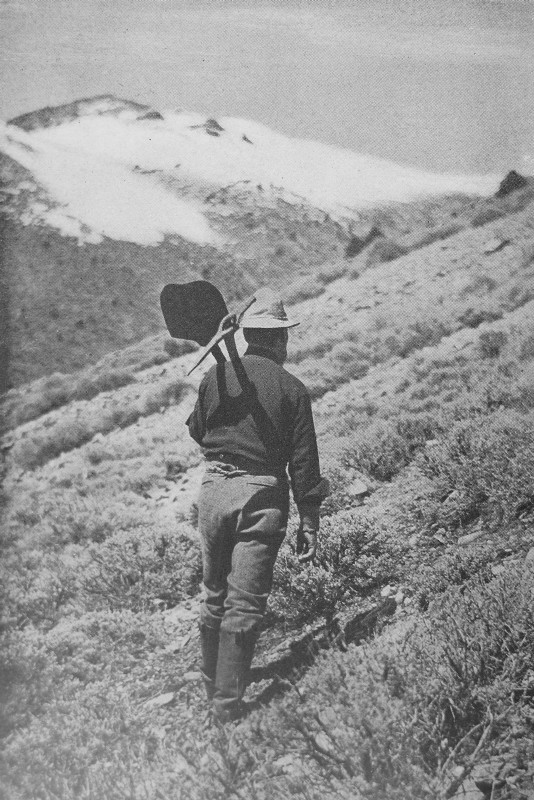 A prospector
The village of Gold Hill, two miles from Virginia City, is deader, if anything, than its neighbor. There is the same dilapidation and wreckage, and the same canting walls and neglect of repairs. Figs called my attention to the church steeple, and said, “That’s goin’ to fall pretty soon. It rocks like a cradle every time the wind blows hard.” On the outskirts of the hamlet I met a Scotchman who affirmed that his cabin was the oldest dwelling in the region. It was built in 1867. The main part contained a single room, but there was a leanto at the rear and .a little cave ran back under the hill. The owner invited me in to rest myself and offered me a cup of whiskey, or, if I preferred, he would make me a cup of tea, coffee or chocolate. When we entered, a gray cat departed through a missing window-pane. The man said the cat was his pardner; “And I don’t want any other,” he affirmed. “If you have a man living with you he is too apt to smoke and drink and read too much and not attend to the cabin business. I been spendin’ a year or two in the new gold region at Tonopah. I had to get away from there on account of my health. It’s a desert country with not enough sagebrush growin’ to shelter a jack-rabbit, and the water is bad — full of borax, soda and alkali. The Tonopah people been dyin’ like sheep. Some of ‘em, when they begin to feel sick go to Carson and boil a little of the alkali out of their systems in the hot springs that are there. But I come here, and the first thing I knew I was in bed with the pleurisy. I had it in good shape, and pretty near died. The doctor said the cabin needed ventilation and he ordered that window-pane broke.” The cabin was very neat in spite of its small size. It was on the warm side of the hill and so was comfortable in winter, while the cavern annex was “as cool as an ice house” in the hottest days of summer. In fact, I judged that its occupant considered it an ideal residence. He was a prospector, and there had been times when he had made so much money he didn’t know what to do with it. Nevertheless he had lost it “twice as fast as he made it.” That evening, at Virginia City, I dropped in at the office of the paper on which Mark Twain began his literary career as a reporter. There was no one behind the counter in the little front room, and I went on into the type-setting department — a high, grimy room with type-cases along the sides, and walls bedizened with big theatre posters. I was made welcome, and I sat down by a stove in the middle of the apartment. Two or three men were busy at the type, and their friends strolled in from time to time to look on, or chat, or warm themselves. Among the rest was one of the early settlers of the region, and I had a long talk with him. He looked as if he had shared the fate of the town. His overcoat was greasy and faded, and he hobbled in aided by a cane, and his ragged beard was streaked with tobacco juice. I asked him how the town appeared when he first saw it. After lifting the cover of the stove and spitting into the opening, he replied, “I come here in April, 1861, and I found just twenty-nine houses. The most important was a small wooden hotel where you paid a dollar a night and furnished your own blankets and slept on the floor. You had to pay a dollar, too, for a meal and it was no better than you get here now for twenty-five cents. What I counted as houses were none of them anything but shanties. Some of the people were living in tents, and some had run back a little drift under a hill and stretched over the hollow a green hide for a roof. The edges of the hide were made fast by laying on rocks. To shut in the front for the night you hung up a blanket. These dugouts were common for years. “Ore was discovered in this region about three miles below by the Grosch brothers in 1858. It was a heavy black sulphite and in order to find out its value they started over the mountains for San Francisco to have some of it assayed. But the cold and the snow were too much for them, and one died on the way and the other died afterward from the exposure. The ore proved to be very rich in silver, and some nephews of theirs went back to where it was found. Other prospectors poked around the neighborhood, too, and in I859 two fellers named Mullins and Riley was lookin’ at the croppings above here on this hill and discovered some heavy sort of rock they didn’t understand. Comstock was still farther up the hill, and he see they’d found something, and he come and looked at it. He knew the ore was valuable and he bluffed ‘em into givin’ him a third right in the discovery. They staked out claims and that was the beginning of work here at the Comstock Lode. The really productive part of the lode is only about a mile long, and in thickness it varies from three or four feet to over a hundred. How deep it goes no one can say, but it doesn’t pinch out as most lodes do after going down a short distance. “At first there was no very great excitement, but by ‘61 people begun to come in pretty rapid on foot, on horseback, and in teams. That next winter was a terrible hard one. The snow was so drifted wagons couldn’t get in with supplies, and wood was fifty dollars a cord and hay a hundred and fifty dollars a ton, and everything else equally expensive. But in the spring we had plenty once more. Until the railroad was built in I869 our supplies come on ten and twelve-mule teams, and there got to be five lines of six-horse stages running into town. The railroad was a great job; for it wound around the mountains, and over the hills, and through tunnels and all that; but with the wealth there was here they’d have built a railroad up a tree if necessary. 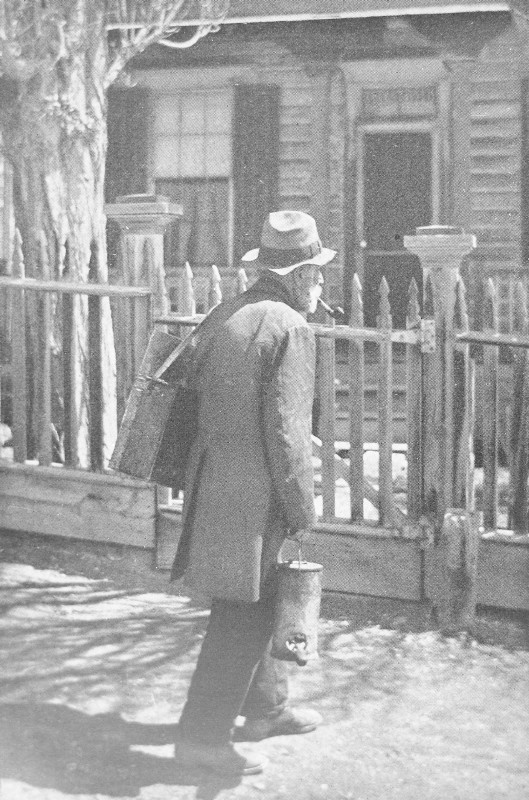 The tinker
“People come faster than ever when the railroad was done and we had here the biggest mining camp the world ever saw. However, it wasn’t the prospectors who staked out the early claims who made the big fortunes. They sold out and traded off and started again. I knew Comstock well. He was a man of some education, big-hearted and good-natured — a man who would never do wrong to anyone except himself. Another person very much like Comstock was ‘Old Virginia,’ as we called him, the man this town was named after. I’ve seen those two lying on the floor under the influence of liquor and the twenty dollar gold pieces rolling out of their pockets. “In those days everybody had money. I used to make five hundred dollars a month myself. Part of it I earned as leader of a brass band. There were four of us, and we got twenty dollars apiece to play at a ball, five dollars apiece at a serenade, and ten dollars each at a funeral. The brass band was always at the funerals. We played a funeral march on the way to the cemetery, a dirge at the grave, and a quickstep comin’ back. “One of the first times I ever saw Mark Twain was at a ball where I was playing. He’d got a little stepladder for a seat, and he kept joggling me as he moved it around to get a better sight of the people. So I finally up with my cornet and blew a blast in his ear. He left the hall then, and the next day he tried to get even by giving me a good hot write-up in his newspaper. But we met afterward, and he treated me to a drink and things were all right. That was the only time I ever saw the color of his money, though I suppose he’s drank one hundred and fifty dollars worth of whiskey at my expense. What he did with the salary he earned I can’t imagine. I never knew him to gamble nor buy mining property. He had plenty of chances to make his fortune, but he was afraid to invest five cents. “Most of us were pretty easy in money matters. If we made a lucky strike we laid off to enjoy ourselves. A man might be rich today and dead broke tomorrow. You probably have met men about town since you’ve been here who are fortunate now to earn a living, but who have been worth a great many thousands of dollars. Comstock died poor. He went to Montana where he wound up by putting a six-shooter to his ear, after having returned to his tent disappointed in a prospecting tour. There’s thousands and thousands of prospectors’ holes dug that never reveal any sign of good ore, and there’s lots of mines that are worth nothing except to sell to Eastern investors. The chance of outsiders making anything in western mines is pretty slim. If a mine is a profitable property we prefer to own it ourselves, and if we sell stock in such a mine it’s usual to dig out some of the best ore to show and boom the price till we’ve disposed of what stock there is for sale. Then we work some poor portion of the mine so the outsiders think it is worthless and sell back their stock at almost nothing. Afterward we get at the richer parts again and make money for ourselves. I suppose it’s likely, if you were to figure up the capital invested which fails to be profitable, and the unrewarded labor and the other expenses, it has cost more to find and get the gold and silver in this Western country than the metals mined have been worth. “But the possibilities are alluring. To show the chances — I knew two fellows from Indiana who rode in here on horseback one morning, staked out claims, and in the afternoon sold out on the street for three thousand dollars apiece. That was more money than they’d ever seen where they came from. They thought they was rich, and they left for home. Another fellow traded an old plug of a horse for an interest in a mine and sold out a little later for four hundred thousand dollars. Then there was Sandy Bowers. He got hold of a claim a few feet wide, and there was a woman had a small claim joining his. They got married, and pretty soon it was found their claims covered a little mountain of gold. It was in the hollow above the village of Gold Hill, and that was what gave the place its name. The gold was taken out and Sandy sold his interest, and was immensely rich. In order to enjoy his wealth he built himself a mansion about twenty miles from here over in the Washoe Valley — country where it is about as bare of everything but sagebrush as it is around Virginia City, and he became known as the ‘Sagebrush Croesus.’ He spared no expense in putting up his house, and it was of cut stone and cost half a million. The door-knobs and hinges were of solid silver, and there was everything else to match. Most of the furniture he imported from Europe because there wasn’t any fine enough to be had on this side of the Atlantic. They had a ten thousand dollar library, though neither Sandy nor his wife could read or write; but the bindings looked well. They bought an expensive piano, though they knew no more about music than a pig does. Of course they had to have what they called statuary, even if it was made of plaster-of-Paris. Whoever sold them the stuff didn’t lose anything. When they opened up their house they had a big feast and invited all their friends, and the oysters that was served were from Philadelphia and cost a dollar and a half apiece. “For a time they lived in grand style, as nearly as they could copy it; but they speculated in stocks and lost all they had. Sandy died, and was so poor at the time he hadn’t the money to buy a single silver hinge of his fine mansion. His wife became a fortune-teller in San Francisco, and was called ‘the Washoe Seeress.’ “It’s astonishing, the wealth that’s been taken from this little strip of rough country here. One shaft alone has yielded two hundred and seventy millions. The men that got the bulk of the money from that hole were what we speak of as ‘The Big Four’ — Flood and O’Brien and Fair and Mackey. The first two were saloonkeepers in San Francisco, and the others worked up here at the mines. They just happened to invest in the right thing, and they hung on. Why, I remember when Mackey was getting three dollars and a half a day while I was getting four. “Very little of the fortunes that have been made in the Comstock have been spent in the state of Nevada. The millionaires prefer to live in San Francisco or New York or Europe. Nevada furnishes the money, but is left poor. However, for the first few years this town was full of wealth. There was gamblers here that had two or three hundred thousand at a time, and if a church was to be built, or other public work to be done they were the heaviest contributors. They made their money easier than anybody else, and they gave more freely. But money doesn’t stay with a gambler. If he lives long enough he ends in poverty. “For some years there was considerable lawlessness, and the fellow who could draw his pistol first was the best man. But, as a whole, this was a good place to live in then — always lots goin’ on and the streets so crowded nights you could hardly get along. Everything was prosperous and promising when in October, 1875, about five o’clock one morning a gentleman threw a lighted lamp at a woman he had some difference with and unluckily missed his aim and set the house on fire. A gale was blowing and that fire swept right through the town and burned all the business section and three-fourths of the homes, and the churches and millions of feet of heavy timber to be used in bracing the walls of the mines when the ore was taken out. The people in the burned district had about all they wanted to do to escape with what they had on, and very little was saved. For a while no sort of adequate shelter could be had for most of the homeless, and many families would just stretch blankets over the sagebrush and crawl under. We went to work at once to rebuild, and forty-five trains a day came in from Carson bringing grub and supplies. But the city was never the same afterward. The buildings were thrown up in a hurry, and they don’t stand the test of time. Pretty soon the town began to dwindle down, and a good many of the mines were abandoned. As they got deeper they became more difficult to work, and there was serious trouble with hot water in them, and, besides, the price of silver had dropped. A few mines are still in operation and are adding to their owners’ wealth, and there is some prospect that things may be brighter in the future; but Virginia City will never again be what it was.” 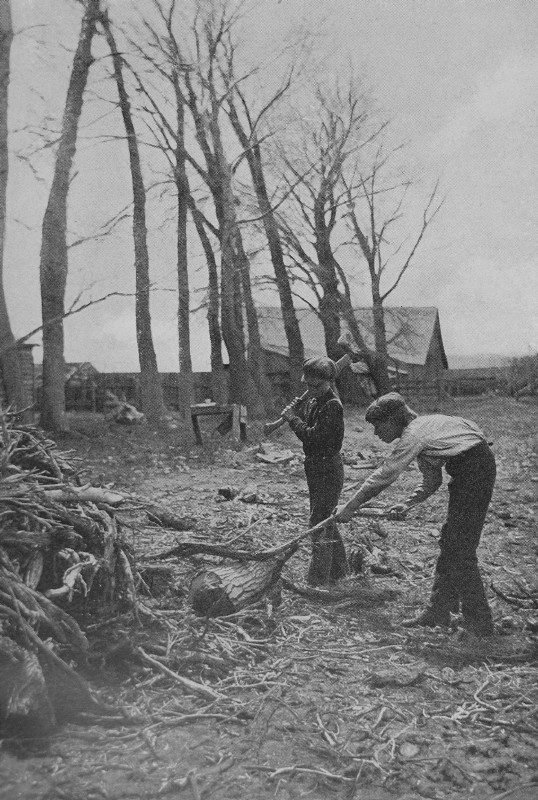 Making firewood of the sagebrush
When I left the old mining camp I went to Carson, the capital of the state. The place is on the level floor of a wide valley and looks like a country village. There is some moisture here and with the help of irrigation the place is an oasis amid the almost interminable barrens of sagebrush round about. The inhabitants number somewhat over two thousand, and there is a long main street of small stores, hotels and saloons, back of which are other streets lined with residences, mostly a story or a story and a half high; but the houses have fruit trees and green grass about them, and the streets are lined with Lombardy poplars which guard the public ways like arboreal sentinels standing in martial array, shoulder to shoulder. Everyone talked mines and ore, and of fortunes made and lost. Such talk was especially rife at the time of my visit because there were reports of a great discovery twenty-five miles distant, where two brothers by the name of Ramsey had been prospecting for over a year. We understood that they had found some wonderful ledges which assayed as much as twelve thousand dollars a ton. With the first rumors men from all the region around started for the new El Dorado. It was even said that one of the railroad trains had been deserted by its crew who stampeded to the gold fields. The spot was a canyon off in the desert, and whoever went had to carry supplies for himself and horses. Teams were in great demand and every sort of a vehicle was pressed into use to convey prospectors and their outfits to the land of promise. A two-horse rig could not be had for less than eight dollars a day. Two old prospectors who went out from Carson told me of their experiences. They started in the afternoon driving a span hitched to a buggy. They had only a general idea of the direction, but travelled on through the sagebrush till dark when they camped. At daybreak they were on the road again, and now they had plenty of company. Other rigs and bunches of horsemen and men on foot were constantly in sight trailing along the valleys and over the hills, all in a rush to reach the gold region in time to pick up some choice location. When they got to the camp they found it consisted of a half dozen tents and about twenty wagons. They lost no time in asking about the ore which was half gold; but they failed to get any very exact information. The Ramseys had nothing to say, and of all the men who were tramping the hills and posting location notices, not one had seen a pound of pay ore of any description. It was known however that the Ramsey brothers had staked seventy-four claims. Some fellows of wide experience said the region resembled Tonopah, Goldfield, and all other mining camps they had ever visited. But one man said it looked like hell with the fire out. The two prospectors tramped about forty miles that day without discovering anything promising. Toward evening they returned to their outfit and camped in a gulch near a tiny rivulet, built a fire of sagebrush, made coffee and were happy. For company they had about three hundred other gold-seekers and the narrow gulch was crowded full. A saloon man had arrived in the afternoon with several cases of whiskey, and the bottles had been promptly bought at his own price. The whiskey increased the hilarity, and some of the lads around the evening camp fires celebrated by firing off their pistols into the air. Finally everybody retired to rest and quiet reigned; but about midnight a number of the horses got loose and there was chasing around barefoot to catch them. At dawn the camp began to bestir itself, and the two old prospectors were careful to secure an early supply of water from the rivulet. They were none too soon; for each man as he awoke would go and scrub and dip water and lead his horses to drink, and conditions in the brook soom became very bad. That was the only available source of supply, and the flavor of soapsuds and mud did not improve it for coffee. Our prospectors did not see much to be gained by staying longer, and they staked out a couple of claims at random and returned to town. If the excitement proved well founded they still had a chance for wealth. If it did not, they would be at no further expense. Lacking new developments the camp was sure to dwindle very rapidly. Thus far, in its three days of notoriety, probably five thousand dollars had been spent by the prospectors who rushed to the canyon, while not five cents worth of ore had been brought away. Round about Carson, at intervals in the valleys, were groups of ranch buildings, usually sheltered by a little grove of cottonwoods. The cottonwoods were to some degree a source of fuel supply and were every few years cut back and allowed to grow out again. However, most of the wood that was burned seemed to be the sagebrush. It looked like poor stuff, but I was assured it made a hot fire. The stems were sometimes as large as one’s arm, though soon dividing into a brush of twigs, and the bushes were seldom over three or four feet high. If the farmers went back into the mountains they could get scrub pine; but they would do this only to sell it in the town where it was worth nine dollars a cord. In both Virginia City and Carson, Indians were frequently seen on the streets; but they seldom appeared to have any very definite business there. It was as if they had come to dream amid a civilization they could not comprehend. Sometimes several would sit in the sunshine on the curbing and stay purposeless a long time, or a dozen or more might gather in a waste lot, some sitting, some lying down, some standing waiting in a seemingly vacant-minded way till the inclination came to go elsewhere. The men’s garments were modern, and so were the women’s gowns; but the feminine portion of the race, both old and young, delighted in gay shawls, and in bright colored kerchiefs which they wore over their heads. The women were fat and stumpy and moved along with an awkward waddle. Sometimes one would have a papoose on her back, strapped to a board that had a hood-like projection above, from beneath which the little one looked out, silent and watchful.  A deserted wigwam
On the outskirts of Carson amid the sagebrush I happened on a little Indian village of a half dozen families. I approached one of the houses — a low, rude shanty, and suddenly a dog made a rush and grabbed me by the leg. I kicked, and a small Indian boy came and drove the cur around the house with a switch. Near the dwelling was an open-sided shed just large enough to shelter the wagon which was underneath. Every Indian family in the region aspired to own a wagon. They usually bought one second-hand at a cost of from fifteen to twenty-five dollars, and they took better care of it than of any of their other belongings. A wagon shed is perhaps exceptional, but they at least cover it from the sun and rain with sacking. Except for the shanty I have mentioned, the habitations of the village were wigwams — conical frameworks of sticks covered with canvas. The cabin had a floor and a stove; but in the wigwams the fire was made in the center on the ground, and the smoke escaped through a hole in the peak. Of course, a good deal of smoke lingers inside, and as a result the older Indians, especially the squaws, are apt to be blind. Not far from each dwelling was a half circle made by heaping up sagebrush in a thick hedge. This served as a wind break, and within its shelter the squaws like to sit and weave their baskets and do other work. A half mile distant was a deserted camp, and for many rods about, the earth was strewn with boards and sticks, broken crockery, tin cans, bottles, pieces of carpeting, pots, pails and baskets and broken tools, and there were shoes galore, the ruins of a mattress and various articles of clothing. One or two of the wigwams were nearly complete. A man who lived in the vicinity told me that the camp had been abandoned on account of the death of a squaw. “You see,” said he, “they think that the squaw’s spirit will be comin’ back and kickin’ things over, and they always move every time anyone dies. They’ll even leave a good wooden house. Often they go only a short distance, but they wouldn’t stay in the same place. It seems to be their idea that the spirit will only harbor around within a few feet or rods of the hut where the person died. “The Indians are queer in a good many ways. They don’t like to have their photographs taken, and if a person comes near their homes with a camera they will go into the hut and shut the door, and they won’t poke their heads out till the photographer goes away. Their notion is that the person who gets their picture has power to make them do whatever he pleases. They believe he could cause their death, if he chose to. There’s a man in Carson got a picture of a papoose, and the child died. He da’sn’t let the Indians know he has that picture. The squaw mother would kill him. “They used to think that the white man’s medicine would be fatal to ‘em; and they still depend to some extent on their own superstitious methods of healing. A young squaw here lately had the pneumonia. My wife went and see her and said she was pretty badly off. But the medicine man come and give her some boiled herbs, and the Indians was there from miles around. They stayed all night and had a devil of a powwow, crying and hollering to keep the squaw’s soul from takin’ flight, and I’ll be darned if she didn’t get well. “When a white man lies down to sleep he always covers his feet and keeps his head out; but, do you know, an Indian does just the opposite. He covers his head every time. If he has only a small piece of blanket his head will be wound up in it, even if all the rest of his body is exposed.” I mentioned to the man my experience with the Indian dog, and he remarked, “Well, there’s no serious harm done. None of the dogs out here ever have hydrophobia. We don’t know what hydrophobia is. Why, one of our women was East once, and she was walking on a town street when she heard a great racket, and a man shouted to her there was a mad dog comin’. ‘What’s he mad about?’ she says. “The Indians use acorns for food a good deal. They lay in a store of them in the fall, and every few days they shell some and hammer the kernels on a flat rock into a kind of meal. Then they make a low, level-topped heap of dirt, two feet across with a rim around the edge, lay over it a piece of cheese cloth and on that put the acorn meal and stick a little bunch of cedar up in the middle. Meanwhile they’ve got some water boiling and they pour it on. It takes the bitterness out of the nuts, and the cedar gives the meal a flavor that they like. That done they boil the meal for a time and then dip out the dough, a big spoonful at a time, and drop it into a dish of hot grease. They gave my wife one of these acorn doughnuts, but I couldn’t get up the appetite to taste it myself. “The women help in the town at housework. They’re not very steady and come and go as they please. The men do better. If you pay them regularly and don’t scold them they’re pretty faithful. But they won’t contract to stay with you, and if the notion takes them to go off a week fishing, they go. The amount they’ll do in a day compares very favorably with what any other class of laborers would accomplish. By gosh! when they work, they work, and I doubt, for instance, if there’s many white men can hook out potatoes as fast as they do. “They always camp where sagebrush is plenty, but they don’t seem to care how far they have to pack water. The Indians earn considerable money, and the young fellows all wear good clothes. Most of the men like to gamble, but they do it principally among themselves, and as a rule they put what they earn to good use. However, they are wasteful in not takin’ care of what they have. Furniture and household goods of all sorts they leave around wherever it happens to suit them, and the things get rained on, or dried up with the sun or spoiled in some other manner and then are thrown away. They are more particular to protect their wagons than anything else — at least while the red paint lasts. That is because it is not easy to accumulate the cash to replace one. The wagons are chiefly useful in going back into the hills after pine-nuts and acorns.” The Indians bring large quantities of the pine-nuts to market, and the nuts are eaten around nearly every fireside in the region where they grow. The seeds are about a half inch long and a quarter inch in diameter, and the shells are thin so that they can easily be crushed in the fingers. In taste the kernels are sweet and pleasing, and not only does the human race enjoy them, but they are devoured by dogs, horses and birds. The trees are the most important food trees in the Sierras and they supply the ranches with much of their fuel and fence posts. They seldom grow more than fifteen or twenty feet high, and they have no inclination to symmetry, but throw out crooked and divergent branches. The trunk of a full-grown tree is about a foot through. They occur scatteringly in bushy patches from the margin of the sage plains to an elevation of about eight thousand feet. No slope is too rough and none too dry for the nut pine, and it is the predominant tree over a vast territory. Tens of thousands of acres are found in continuous belts. Seen from a distance the trees darken the land where they grow, yet a closer view shows that they never form crowded groves, cast little shade, and their forest has none of the damp leafy glens and hollows so characteristic of other pine woods. When the brown nutritious seeds are ripe the Indian women who have been out at service among the settlers washing and drudging, assemble at the family huts, and so do the men who have been working on the ranches. Then they make ready the long beating poles, and such bags and baskets as they can procure and all start gleefully for the nut lands. As soon as they get into the vicinity of the trees they select a spot where water and grass are found and camp. That done the children run up the ridges to the forest, and the men laden with poles, and the women with baskets, follow. The beating begins and the cones fly in all directions among the rocks and sagebrush. Once in a while a man will climb a tree and cut off the more fruitful branches with a hatchet. The squaws gather the cones and build fires by which they roast them until the scales open sufficiently to allow the seeds to be shaken out. The nut gatherers get much bedraggled with the soft resin of the pines, but this does not trouble them in the least. In the evening, assembled about their camp fires, all chattering and feasting on the nuts, they are especially happy. Here was a bit of life truly idyllic, and it seemed to me nothing in the feverish delving for fortunes in the earth was half so charming. NOTE. — To Eastern eyes, the Nevada country, as soon as you get away from the wooded mountains, is desolate in the extreme; but its very desolation is one of the things that makes it interesting by way of contrast. Virginia City and Gold Hill, however, have a magic past that makes them quite fascinating entirely independent of their surroundings. Then there is Carson — which is a real curiosity, it is such a half-wild and tiny hamlet for a state capital. These places are not far aside from one of the main routes across the continent and well repay a visit. For those who have time it is to be recommended that they keep on southerly to the new mining regions in the Goldfield and Tonopah country. Here is life in the rough and men with the bark on, and much is to be seen of humanity and nature in this district that is a revelation to the average traveller. Easier of access, and with another sort of attraction is Lake Tahoe on the dividing line between Nevada and California. It is only a fifteen-mile ride on a narrow-gauge road from Truckee on the main line. At the end of this ride you find the best of hotel accommodations, and a wilderness lake some twenty miles long and twelve broad surrounded by forests and snow-capped mountains. The lake is more than six thousand feet above the sea level, and is marvelously deep and crystal clear. There are many lesser lakes in the vicinity and foaming cascades, and good hunting and fishing. The region is at its best in the late summer and autumn. One can judge of the virtues of the lake from the fact that Mark Twain, who spent some time on its shores, says, “Three months of camp life on Lake Tahoe would restore an Egyptian mummy to his pristine vigor and give him an appetite like an alligator.” Captain Dick, an eccentric old English sailor, chose this wild mountain retreat for his home, built a cabin, and chiseled out a tomb in the solid rock on a lonely rock-bound island. But he fell out of his boat, while intoxicated, and the lake, which is said never to yield up its dead, became his last resting-place. Automobiles have done good service in the Nevada deserts, and are used in many places on regular stage routes. There is a motor route across the state from Utah into California, and branches from this in several directions. On the more important routes there is nothing to seriously trouble a traveller in good weather, but sometimes washouts are encountered, and the going is rough where alkali is found. Lake Tahoe can be visited by motorists either from the north by way of the quaint mountain town of Truckee, or the journey can be made from Carson City around the south and east side of the lake. Nebraska is known as the “Sagebrush State,” and in general I suppose it merits the name, but when one reaches the vicinity of the famous divorce town of Reno the wildness of the country disappears, and the landscape is distinctly pastoral and agricultural. |
 Click the book image to turn
to the next Chapter.
Click the book image to turn
to the next Chapter.