 Web
and Book design,
Web
and Book design, Copyright, Kellscraft Studio 1999-2006 (Return to Web Text-ures) |
Click
Here to return to Highways and Byways of California Content Page Return to the Previous Chapter |
 (HOME) |
| III
A RUSTIC VILLAGE NOT for a long time had I been in a place that so filled me with delight as did Capistrano in Southern California. Such a dreamy, easygoing community — no hurry, no worry — such a luxuriant valley, such lofty environing hills with the green turf clothing every rounded outline! Then, to the north, were the rocky peaks of a mountain range, serene and blue in the distance. The village itself was a queer huddle of primitive houses, some no more than board shanties, and none of them large or in the least pretentious. However, the feature that gave especial distinction to the hamlet was the ruin of an old Mission, still impressive, calm and beautiful, and appealing powerfully to the imagination. It would interest one anywhere, and we can boast of so few ruins that have age and noble proportions in this new land of ours that the appeal was doubly strong. Though the Mission buildings are much shattered, some parts continue in use even to this day. The chime of four bells performs its accustomed service, one portion is used as a church, and there is a fine corridor in an excellent state of preservation. 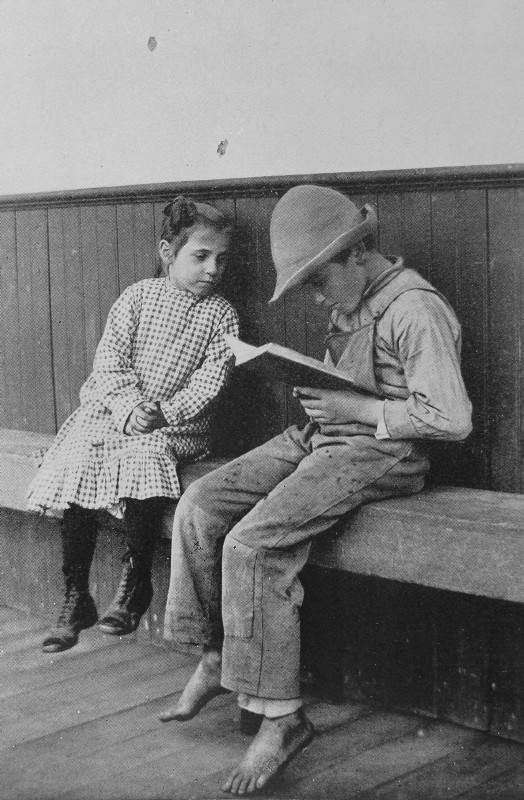 The story book
The structures were begun in 1776. Adobe was largely used for the walls, but the church was of stone with a lofty tower and a roof made of solid concrete domes. At early mass on Christmas morning in 1812 there was an earthquake that toppled over the tower onto the body of the building, and the entire roof crashed down. Forty-nine people were killed. “We’ve had no earthquake worth mentioning since,” one of the leading Americans of the vicinity informed me. “Of course there have been a good many tremors, but they have been mere sardines compared with that shock of 1812, and we pay no more attention to them than we would to a spatter of rain.” The village was charmingly pastoral. The insects thrummed, the children laughed and called at their play, the roosters crowed in endless succession, the dogs barked, and the cattle lowed from the luscious hillslopes. And what throngs of birds there were! I saw them flitting everywhere and the air was a-thrill with their songs. The mocking-birds were lilting their varied notes, the turtle-doves sounded their mellow calls, and in the vicinity of the buildings were multitudes of linnets — pretty little birds and cheerful songsters, but very destructive to grapes, apricots, peaches, pears and berries. In the pastures the red-winged blackbirds abounded, hovering about the sheep and cattle. Often they could be seen on the sheep’s backs picking off ticks. Meadow larks were frequently within sight and hearing, but their song was decidedly coarser and less plaintive than in the East. I observed many gay little birds known as “canaries,” and there were flickers and pewees and bee-martins and thrashers and numerous others. Of them all I perhaps most enjoyed the swallows. A few had been noticed flying about for a week or two; but the mass of them had come the evening before I arrived. Now they were darting everywhere, building under the eaves of the houses and barns and establishing a populous colony beneath the loftiest cornice of the old Mission ruin. Far up against the blue sky I would sometimes see the buzzards soaring. Nothing in the way of offal escapes their alert eyes or scent. Back in the hills, if a man killed a gopher or a rattlesnake or some such little creature, there might not be a buzzard in sight at the time, but the next day half a dozen would be around. On the noon that I reached Capistrano the main street was full of teams tied to the wayside hitching rails, and yet the place seemed mysteriously devoid of human beings. At last I discovered the male inhabitants of the region gathered at the far end of the street in and about an adobe Justice Court. The wide doorway was jammed full of men peering over each others’ shoulders, and the case was evidently of the most absorbing and vital interest. At length, however, the gathering broke up, the village became populous, and one after another the teams were unhitched and driven away. The excitement, it seemed, concerned two individuals, one of whom had said the other was a liar, and the latter had responded that the former was a son of a gun and likened him to a variety of similar obnoxious things. But the court failed to get together a jury and the judge had dismissed the case. As a clerk in a local store expressed it, “The two fellers remind me of my schooldays when one of us kids’d sometimes go and complain to the teacher saying, ‘ Jimmy’s been a-callin’ me names.’ 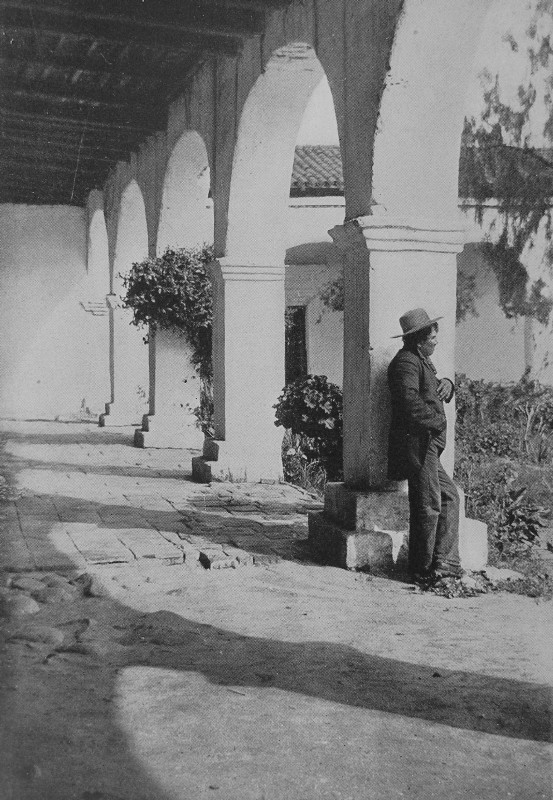 Among the arches of the old Mission “‘What’s he been callin’ you?’ she asks him. “‘I don’t like to tell you,’ the boy says, ‘It’s awful bad things.’” While I was in this store a fat old Indian entered. He had short hair, wore overalls, and except for his color was not much different in dress and appearance from a white workingman. His breath was odorous of liquor, and he was loquacious and happy. The clerk introduced him as the best sheep-shearer in the county. He shook hands and said, “Me good man! You good man?” In talking with him it was not easy to catch the meaning of some of his remarks. The common patois of the region used by both the whites and the darker skinned folk is based on Spanish, but with an intermixture of Indian and of words borrowed from the English. The old sheep-shearer had about fifty other Indians working under him in the season, got five dollars a day himself and two dollars for his wife who did the cooking for the gang. The wealth he acquired did not stick to him. He gambled it away. Gambling was a common recreation among the villagers, and the place supported four “blind pigs,” or unlicensed saloons. There were always loafers hanging about their porches and a noisy crowd inside playing pool. One of the Capistrano experts at poker was a Chinaman who had a ranch just outside the village. He lived in a dirty little hut there and kept his horse under a pepper tree with only the shelter afforded by the leafage. For ten miles around the people depended on him to supply them with vegetables. Some of the poorest families in the village bought of him, rather than take the trouble to raise their own vegetables, though they have the finest kind of land right at their doors. “He can’t hardly speak three words of English,” I was told; “but he’ll sit down and play poker all right with any of us. Perhaps he’ll lose fifty dollars or more in a single sitting and not go home till the small hours of the morning; and yet he’ll be at his work that day as usual without batting an eye. No doubt, on the whole, he makes oftener than he loses.” One of my acquaintances was a short, stooping old German with a broken nose. He lived in an adobe house with walls two or three feet thick. “You keep der adobe dry,” said he, “und it vill last forever; but der vather from der eaves spatters oop and vashes avay der bottom till it breaks down unless you be careful. Some puts on cement to make der valls look nice and last more long. We do not build adobe houses now. It is quicker to use boards, and you cannot keep them so clean as a board house, and the air is not so goot inside. Some of der adobe houses are one hundred years old already, I tink. I haf not lif here always. My business is a bee ranch, twelve miles back in der hills. My home vas out dere till der dry years make me move. If you git no rain dere be no flowers — no not’ing. Perhaps der bees can find enough to keep alive, bud dere is no vork you can do to help. Der vather give out and everyt’ing, and you might as yell come avay. Last year it vas goot — all right, and I t’ink dis year be good. So I soon shall haf to go dere. Dem hills are chock full o’ flowers now — oh, yes — like a flower garden. I haf not been dere since last August. In another month the bees begin to swarm, and I haf to get ready for dot. You haf to be on der vatch or der swarms go avay. It ish not often dey vill go into another hive demselves. Dey come out and hang on a bush while der scouts are lookin’ for a goot place. Maybe a place is found and dey be off in one half hour. Maybe dey hang on der bush two, three day or a veek. “Many time we haf bees fly over dis town. Perhaps dey stop and someone catch and put dem in an old box, and dey make honey. Bud der honey ish not much goot. Der flowers down here are not like dose on der hills. Here der country soon be yellow mit wild mustard, and dat make der honey a bitter taste and catch in your throat, just like as if you eat too much pepper. You couldn’t sell it. Sometimes a swarm vill get in a house. It vill go in a crack, and perhaps der bees vill make honey in der ceiling, and it vill begin to leak through. Den der people haf to tear a hole and drive der bees out. “Der honey in der hills is white as vather. Der bees haf hundreds of kind of flowers dere, but der best is der sagebrush. I wear a veil when I handle der bees and gloves mitout fingers. You cannot tell ven der bees vill sting — some days not at all, and other days dey joost like bulldogs. Dey sting yen dey feels like it, according to der veather. “Each hive of bees vill make from one hundred to five hundred pounds of honey in a goot season, and I get about thirty tons from my two hundred stands. Der bees fill der frames each season half a dozen times. We extract der honey by puttin’ der frames in a machine dat whirls dem and throws der honey out, bud leaves der comb to be put back in der hives. Dis vay der bees are save much york, and dey get twice der honey dey used to did. In July already you can do not’ing any more. Der best flowers are past and things are getting dry and der bees can only make what dey need dem-selves.” We were sitting on the post office piazza, and here we were joined just then by a man who was a former resident of the village and had recently arrived for a visit. He accosted my companion and they were soon discussing incidents of the past. Among other things they mentioned cock fights, and the German said, “Eighteen or nineteen years ago dey use to haf a cock fight mos’ every Sunday, but I didn’t see him now for a long time.” When the newcomer moved on, the German happened to turn his eyes toward home and remarked, “I haf now to go to my house. Dere is a peacock from my neighbor dot I can see on der roof. Sometime it vill stay dere all der night and holler; so I vill drive it off.” The peacock belonged on a place that formerly was the home of Don Foster, the feudal lord of the region. He had hundreds of thousands of acres, and sheep and cattle unnumbered, and he set a generous table free to all comers. Indeed, two or three dozen of the villagers were constantly fed at his board and he really supported “the whole shooting match;” for they did practically no work. The most exciting period in the village history was that immediately following the acquisition of California by the Americans. To quote a leading citizen, “There was then a band of sixty or seventy disgruntled Mexicans known as ‘Manillas’ who were a terror to all the region. They had a leader by the name of Basquez who was credited with all sorts of savagery and wild escapades. He delighted to come unexpectedly when a dance was in progress and join in the merry-making and cut the fandango. Then, again, he would dash into a village with all his troop and commence firing. At once there’d be a yell, Basquez is in town!’ and you’d ought to see the people hide. “The Manillas sailed in here one day and captured the town, all except Don Foster’s house. There’s one old man living in Capistrano now who at the time of that raid had a store here. When they broke into his place he crawled under a big basket among some rags and rubbish in a corner. He heard the Mexicans helping themselves to his firearms and nice things, but he kept quiet and as soon as it was night he escaped to Don Foster’s. After about a week the Manillas got news that the sheriff was comin’ with a posse from Los Angeles to punish them, and they went and bushwhacked him and killed all but one man. The sheriff made a brave fight, and as he lay dying he kept firing his pistol at the fellows as long as he could hold it. “In a short time another and bigger posse was gathered. Then the Mexicans scattered, but within a few months they’d nearly all been hunted down. When one was caught there were no legal proceedings. He was just hung to a sycamore tree, or stood up against an adobe wall and shot. Last of all they waylaid Basquez and shot him all to pieces. “This was a much bigger place years ago. In 1870 there were nearly two thousand inhabitants. Now there are less than four hundred. But in those days they were practically all Mexicans and Indians, and they didn’t work any more than was necessary to exist. A few watermelons and a sack or two of beans will suffice a Mexican family for a year. They live from hand to mouth, and are content to half starve rather than exert themselves. Why, an energetic American will raise a crop of walnuts and clear in a single season four or five thousand dollars, which is more than a Mexican would clear in four or five thousand years. “Most of the Indians have drifted off to the reservations to get the benefit of Uncle Sam’s coddling. We’ve managed to pauperize nearly the whole race. If someone else will support them they quit doing anything for themselves and are just loafers. As for the Mexicans they were never reconciled to the change of government, and when there come a mining excitement down in their home country many of them went there and never returned. In spite of the decrease of numbers we really get more out of the land than ever before. Nevertheless there’s plenty of laziness still. Work is plenty and men can earn a dollar and a half a day; but if they take a job they soon are tired or get too much money and lay off. A Mexican with five dollars will spend it like a lord. He is very apt to get drunk on Saturday night, and you never know whether he will be back to his work Monday morning or not. Some families are so shiftless we are obliged to support ‘em. The county allows such from five to ten dollars a month. But they don’t consider themselves indigents. They are, rather, indignants. We have no paupers. They call themselves ‘pensioners’ and think it an honor to get public aid.” English walnut growing had chief place among the local industries, and there were a number of extensive groves. The trees spread out like apple trees, but have a smooth light-gray bark. In the walnut harvest-time the school closes for six weeks to give the children a chance to help gather the crop. Some of the nuts fall of themselves, but a large proportion are thrashed off with poles. Often the poles have a hook on the end and by their aid the branches are shaken. The ground is free from weeds and has been gone over with a smoother so that the picking up is easy. A sack is the usual receptacle, but the women use their aprons. The nuts are spread on big racks to dry, where they are stirred once in a while with a garden rake. In two days of clear warm weather they are ready to ship. There were a number of the great slatted drying benches in a yard back of my hotel. A few nuts were still left on the frames, and I often loitered there and feasted. If I chose I could supplement the nuts with oranges picked from trees in the garden. The hotel was an old-time stage-route tavern — a big, long two-story building with a piazza and balcony on both front and rear. I had to go upstairs outside and walk along the balcony to get to my room, which was a rather bare and shabby apartment, with a bed that had two boxes under it to prop up the slats. “We had a heavy-weight sleeping in your bed last night,” explained the landlord, “and he broke through.” Behind the hotel were all sorts of whitewashed barns and sheds and shacks, including a kitchen and dining-room which were under a roof by themselves. Suspended from a full-foliaged pepper tree was a framework box covered with fly-netting. This served for a refrigerator. Among the various lodgers at the hotel when I arrived were three men who were driving a couple of wagons to San Diego. They had been stopping four days on account of rains that had flooded the rivers. There were no bridges, and the quicksands at the fords were treacherous. That evening one of the men came into the office and sat down on the counter. The landlord entered soon after, and he too roosted on the counter. “What was that noise I heard as I passed through the yard?” asked the traveller. “It was in your barn, and, by gee! I thought it was snoring.” “That’s what it was,” replied the landlord. “It was my old black horse. Fie can snore to beat the band. He lies down flat with his head stretched out on the ground, and at it he goes. You punch him to wake him up, and he grunts just like a person that’s dead tired. He’s the darndest horse I ever see.” “Well,” said the traveller, “my father used to have a pair of horses that was great hands for sugar. When we got ‘em out to go anywhere they wouldn’t start unless we give ‘em each a lump of sugar. Without that you couldn’t get ‘em to budge — not to save your neck from the rope. Those horses was a cute pair. One time some of us young fellers took ‘em and drove to the beach for a picnic. We left ‘em on a hill not far from the shore tied to the wagon, one on each side. Then we went down to the sea and fooled around and had a swim, and by the time we clumb back up the hill we was hungry as wolves. We’d left our lunch in the back end of the wagon. It was in a handle basket that had a lid flopping up from either way; and, sir, those horses had got the covers up, one workin’ on this side, one on that, and eaten every blessed thing, pie and all. My, wa’n’t we mad! We made ‘em pay for their grub though by running ‘em home, seven miles in thirty minutes.” “You’ve decided to leave tomorrow, have you?” said the landlord. “Yes,” answered the other, “and I’d have gone before if we hadn’t been drivin’ mules. A horse with a load stuck in a quicksand will try its best to struggle out; but a mule will just lie down, and as soon as a mule’s ears get full of water there’s no saving him. He’ll drown in spite of all you can do.” In response to some questions of mine the landlord became reminiscent. “My people come here in 1870,” said he, “about fifteen years before the railroad was built, and papa bought the store which is now the hotel office. Capistrano was on the main route north and south, but there was no place in town where travellers could stay. They used to bother papa asking for accommodations, and finally he built on to the old store and made this big two-story hotel, and by golly, in those days it was jammed all the time. The stable was full too, and we kept a regular hostler. From the stable alone we took in nearly a thousand dollars a month. The daily stages, one going south, one going north, met here at midnight, and we always had hot coffee ready for persons that wanted it. You’ve noticed how the village people go and hang around the depot to see the trains come in. Well, they used to gather at our hotel just as thick to see those midnight stages arrive. The building of the railroad made a great sensation in the town. When the first engine poked her nose in sight a good many of the people fled to their homes and buried themselves under the bed-clothes. It was weeks before some of ‘em would come out of their rooms, and there’s those here today that you could no more get on a train than you could get them to fly. If they have to go to Santa Ana, twenty-five miles away, they’ll squat in the back end of a lumber wagon and jolt along that fashion rather than trust themselves to the train. 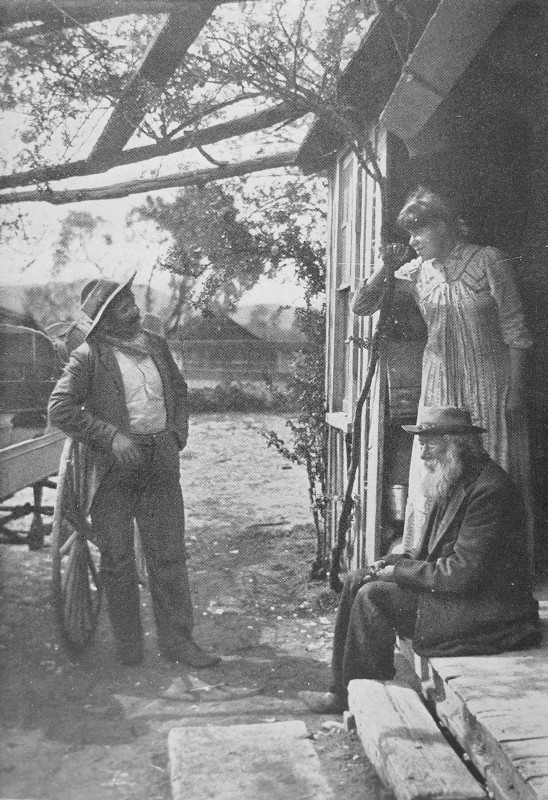 An Indian family
“This was a rough town in the old days. Behind the counter in our store we had a pistol every few feet to be ready for emergencies. We ran a bar in connection with the store, and one day an Indian come in and wanted liquor. He was drunk already, and I told him he couldn’t have any more. That didn’t suit him and he drew a knife on me. I picked up a pistol and gave him a welt with the butt that laid him flat on his back. Then I took him by the heels and dragged him out into the street. I thought he was dead, but pretty soon he drew up first one foot and then the other. After that he tried to sit up, but he’d roll over back on the ground. At last, however, he made out to crawl away. “Papa had almost the same experience with a Mexican. The fellow stooped down and took from his bootleg a knife eighteen inches long and sharpened on both edges. But while he was stooping papa got a couple of pistols and poked ‘em into his face as he looked up and said, ‘You give me that knife or I’ll blow the top of your head off.’ “‘Boss, don’t shoot,’ the fellow said, and he laid down the knife. “I’m goin’ to take that knife up to Los Angeles,’ papa told him, ‘and leave it and your name with the sheriff, and the next time you don’t behave they’ll come down here and kill you.’ “The Mexican was scared. ‘Don’t do that, boss,’ he begged. ‘You give me back my knife, and I’ll work for you as long as you want.’ “So finally papa give him the knife, and after that the Mexican was his best friend. There was nothing the fellow wouldn’t do for him. “You ought to be here the last day of Lent — Judas Day, we call it. The night before, it is customary for the Mexicans to ransack the village and steal buggies and tools and anything they can carry off, and they make a big pile of all this plunder just outside the fence in front of the old Mission. Then they take a worn-out suit of clothes and stuff it full of weeds and stick it up on top of the pile, and that is Judas. Next they get an old dress and stuff that full of weeds and set it up side of Judas to represent his wife. In the morning when we wake up we find all the vehicles and loose things that were around our yards stacked up over by the Mission, with those two scarecrow figures on top. But the best of the performance comes in the afternoon when the Mexicans bring to the village two half-wild bulls from the hills. They tie Judas to one, and Judas’s wife to the other and chase the creatures up and down the street till the two figures are torn to tatters. “There was one Judas Day a tramp come to town, and he stopped at the store and bought a couple of dozen eggs. As he was goin’ out of the door carryin’ the eggs in a bucket papa says to him, ‘They’re just turnin’ the bulls loose out there, and you’d better wait a while.’ “But he said he was in a hurry and he wouldn’t stop. We watched him, and about the time he got in the middle of the street one of the bulls come tearin’ along and hits him in the seat of the pants. He went one way and his eggs went another, and that would have been the end of him if the vaqueros hadn’t galloped to his rescue. He was mad and he went to Judge Bacon’s office and said, ‘I want to have these fellows out here arrested. They’ve been lettin’ wild and vicious animals loose in the street and I’ve been knocked down, and two dozen eggs I’d just bought are all smashed.’ “‘Well,’ the Judge said, I don’t like to arrest these men. This is an annual celebration, and the men themselves didn’t do the damage. If anyone is to be arrested it ought to be the bull.’ “I don’t care who or what it is you arrest,’ the tramp said; ‘I want justice done.’ “Don’t bother me any longer,’ the Judge said, and he pulled out a dollar. Here, take this and go buy some more eggs,’ said he. “So the fellow left satisfied.” The traveller sitting beside the landlord now got down off the counter and stretched himself. “Who was the man that was here to dinner and went away just afterward on the train?” he inquired. “It was a doctor,” the landlord replied. “He had some thought of settling here; but I told him he’d starve to death. You see the people avoid callin’ a doctor till the sick person has one foot in the grave and the other following after. The old women think they can cure most anyone with herbs and weeds, and they keep dosing the sick person till he’s nearly dead. Then if the doctor can pull him through things are all right; but if the doctor has his patient die on him they’ll never pay for his services. “Whenever there’s a death, whether it is day or night, the first thing that is done is to make a run for the Mission to toll the bells. They toll the two big ones for a grown person and the two little ones for a child. The bells toll for ten minutes, and all the friends and relatives start for the house of mourning — get up out of their beds to go, if it is night. The corpse is dressed in what had been the deceased’s best clothes and is put on a table, and candles are lighted and set about on the table, and outside on the porch. When all this has been done the company kneel and sing a hymn. Each new arrival who comes later kneels by the body and says a prayer, and some of the women are praying pretty constantly. A crowd is hanging around all the time till after the funeral. “On the day of the death, or the one following, some of the men go up to the cemetery to dig the grave; but they have a big demijohn of wine with them, and they’re sure to quit when they’ve got down about three feet. The next night there is a wake and a feast. It is the fashion to cat, drink and be merry and fight. If the night is cool the men and boys build a fire outside which they gather around. By three or four in the morning they are ready to scrap. They are full of their cheap wine then, and it don’t require much to stir their anger. “The morning after the wake, at ten o’clock, the bell begins to toll for the funeral and the grave-diggers hustle off to finish their work. An hour later the funeral takes place. The coffin is usually an ordinary box made in the village and covered with black cloth for an adult, white for a child. On the cloth are fastened many flowers, and crosses and other figures made out of tissue and gold papers. The coffin is carried on men’s shoulders to the church where the people sing a hymn and then go to the grave bearing the coffin in relays. At the cemetery they sing again, and recite a prayer. Lastly the body is lowered into the grave and every man, woman and child tosses in a handful of dirt.” For twenty-five dollars a family can have a priest conduct the funeral, and while he goes through the sacred rites, the coffin reposes on a table in the church. For fifty dollars a more elaborate service can be had, and the coffin rests on two tables, one placed on the other, while for seventy-five dollars the coffin has three tables beneath and the priest puts on his full robes, swings the censer, brings forth the silver candlesticks and makes the ceremony superlatively impressive. Weddings take place at the church at high noon, and the rest of the day and the night till broad daylight is spent in feasting and dancing and in eating a barbecued beef. A christening is also an occasion for “a big blowout.” It takes place on Sunday, of course, and outside of the Mission in the churchyard is a crowd of men and boys who, as soon as the christening party comes forth, begin to shout and fire pistols and guns, and they follow the party home banging away as they go. An Eastern girl, not long before, had told me something of her experience as a school teacher in San Diego County. She was twenty miles back from the railroad among the hills. The people were Americans, but they were shiftless and ignorant, and the women and children did most of the work. The man at the place where she boarded was a fair sample of what the other men were. He did not drink or smoke and was in no wise vicious, but he didn’t amount to anything. The woman and her children looked after the garden, took care of the cows, raised the chickens, harvested the crops, and brought the house water from a spring a half mile distant. The older girls, when they came from school, would put on overalls and milk the cows. Often the children were dismissed from school to run the mowing-machine and get in the oats and barley which were raised for hay. The woman would even go and dig greasewood roots which they cut up for household fuel. Sometimes she would get ready a load of the roots, and the man would take the load to the nearest town to sell. He occasionally did a little ploughing, but he would exert himself most in hunting wild bees that had made their homes in the hollow oaks. There was no feminine timidity in that region. The girls were ready to kill rattlesnakes as often as they encountered them and all the women could shoot. Every few days the teacher’s landlady went out with her gun and would return with five or six rabbits. The children were all apt to be at school regularly; but this was because short attendance would mean a curtailing of the school money. The parents, however, were not at all particular to have their progeny there on time, or to have them stay the sessions out. Still, they preferred a clean record, and in order that the children should not be marked tardy they requested the teacher to turn the clock back an hour or so in the morning. Their previous teacher had done this, they said. The pupils were very docile and patient. They seemed not to have life enough to be mischievous, and they could be kept on the same lesson for two weeks and never utter a complaint. Indeed, they would study it just as faithfully at the end of that period as at the beginning. This glimpse of educational conditions stimulated a desire to visit the school at Capistrano. I found about seventy-five children in two rooms, the little ones under a young woman, the upper grades under a young man. They were an odd mixture, whites and Mexicans and Indians, and various combinations of the races. The dark-skinned children are as a whole lazy and unreliable. They would as soon tell an untruth as not, if it will be accepted. As one man said, “They are like a Chinaman — if he steals and is found out, his act is a sin. Otherwise, he esteems his dishonesty a virtue.” Many of the children have only a vague understanding of English, and this makes their progress in school doubly slow. The building and its surroundings and the two teachers were all that could be desired. A generation ago the place had no school, but one day a New England resident of the village stumbled on the fact that they could get money from the state for educational purposes. This man was the local Justice of the Peace, and known as Judge Bacon. “The people here didn’t want to learn anything,” said one of the early settlers in telling me the story, “and if a school of the usual sort had been established they wouldn’t have attended. They’d heard of such a thing as a public school, but they didn’t really know what it was. Why, these billy-goats had the idea it was a sort of institution to make Protestants out of ‘em. To get around that snag Bacon went to the padre and asked him to start the school and teach it himself in his little rooms at the old Mission. 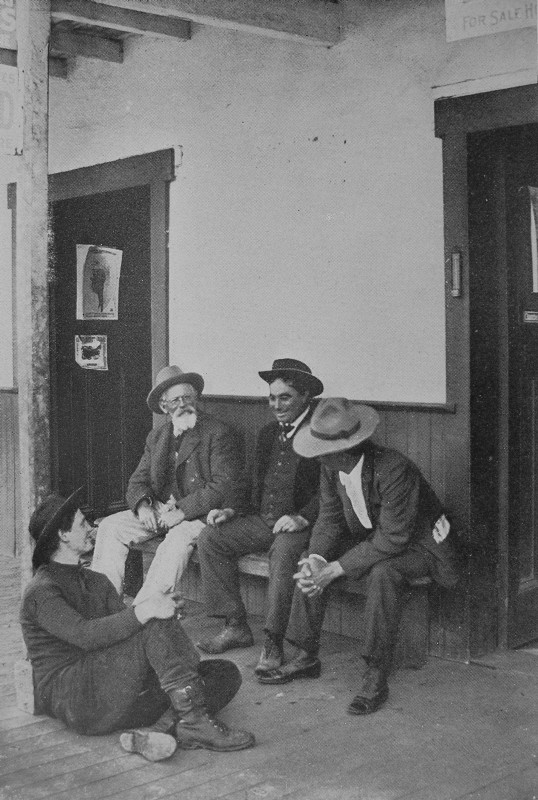 On the porch at the village store
“Well, the padre couldn’t spell one syllable of English, but Bacon got him to undertake the job, and dug up a diploma from somewhere allowing him to accept the position. The children came, and he kept along and kept along for a year or so. Most of the school conversation was in the Spanish language, and what was learned didn’t amount to much, but it was a start and about the only way a school here could start. However, at the end of a year Bacon persuaded the padre that teaching school was beneath the dignity of a Catholic priest and fixed things so the priest was authorized to hire a nice young lady to take his place. He got one and she taught about three months, when we had a horse race here and some feller came along and made love to her. The result was she ran away with him, and gad! we’ve never seen her since. “The school was Bacon’s hobby, and he got a building put up and afterward painted it himself — spent three weeks at the job. He laid out the grounds around with the notion of having a sort of park, and he urged that there should be put on the post at each corner of the fence a big globe having the entire world mapped on it. Then, inside, on an arch over the teacher’s alcove he wanted a motto painted — ’ The poorest child may tread the classic halls of yore.’ But there were two other trustees, and we wouldn’t agree to these things. We didn’t see much sense to ‘the classic halls of yore,’ and were afraid it would only get us laughed at. So, instead, we finally had an eagle and some stars painted on the arch. “Bacon knew how to read and write, but that was about the extent of his book learning. He was one of the argonauts of ‘49. He made money in mines and then he invested in cattle here. His home was an old adobe without a floor, but he was rich — oh, heavens! he had money galore. As soon as he got the school building done he put in a seventy-five dollar chandelier to light up so they could have dances. He paid for it — plunked up every nickel himself, and he furnished the oil, and he hired a dancing master to come from Los Angeles. They had a dance every Wednesday night. One day he says to a mother, ‘Why wasn’t your girl there last time?’ “‘She can’t go no more,’ the mother says. ‘She’s just wearin’ out her Sunday gaiters on the floor there, and I can’t have it.’ “‘Buy her a pair of gaiters, and I’ll pay for ‘em,’ says he; and after that he had to buy gaiters for every girl in town, you bet-cher! “In fact he got into the habit of buying anything the girls said they wanted for the dancing. But after a while they carried matters a little too far. I remember how he called on me and said, ‘One of my best dancers that lives down here on the lane has balked.’ “‘What has she balked for?’ I asked. “‘Well,’ he replies, ‘she says she’s got no corsets. Now I’ve give them girls calico frocks and shoes and lots of things, but I’ve got to draw the line somewhere, and I won’t give ‘em corsets.’ “After that the weekly dance ran down. Then pretty soon the idea struck him he’d like to learn music. So he sent to Philadelphia for instruments to fit out a brass band, and he got the finest that money could buy. He distributed them among a lot of old pickles of his caliber, but I told him he’d forgot one thing — ‘Whoever heard of a brass band without a banjo?’ I said. “At once he telegraphed to have a banjo sent regardless of expense. Those old stiffs he picked out for members of the band knew no more about music than a dog does about his grandfather; but they went to practising in a room here in the town and kept at it till the neighbors fired ‘em out. Then they made their headquarters off a couple of miles on a sheep ranch where the coyotes were in the habit of gathering to serenade the ranch dwellers. They petered out after a while. The only fellow among them who pretended to do real well was the man with the bass drum. ‘Oh, yes,’ he’d say, ‘I’m gettin’ along first rate. All I have to do is to draw off once in a while and give her a devil of a whack!’ “Bacon was an old resident when I came, and he’s been long dead. It was his habit every time he wanted to go away anywhere to buy two or three white shirts. When he’d worn ‘em he’d chuck ‘em in a closet and never bother with ‘em again. After his death, when things was bein’ settled up, we come across all that big heap of white shirts, and we threw ‘em outside. The result was that every Mexican in the place wore a white shirt for the next few months.” NOTE. — Capistrano is not a tourist resort, and its hotel accommodations are poor; yet this lack is not without certain picturesque compensations. The village is one of the quaintest, its setting among the hills is charming, and it has the most imposing and beautiful Mission ruin in California. No traveller who goes to San Diego can afford to miss visiting the place, if only to stop off from one train and go on by the next. The outlying sections of the village where the Indians and poorer inhabitants dwell should not be neglected; and it would be well to visit the wild, abrupt coast. This is close at hand and has an added interest because of the adventurous incidents which Dana in his “Two Years Before the Mast” describes as occurring in his experiences there. About 30 miles south of Capistrano, and 4 miles from the railway station of Oceanside, is the San Luis Rey Mission, which, after being in ruins for nearly a century, is again occupied by monks. There is an automobile route the entire distance from Los Angeles to San Diego, 136 miles, over roads that as a rule are good, but have some bad sandy stretches. |
 Click the book image to turn
to the next Chapter.
Click the book image to turn
to the next Chapter.