 Web
and Book design, Web
and Book design, Copyright, Kellscraft Studio 1999-2005 (Return to Web Text-ures) |
Click Here to return to Book of Boston Content Page Return to the Previous Chapter |
 (HOME) |
|
CHAPTER
XVIII "COLLEGES
RED AND
COMMON GREEN"  O people in general, away
from Boston, Harvard means Cambridge and Cambridge Harvard; the names
are used
as if practically interchangeable; although, as a matter of fact, every
one
knows that there is at least something in Cambridge that is not
included within
the university – for is there not the home of Longfellow! Another
general idea
is that Cambridge is part of Boston, whereas in reality Cambridge is a
separate
city, although it is just on the other side of the Charles and ought,
for
various reasons, to be included within Boston limits. To most intents
and
purposes it is really a part of Boston, and Bostonians so consider it. O people in general, away
from Boston, Harvard means Cambridge and Cambridge Harvard; the names
are used
as if practically interchangeable; although, as a matter of fact, every
one
knows that there is at least something in Cambridge that is not
included within
the university – for is there not the home of Longfellow! Another
general idea
is that Cambridge is part of Boston, whereas in reality Cambridge is a
separate
city, although it is just on the other side of the Charles and ought,
for
various reasons, to be included within Boston limits. To most intents
and
purposes it is really a part of Boston, and Bostonians so consider it.There is really a
great deal
of Cambridge outside of Harvard. There is Radcliffe, that active and
growing
college for young women; and there is a thriving city besides, with
numerous
features of interest. It may be regretted that so much of the city is
painted
from the same pot of paint, a dingy drab, that has been used on the
houses of
most of Boston's suburbs, for dingy drab as a permeative color is not
inspiring; but after all, that is a minor point. Cambridge is a busy
city,
with its student life and its active Harvard and Radcliffe, but as I
think of
it there comes, for the moment, in place of the picture of its business
and
social and educational life, that of one of the most beautiful of
cemeteries,
in every respect restful, as a beautiful cemetery ought to be; that of
Mount
Auburn. For Mount Auburn represents so much of the best history of
Boston,
holds so much of the dust of Boston genius. It occupies a great
area of
gently rolling land, on the farther edge of Cambridge; it is thickly
dotted
with trees, it is charming with birds and squirrels, there are
fountains
tossing their water high, and there are great beds of flowers; and it
is
astonishing what a number of famous New Englanders have found their
resting-place here. Here lies James Russell Lowell, under a
dark-colored stone,
amid a group of other Lowells who are gathered about him, including
several who
died in the Civil War. Not far away is the little headstone which marks
the
grave of Motley. Near Motley is the dignified tomb of Longfellow, and
close at
hand are the graves of Parkman and Holmes. It is amazing; for
this
notable group of men were practically neighbors and friends and
contemporaries
while living, and now they are neighbors in their final rest. So
close-gathered
are they within this great cemetery that they might almost be under one
monument! And, were it not for the Concord group, such a monument might
almost
stand to the memory of New England literature. Seldom, elsewhere, has
there
been such a close concentration of literary fame. On the way back into
Cambridge, Elmwood is passed, the home of Lowell, the house where he
was born,
and where he lived his life of honored achievement, and where he died;
an
attractive old Colonial house, with a fetching line, on either side of
the
door, of low box-bushes shaded by great elms which are fading away,
like
innumerable other beautiful elms here in Cambridge and elsewhere in New
England, under the attacks of the destructive descendants of that
imported moth
that won dubious fame for the Harvard professor who carelessly allowed
it to
fly away after his experiments. Countless elms have already perished
from the
ravages of the gypsy moths, themselves of more than countless number;
but at
least every American member of that family of moths can
unquestioningly, if
there is any satisfaction in the fact, trace his descent from the moth
who was
bred at Harvard. Lowell was not the
first
famous inhabitant of his beautiful house, for it has the distinction of
having
been the home of the very last of the royal governors of Massachusetts,
and,
also before it became the Lowell home, it was that of Elbridge Gerry,
the
politician whose ambition was to be known as a mighty statesman, and
who really
won high place, but who succeeded only in sending his name down to
posterity
linked with the notorious Gerrymander. In Lowell's time it
was
deemed a mere nothing to walk from Cambridge into, Boston and back;
Lowell
himself often did it; and even the ladies of Cambridge used frequently
to walk
into Boston to do their shopping and then would likewise return on
foot.
Somehow, the people of those days managed to accomplish a great deal
without
motor-cars or trolleys; in these degenerate times it is considered very
tiring
to most people to walk, not from Boston – that would be impossible! –
but even
the short distance from Cambridge Common to Lowell's house and back. A little farther
toward the
center of Cambridge is the house that was long the home of Longfellow,
a
beautiful old Colonial building, dignified in its buff and white, with
its
plain pilasters, its dormered and balustraded roof, its fine chimneys,
its
generous lines, its terraced front. The terrace wall is thick-greened
with ivy,
great elms shade the house and grounds, and along the sidewalk line is
a high
hedge of lilacs. Lilac hedges, indeed, are a delightful characteristic
of
Cambridge, and one which I do not remember having noticed as a feature
in any
other town. It has somewhat
become the
fashion among certain classes to deem Longfellow a poet of
insignificance,
which is as much of a mistake as to deem him among the very greatest.
He put so
much of beauty and sweetness and fine Americanism into his poetry as to
deserve
high place in the regard of the world and particularly in that of his
own country.
His excellent English is always so excellently simple that some think
it is a
sign of inferiority! But even Browning thought no less of him on that
account,
but loved both his poetry and himself, and walked the London streets with him in eager talk – the English poet
literally arm in arm with the American! Distinguished though
any
house would be by the long residence of Longfellow, this house of his
has
another and even greater fame; for it was the headquarters of General
Washington during most of the time that he was conducting his
operations
against Boston. The fine old house, loved and lived in by men of such
diverse
greatness, stands as if with a sort of sedate pride in such
associations. For some years
between the
time of its occupation by Washington and that by Longfellow it was the
home of
a certain cunning Andrew Craigie who, it is worth remembering, as a
warning not
to apply the word "patriot" to everybody connected with early times,
was an apothecary-general in the hospital service in the Revolution and
was
believed to have made a fortune through using his special opportunities
to buy
medicines cheap and sell them to the army dear. "Graft," and
unscrupulous holders of office, are evidently not products of modern
days
exclusively. Next door to the
stately
Longfellow house is one that is even finer and more stately; indeed,
the entire
neighborhood hereabouts is full of charming homes, mostly Colonial, or
admirable copies of the Colonial style. Cambridge displays a great area
of
beautiful living, with beautiful houses, sloping lawns, and green
trees, and it
is a pleasure to notice that these trees are largely horse-chestnuts,
after
knowing what ravages are taking place among the elms. A few minutes' walk
from the
Longfellow house takes one to the site of one of the most thrilling
events in
the world, at least one of the most thrilling to any American, the spot
on
Cambridge Common where George Washington first took command of the
American
army. Here, soldiers and officers stood in array before him, as he sat
upon his
horse under an elm that even then was old, and in a few simple words
declared
that he assumed command. And that old elm is still standing! It is only
a
wreck, now, this ancient tree, only a fragment, a remnant, and trolley
wires
crisscross it and trolleys rumble close beside, but it is still there,
still
alive, a monument to that event of significance. It stands in the
center of a
tiny bit of green, at a street intersection at the edge of the Common,
and a
tablet commemorates the event with a simple dignity which befits the
event
itself. UNDER
THIS TREE WASHINGTON
FIRST TOOK COMMAND OF THE AMERICAN ARMY, JULY 3, 1775. On the Common itself
stand
several cannon, big, black, heavy, long-barreled things; not only old
cannon,
but very distinguished old cannon, for at least two of them were among
the very
ones that General Knox brought down so marvelously from Ticonderoga
when
Washington needed them to use in his siege operations against Boston. The ancient
Washington elm,
and these cannon, are among the things that ought to be seen by every
American. Off at the edge of
the
Common, close to where the Harvard buildings begin, is an open pace
where the
American soldiers, some twelve hundred of them, lined up for their
March to
Bunker Hill, on the night before the battle; a brave and solemn thing
to do,
for all knew that they were not only about to risk death in battle, but
that
they were to take the even more serious risk of death as traitors
should they
fail. The President of Harvard stood on the steps of a gambrel-roofed,
elm-shaded, – altogether delightful old house, to pray for the soldiers
as they
stood solemnly before him. The fine old house has disappeared; within
my own
memory it has been torn down, apparently without reason, for no other
house has
taken its place; but although the beautiful old house has been
demolished, and
although that Harvard president became long since dust, the bravely
impressive
scene has not been forgotten-and ought never to be forgotten. And it also need not
be
forgotten that this was the house in which, some quarter of a century
after the
Revolution, Oliver Wendell Holmes was born. Another old house,
now known
as the Wadsworth house, was until recent years the home of the Harvard
presidents, in honored sequence; in fact, it was built, in 1726, for
the very
purpose of being the home of the presidents. Its back is toward the
university
grounds and buildings, but it faces out on busy Massachusetts Avenue,
and its
porticoed door is directly on the side-walk. The narrow portico would
just keep
the rain off a president as he stood while putting the key in the lock.
Two
plain wooden columns support a pediment with severe triglyphs, and
there are
such plain, simple, good ornaments as to make it a delight among
porticoed
doorways. The door itself is eight-paneled, with a high-set knob and
with four
lights of glass above to light the entry. And it is the door through
which
Ralph Waldo Emerson used to pop in and out! For he was "President's
messenger" when working his way through Harvard. Harvard University
was
founded almost three centuries ago; it was founded as far back as 1636!
And
what those early Americans determined upon was expressed in words that
are
perpetuated in an inscription at the principal gateway to the Harvard
grounds: "After God had
carried
vs safe to New England, and wee had bvilded ovr hovses, provided
necessaries
for ovr livelihood, reard convenient places for Gods worship, and
setled the
civill government, one of the next things we longed for and looked
after was to
advance learning and perpetvate it to posterity." It was in 1636 that
the
General Court of Massachusetts Bay agreed to give four hundred pounds
towards a
"schoale or colledge," half to be paid the next year and half when
the building should be finished, and it was ordered that the school be
established at Newetowne, and that Newetowne should thenceforth be
called
Cambridge, and later it was ordered that the college "shall bee called
Harvard Colledge": which directions were duly followed. Harvard dislikes outside criticism, but enjoys humorous flings if it flings the humor itself; as when Harvard men some years ago flung paint humorously upon John Harvard's statue – only to find, in that case, that it did not seem so very humorous after all! And as to that statue, with its inscription, "John Harvard, Founder, 1638," even dignitaries of the university are prone to refer to it as the "statue of the three lies"; for John Harvard was not the founder; and it was not even in the year of the founding, but two years afterwards, that he made the bequest, of all his library, some three hundred books, and half of his fortune of some fifteen hundred pounds, which actually acted as the needed impulse to carry out the initial inspiration; and, finally, the figure does not really represent John Harvard, for it is made from the sculptor's imagination of what he ought to look like! And it does not, it may be added, give precisely the impression of what John Harvard really was – a cultured, earnest minister, of only thirty-one years of age. And few men dying at thirty-one have been able to link their names with a movement or institution so famous. 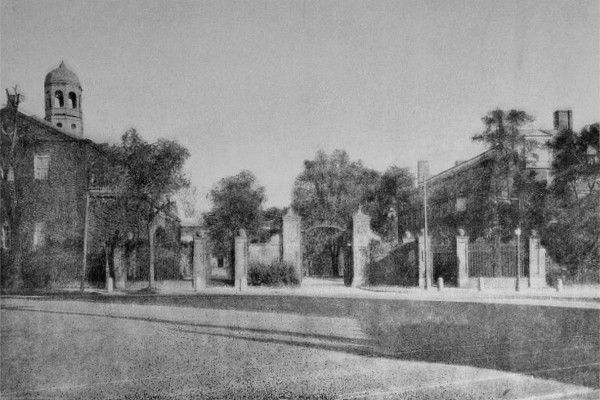 The Main Gateway of Harvard Another of the flings
from
within Harvard came from the beloved Lampoon, which,
referring to a not-so-very-long-ago president,
noticeably cold in
general mien, suggested that a monument be raised to him on a certain
spot,
with an inscription declaring that there he actually spoke to a
freshman. The fine gateways to
the
Harvard grounds, all of them memorials or gifts, add materially, in
connection
with the wall which surrounds a great part of the grounds, in giving an
effect
of harmonizing and binding together college buildings which are really
a
conglomeration of architecture; wall and gateways almost give character
and
distinction to the entire group of buildings; although some of the
buildings,
considered individually, cannot be deemed either distinguished or
attractive. It is pleasant to
note that,
although many a modern college or university is not content without the
ambitious name of "campus," old Harvard is quite satisfied in
honoring its great, reposeful, tree-shaded, grassy rectangle,
surrounded as it
is by college buildings, with the name of "yard." The most interesting
and at
the same time the oldest of all the Harvard buildings is Massachusetts
Hall, an
attractive old structure of time-dulled brick, standing just inside the
main
entrance. It was built two centuries ago and is an admirable example of
its
fine period, with twin-chimneyed gable at either end, with shingled
gambrel-roof,
with its long row of dormers, its long wooden balustrade, its
small-paned
windows, and the lines of slightly projecting brick which mark the
floor-lines
and give special distinctiveness. The finest of all the
buildings is the great modern structure, built in memory of one of
those
drowned on the Titanic, known as the Widener Memorial Library, a magnificent
structure that
represents lavishness of wealth and a deep sense of classical beauty.
The
splendid front looks out on charming greenery, on grass and elms, with
here and
there a maple or pine or chestnut. The entrance door is approached by a
broad
flight of granite steps, and at the top of the steps is a long
colonnade of
mighty pillars of stone, fronting the façade in splendid dignity. The
interior
of the building is temple-like in beauty, in its soft glory of smooth
but
unpolished stone. There is a curious and impressive vista when one
enters; for
ahead, at a sort of vanishing point of sight, through and beyond the
superb
hall, is the effectively placed portrait of Widener himself, as if
looking
pleasantly at each man who enters. The other day I saw a
full-page description of this building in one of the Boston dailies,
and quite
a part of the reading matter – twenty-four lines of it and a subhead,
to be
precise – was devoted to what was termed the "most curious book" in
the library that the great building holds. "It is curious, not because
the
book is rare or splendid or has the most remarkable associations or
represents
the highest flights of an immortal author. "You see, it is not notable
for
any of the reasons which would arrest attention in Chicago or San
Francisco or
New York or Paris or London. But the newspaper, after tantalizingly
going on
about non-existent reasons, at length works up to the climax, the real
cause of
the book's being singled out for distinction. It seems that it is a
presentation copy, with a personal inscription to the man whose name
gives name
to the library, and that the inscription spells the word "guild"
without
the "u"! – just "gild"! That is absolutely all. A great
Boston newspaper accepts the contribution of some one of its staff who
is so
little conversant with English as not to know that the word in question
may
properly and with authority be spelled "gild"; no editor, no
copyreader, checks it or looks it up; and the splendid library and the
remarkably beautiful building are held up to Boston scorn because of
the
newspaper's own deficiency in orthographic knowledge; and, according to
the
newspaper, as the supposed error is noted, "your face wears a smile of
amused wonder." I tell of this, because it is so typical of Boston's
absolute certainty that nothing can be right which is not done
precisely as a
Boston man would do it. It is a natural
transition
from the most beautiful of the buildings of Harvard to that which is
furthest
from beauty – the great Memorial Hall, which was put up some half a
century ago
as if to be a notable example of that bad period when scarcely anything
of
beauty was built. But although this building itself is unbeautiful, the
idea
that caused it to be built was nobly beautiful; for it was erected as a
memorial to the men of Harvard who gave their lives for their country
in the
Civil War. And much of the interior is of striking effect. Down the
lofty and
impressive main corridor there are tablets to one after another of the
many who
thus died – a thrilling list. One sees such old New England names as
Peabody,
Wadsworth, and Bowditch; one sees the name of Fletcher Webster; one
sees that
an Edward Revere died at Antietam and a Paul Revere at Gettysburg. One end of the
building is
given over to a great college dining-hall, imposing and lofty-roofed,
and so
remindful of the dining-hall of Christ Church at Oxford as clearly to
show that
it must have been inspired by that noble hall, although it is without
the
wealth of finished beauty that the Oxford hall presents. Still, this
Harvard
hall is very impressive; in spite of the mistake of ill-placed rows of
hat-racks, and in spite of the heaviness of the crockery on the long
rows of
long tables, and in spite of an Ethiopian and his water-pitcher at the
end of
each row. But what is most
notable
here are the portraits, which extend around the great hall in lines of
grave
dignity; most of the paintings are by the best of the early American
artists,
and are priceless in that they bring down to posterity the appearance
of the
great men of the past, while at the same time the greater number are
notable
achievements of art as well. Here is Thomas
Hancock,
worthy uncle of the patriotic and famous John; a painting by Copley,
made in
1766. Hancock is standing on a floor of tessellated marble, and is
gorgeous in
showy clothing, and coat of bottle-green velvet, with ruffles at his
wrists and
ornate buckles on his shoes. And here is a fine Washington, by
Trumbull, a
portrait given to Harvard, while Washington was still alive, by that
Craigie
whom we have seen making money out of army medicines. And here is a
John Adams
by Copley; an Adams quite unknown to Boston – for he is represented in
full
court dress; a costume that in the early anti-English days he would
scarcely
have dared to wear. And here, too, is a painting understood to be a
Benjamin
Franklin, sent from England by Franklin himself as a gift for his
brother; but
it does not at all meet the usual ideas of Franklin's appearance, as it
shows
him quite a youngish man with curly hair and bishop-like sleeves; it is
with
some difficulty that one realizes that Franklin was ever a youngish
man, there
being but two general impressions of him, one as a boy with a bun and
the other
as an aged philosopher. Here, too, is an excellent portrait by Chester
Harding
of that many-titled man, the Earl of Aberdeen, Viscount Gordon,
Ambassador to
Vienna, Prime Minister, and so on; one of the many notable paintings
that this
American artist from the backwoods made in England. That the hall is
rather dark
adds materially to the general impressiveness, but does not make it a
better
medium for the display of old-time paintings; and besides, most of
these
paintings are skied on the lofty wall. The social life of
the
university, at least from the standpoint of some of the newer members
of the
faculty, possesses a certain frigidness not incompatible with Boston
and
Cambridge social life in general. "The winter climate of Boston is
distinctly arctic, and society life, from sympathy, perhaps, seems to
pass
through a long period of cold storage"; thus, toward the close of his
long
life, wrote the late Charles Francis Adams, who knew all that was to be
known
of the best of Boston and Cambridge society; and I thought of this when
I was
told, recently, of a call made upon the wife of a new professor by the
wife of
a professor of long standing. She found the younger woman in tears.
"Oh, I
am so glad you came!" she sobbed. "Now – now – somebody knows me!
I've been so lonely and I've been crying, for I thought that nobody
knew me and
– if I should die – there'd be nobody in Cambridge to come to my
funeral!
" A happier story of
social
life was related to me, of an absent-minded professor who, at a dinner,
was
offered an ice served on a doily of exquisite workmanship, and taking
it, but
continuing his conversation, he absent-mindedly twisted the doily with
his
fork, round and round in the ice – and then swallowed it; to the amazed
distress of his hostess! Even from early days
Cambridge has always seemed a part of Boston, and it is now, by means
of rapid
subway trains, really only a few minutes from Boston Common, and
therefore
seems more than ever a part of the big city. But the Cambridge people
like to
remain under a government of their own; only, it may not be amiss to
suggest,
altogether charming though that part of Cambridge is where stand the
homes of
Longfellow and Lowell, there is, in the center of the town and in its
approaches from Boston, a little too much of shabbiness, a shabby and
drab
aspect associated with the old reputation of Cambridge for dust. And yet, there is so
much of
charm about the place, there is so much of thrilling interest about it,
in addition
to its collegiate associations, that one wishes only to think of that
summary
of the place made long ago by one of the most distinguished of
Americans: Colleges red and Common green, Sidewalks brownish with trees between." And the university itself remains a pleasant memory, with its throngs of Harvard men in the making; of whom I think it was a Bostonian who said, that you can always tell a Harvard man – but you can't tell him much!  |
 Click the book image to turn to the next Chapter.