 Web
and Book design, Web
and Book design, Copyright, Kellscraft Studio 1999-2005 (Return to Web Text-ures) |
Click Here to return to Book of Boston Content Page Return to the Previous Chapter |
 (HOME) |
|
CHAPTER
XI TO
THE OLD STATE HOUSE  N early days Washington
Street, upon which the Old South Church faces, was known in its
successive
sections as Cornhill, Marlborough Street, Newbury Street and Orange
Street;
names not thrown away but frugally saved to be used in a new district;
and all
were merged in the Washington himself entered the city along this route
at the
time of his visit in 1789; and perhaps the naming was partly in amends
for
having kept him waiting for two hours, mounted on his white horse, just
outside
of the town limits, while the State and town authorities debated on
just how he
was to be received. N early days Washington
Street, upon which the Old South Church faces, was known in its
successive
sections as Cornhill, Marlborough Street, Newbury Street and Orange
Street;
names not thrown away but frugally saved to be used in a new district;
and all
were merged in the Washington himself entered the city along this route
at the
time of his visit in 1789; and perhaps the naming was partly in amends
for
having kept him waiting for two hours, mounted on his white horse, just
outside
of the town limits, while the State and town authorities debated on
just how he
was to be received.It was fortunate that
Washington
had drilled himself to patience and at the same time that he well knew
how to
hold his dignity, for in the early days of the adoption. of our Federal
Constitution a burst of anger on his part, or even of impatience, no
matter how
well justified, might have had a disastrous national effect, as might
also any
impairment of the President's proper position. Yet, though he looked
upon a
little waiting as too minor a thing to be taken notice of by a great
man, he
did not overlook Governor John Hancock's not coming to call upon him.
Hancock
stayed at home, as if thinking a Massachusetts governor more important
in
Massachusetts than a President of the United States, and as if
expecting
Washington to make the first call; but this, Washington absolutely
refused to
do; not only his own dignity but the dignity of the nation was at
stake; and on
the next day Hancock, swathed in explanatory flannel. wrappings,
belatedly and
formally called, offering an alleged attack of the gout as an excuse
for not
calling the day before. And perhaps the gout was real. Or, if Hancock
had but
tardily done honor to the first President, it was probably because John
Adams,
the first Vice-President, had entered Boston in the President's
company, and
that Hancock and John Adams were far from being friends, Adams having
even gone
to such a length, in his jealousy, as to term Hancock an "empty
barrel"; the resounding sound of which appellation must have reached
Hancock's ears. But there ought not to have been any real ill feeling
on the
part of Hancock toward Washington, whatever may have been the case as
to John
Adams. Hancock had named his only son after himself and Washington,
John George
Washington Hancock, and that the little fellow had recently died would
assuredly make even closer the personal tie between President and
Governor. Other streets of old
Boston
have had their names changed, for reasons not so excellent as those
which gave
the city Washington Street, and on a few of the corners the old names
are given
as well as the new, but in the main the old ones are forgotten. The
greater
number of changes seem to have been made because, as the city grew
bigger, it
became more finical; and one realizes that Frog Lane would not be so
excellent
a business address as Boylston Street, that Pudding Lane and Black Jack
Alley
would seem less respectable than Devonshire Street, that Black Horse
Lane is
more dignified, if that were all, as Prince Street; but it is not clear
why the
delightful name of Royal Exchange Lane should have been altered, except
actually during the time of the Revolution, to Exchange Street, and it
is hard
to reconcile oneself to Broad Alley becoming Hollis Street, to Turnaway
Alley
becoming Temple Place, and to Coventry Street becoming the prosaic
Walnut; one
may quite sympathize with changing Blott's Lane to Winter Street but
feel that
romance was lost in altering Seven Star Lane to Summer Street; and if
it might
be objected that Seven Star Lane does not sound citified enough there
would
really be no objection to calling it the Street of the Seven Stars. Washington Street,
and
especially that part which . is directly through from the Common, has
especial
interest in the difference between its general aspect in the evening
and its
aspects during the day. In the morning the better part of it is crowded
with
the women of the socially elect doing their shopping, and in the
afternoon with
women whom the socially elect consider hoi polloi;
and the men who thread their
way along the narrow, side-walked shopping sections in daytime are
alert
business men, not too intensely hurried; the daytime is the time of
Boston bags
and prosperity; but in the evening, for a few hours – never until
really late,
for this is an early city – it is differently thronged and brilliantly
lighted,
and at this time it gives much the aspect of the main street of a busy
English
mill town, crowded as it is with the people who come for the "movies"
and the cheaper theaters, or who are out simply for a stroll. Boston has not lost
capacity
for enthusiasms; cities, like men, need that; but Boston shows
enthusiasm in a
typically quiet way. I have seen Washington Street, in the business
center,
jammed solid for several blocks with a crowd, estimated by the police
as
numbering from twenty-five to forty thousand, which absolutely stopped
traffic,
and all these people had gathered to watch the score-boards of several
newspaper offices that are close together there; for the Boston club
was
playing for the League championship in old Philadelphia. The streets
were
packed to capacity for a long distance within sight of the boards, and
the
windows and roofs were crowded with decorous, neat, well-tailored,
well-dressed, self-restrained men, every one with his shoes polished
and his
hat on straight. It was a very proper crowd. Many of the men were ready
to yell
if an announcement were extremely favorable, but even then they would
not yell
very loud. The business men and office clerks of the city had given up
an
entire business afternoon to follow in packed decorousness the record
of a
baseball game. A walk of less than
five
minutes on Washington Street, from the Old South Church, takes one to
the
corner of State Street, where once stood the bookshop which graduated
that
superb artillery officer, Henry Knox; and here there opens out what is
known as
State House Square, out in the center of which stands the Old State
House. Once in a while, in
Boston,
it is necessary to say, in differentiation, the New State House or the
Old
State House, for when the new one was put up the old one was preserved,
and it
stands among the new business buildings of the busiest district of the
city.
Extremely strong efforts have from time to time been made to destroy
this old
building and use its site in important business development, and great
financial temptation has been offered to the city, and the arguments
for the
needs of business were really so cogent that a few years ago it seemed
as if
the city would yield to them. It had already yielded, so far as giving
over the
building to rental for offices and other business purposes was
concerned, and
there was danger that the entire building would be given up. But while
the city
wavered, hesitant and doubting, the news went out through the country
that
perhaps the long-treasured building was doomed, whereupon a formal
message came
from the city of Chicago, offering to buy the old structure in order to
tear it
down and rebuild it, brick by brick, out there on the shore of Lake
Michigan.
The structure would thus be kept, so Chicago with earnest dignity
expressed it,
as an American monument for all America to revere. Of course that
settled it.
Perhaps the building would have been preserved in any event, but after
that
message, had Boston decided to tear the building down, it would have
been quite
impossible for her to throw away the bricks when Chicago was ready not
only to
pay for them but to build them up again and honor them, and it would
have been
altogether unbearable for Boston to think of people going to Chicago to
see
this old State House! – and so it still stands here. It will be remembered
that
Chicago won another victory for the world by offering to buy and set up
within
its own precincts the birthplace of Shakespeare, when that building was
about
to be lost to Stratford, and in that case, as in this, the offer by
that
broad-mindedly acquisitive city of the West was sufficient to secure
the
preservation of the old building on its original site. It is
interesting to
speculate what buildings of the world, whether in America or Europe or
Asia,
will in time be pleasantly captured by Chicago in this way. The Old State House
is a
building of piquant individuality; it would easily attract attention
anywhere;
without knowing anything about it one would be sure that it must be a
building
of interest, and it is. It stands at what was long the center of much
that was
important in old Boston. In the open space beside it and beside the
still
earlier building that preceded it was the early public market of the
city; in
fact, the public market was not only beside but under the earlier
building,
which, in the old English market-place way, was built upon pillars,
leaving the
level space beneath the building as an open arcade for the merchants. Even the present
building
has a history that goes back to 1713, and when, about forty years
afterwards,
it suffered a disastrous fire, at least the walls of 1713 were saved,
thus
preserving the early felicitous shape and proportions of the building. Hereabouts went on
much of
the early Boston life. Here in the open square stood a cage, for the
display,
in restrained publicity, of such as had dared to violate the Sabbath;
here were
the stocks; here was the pillory – reminders, these, that all was not
gentleness and moral suasion in the days of yore! – and here stood,
even into
the nineteenth century, the whipping-post. It is not with any spirit of
criticism of the past that these things are mentioned; it is proper to
speak of
them, that we may not forget that the past was not altogether perfect. Nobler and more
tragic than
such associations is the association with what has always been known as
the
Boston Massacre, of 1770; directly in front of this building is where
the fatal
shooting by the English soldiers took place, that roused a wild storm
of
indignation that even yet is remembered, and which in itself had much
to do
with intensifying and crystallizing the sentiment in favor of an actual
and
final break with England. In the general excitement of that time and
the
feeling that at any moment, should the demands of the citizens for the
removal
of the soldiers from Boston not be heeded, there might be actual
warfare, most
of the men of Boston were under arms, and even John Adams took his turn
with
others, as a soldier, at this very building, coming, as he has with his
own
hand recorded, "with my musket and bayonet, my broad sword and
cartridge
box." It is an interesting remembrance of the trial of the English
soldiers, that followed, that two of them who were actually convicted
of
manslaughter escaped punishment by pleading the very ancient English
plea of
"benefit of clergy"! – which had nothing whatever to do with literal
clergy, but only with the ability to write, which was anciently
supposed to be
an accomplishment of the clergy alone, who as a class were immune from
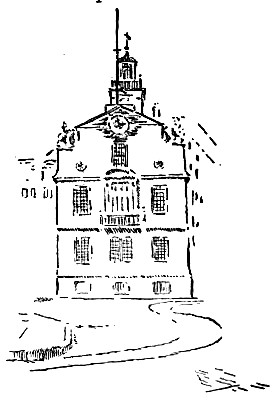
punishment. In outward appearance
the
Old State House suggests a memory of Holland. It elusively but
charmingly
indicates a bit of Dutch architecture. It has a long line of dormers on
each
side of its roof, and in the center rises a quaint tower, in
square-sided
sections which go up in diminishing sequence to a little belfry. At
either side
of the gable lines on the high and almost corbel-like corners of the
façade,
the square-shouldered front that faces out toward the oncewhile
market-place,
stand the lion and unicorn, effective and highly decorative, breezy
copies of
the originals which were thrown down and destroyed in the Revolution,
gayly
gilt like the originals, and looking almost royally rampant as they
face each
other across the central clock which points out that times have changed. In the center of this
façade
is a beautiful second story balcony of stone, in front of a many-paned
central
window with curving pediment. From this balcony many a speech has been
delivered and many a proclamation has been read, from the time of the
early
Colonial governors down, but the long succession of royal proclamations
came
finally to an end when, on a July day in 1776, to an exalted throng of
Revolutionary citizens gathered in this open space below, there was
read the
full text of the Declaration of Independence, which had been relayed to
Boston
as fast as a galloping messenger could take it. "In the brave days of
old!" – these fine old familiar lines may well be applied to Boston. From this very
balcony, ten
years before the reading of the Declaration, was proclaimed the repeal
of the
hated Stamp Act, and also from this balcony, at the close of the
Revolution,
the people were told that peace with Great Britain had been made and
that full
recognition of the rights of the American Republic had been yielded. This old building was
successively the Town House of Boston, the Court House, the Province
Court
House and then the State House; and after the State offices were moved
into the
big building on Beacon Hill it became for a time the City Hall. The
building is
now restored, but has not suffered the misfortune of being
over-restored, and
it is given up to the accumulation and display of a collection, of
fascinating
interest, of a vast number of mementoes relating to early days; and
like the
Museo Civico of Venice, and others of that admirable class, it sets
forth, with
its mementoes, the things which represent the daily life of long ago. Among the individual
relics
is a beautiful silver tankard, that was made by Paul Revere. It is a
masterpiece of silver-smithing, and is so highly prized that it is held
in
place by a hidden lock and chain, in order to keep it should some thief
break
the glass case in an effort to snatch it away. Here, too, is preserved
one of
the original Revere prints of the Boston Massacre, which took place
under the
windows of this building, and it is so valued that it is put into a
fireproof
safe every night. The building also holds, in one of its corners, a
little old
organ, which rivals the old organ of the Park Street Church with its
"America," for this in the Old State House was one at which the
stately old tune "Coronation" was composed and on which it was first
played; it is an organ with lead pipes and is still playable and of
excellent
tone. For a building which
outwardly does not appear large, and which is really not large, there
is in the
interior an astonishing effect of amplitude. In this respect it is a
marvel. There are various
meeting
rooms in the building, each of old-fashioned dignity, and in particular
the
fine big room, with its noble spaciousness, that is still known as the
Council
Room, as it was in the long ago time when the royal governors, richly
appareled, sat here in formal state in conference with their
councilors. It is
a room with twin fireplaces and big recessed windows and fine cornice
and
charming wainscoting, and it is pleasant to remember that John Hancock
was here
inaugurated governor. It is astonishing
what a
degree of beauty, what an amount of dignity, the earliest American
architects
were able to secure in their public buildings, and this in Boston may
compare
honorably with the best. There is the old Maryland State House in
Annapolis;
there is the one-time State House, Independence Hall, in Philadelphia;
and
there is the Old State House here in Boston; all of them
pre-Revolutionary
buildings of practically the same period, and all of immense dignity
and
distinction. The three are of very different appearance from each other
but
they are alike in continuing to be worthy points of pilgrimage for
Americans
and in having direct connection with important events of the past.
 |
 Click the book image to turn to the next Chapter.