
Web
and Book design,
Copyright, Kellscraft Studio 1999-2007 (Return to Web Text-ures) |
 (HOME)
|
|
XLVI The Color Bearer 1 WHEN the
war began
Atlanta was a place of not over seven thousand inhabitants. It was in
the heart
of the Confederacy, and it was a natural center for gathering and
distributing
supplies. The Federals didn’t penetrate to the region till toward the
end of
the war, and until that time the people lived very comfortably. In
fact, before
Sherman came, we never wanted for anything. My father
went into
the army early. At first he was a lieutenant, but later he made up a
company of
his own and was its captain. I became a color bearer in his company.
That was
in 1861 when I was thirteen years old, and I was the youngest soldier
who ever
went from Atlanta. I used to
see lots
of fellows leaving here to go to the front, and they'd holler and laugh
as if
they were starting off to a picnic. They were new recruits, all fresh
then.
They hadn’t got a taste of war. Box cars were used for transporting the
troops,
but that didn’t trouble 'em. Some rode inside and some on top, and they
were
feeling fine. They felt as if they could whip the whole world. When
they came
back it was like a funeral — no hilarity then. Some of the dust had
been
knocked out of 'em, and a good many never returned at all. Perhaps
our
greatest excitement in the earlier years of the war was Andrews's Raid
in the
spring of 1862. I don't know much about this man Andrews before that
time
except that he had been teaching school in Kentucky and had become a
Union spy.
His scheme was to have a small company of picked men go down into the
South
nearly to Atlanta, steal a locomotive, and then ride back north on it,
stopping
on the way to burn the bridges and wreck the railroad as much as
possible. The
raid was well planned, and only a mere chance prevented it from
succeeding. Twenty-four
soldiers were selected from some Ohio regiments to aid Andrews. The men
put on
ordinary Southern clothes instead of their uniforms and went south in
small
detachments of three or four. When they were questioned on the way they
said
they were Kentuckians going to join the Confederate army. Nineteen of
the
soldiers succeeded in reporting to Andrews at Marietta, about
twenty-five miles
north of Atlanta. On Saturday, April 12, the adventurers bought tickets for various places in the direction of Chattanooga and got on an early north-bound train. The day was chilly and rainy. After a ride of eight miles they reached Big Shanty, where a stop was made for breakfast. The train crew and all the passengers, except those twenty raiders, flocked into the hotel and left the train unguarded. Then Andrews and his men got busy and uncoupled the locomotive, the tender, and three box cars from the rest of the train. Sixteen of the men climbed into the rear car of the front section of the train, and their leader and the three other men got into the locomotive car. Big Shanty was a place where Confederate soldiers rendezvoused. Plenty of 'em were around, and a sentinel stood not a dozen feet from the locomotive watching proceedings, but before any of 'em made up their minds to interfere the train started. Among the
men
gathered about the hotel dining-tables was Captain Fuller and the
locomotive
engineer and my brother-in-law. A commotion outside attracted their
attention
and they rushed forth to find that a bunch of strangers had gone off
with a
part of the train. At once they started running along the track in an
attempt
to overtake the raiders. But of course that was hopeless. They kept on
for
about a mile and got to the next station. There they secured a hand-car
and
continued to press on. That pursuit was a thing Andrews hadn’t
calculated on,
and really it was ridiculous — three men on a hand-car chasing twenty
men on a
train. The
raiders were
handicapped by the fact that there was only a single track. They had to
meet
two passenger trains and a freight, and it was therefore necessary to
run
according to time-table. Besides, they were obliged to make stops to
get wood
and water for the locomotive, and to cut the telegraph wires beyond
each station
lest word should be sent on ahead to stop them. When they halted at a
station
they explained that they were going with a special powder train to the
Confederate army at Corinth. Once they
tore up
the track and loaded a lot of ties into one of the box cars to be used
in
bridge burning. Their most serious delay was at Kingston where they had
to make
a long wait for a regular passenger train from the north and two
extras. Meanwhile
their
pursuers on the hand-car had come to where the raiders had torn up the
track
and were thrown down an embankment into a ditch. But no bones were
broken and
they got the hand-car back on the rails and proceeded with more
caution. Presently
they came
to a station where they found a locomotive with the steam up, and they
hastily
loaded it with soldiers who were there and renewed the chase. They
reached
Kingston only four minutes after the raiders had gone. Here they
shifted to
another locomotive and took along one car with about forty men aboard.
But they
had to abandon their train when they came to a place where the raiders
had
broken a rail. They then hurried along on foot until they got a fresh
locomotive from the second of the two regular passenger trains that the
raiders
had been obliged to meet. Soon they
were
right on the heels of the fugitives who were still obliged to stop
after
passing each station to cut the wires. They followed them so closely
that they
often had the raiders' locomotive in sight. The country was hilly, and
the
railroad was nothing but a snake in its winding, and when a curve took
the
stolen train out of view they could usually still see the smoke of its
locomotive. The
raiders dropped
off ties and put all sorts of obstructions on the track but did not
succeed in
stopping their pursuers. At last they approached a long covered bridge,
and
they set fire to their rear box car and left it in the bridge while
they kept
on. But before the bridge was seriously harmed the pursuers arrived and
pushed
right into the smoke with their locomotive and shoved the burning car
before
them to the next side-track. Now, after
making a
run of ninety miles, the raiders were without fuel for their engine,
and there
was nothing to do but abandon it. They scattered in the swamps, but men
gathered from every direction to chase 'em. Some of them were soon
captured.
Others contrived to keep their freedom for several days and got away
quite a
distance. But eventually every man was caught, and also two of the
original
party who had failed to make connections with Andrews at Marietta. If the
daring
undertaking had been successful it would have seriously disturbed
traffic and
cut off the usual means of getting supplies to our army in Tennessee.
That
railroad was the only one out of the state to the north. The raid was
certainly
one of the most thrilling incidents of the war. Eight of
the
captives were tried by court-martial. They were condemned as spies and
hung
here in Atlanta. I was at home when Andrews was executed. The
procession passed
our house, and I sat on one of our gateposts and watched it go along
the
street. Andrews was sitting in a big, old-fashioned family carriage
drawn by
two horses. The sides were open, and I could see him on the back seat.
His face
was very pale. He had long, black whiskers and very black hair. Beside
him sat
a guard, and on the other seat, facing him, was a minister. The driver
sat out
in front. A squad of soldiers marched ahead, and on each side of the
carriage
were several more, and a company of 'em followed behind. Then came
quite a
crowd of people, some on foot, some in carriages, and some on
horseback. They
were all very quiet. It was a serious occasion. My sister,
who was
standing at our gate, always said that was one of the saddest days she
ever
spent in her life. It seemed to her that a depression or gloom had
settled over
the city. She first realized at that time the horrors of war. Until
then she
had seen only our own soldiers here, and though there were army
hospitals, very
few wounded men had as yet been sent to them from the front. The
hanging was to
be public, and the crowd wanted to see it. A good many boys were going
along,
and I jumped down off the gatepost and fell into line in company with
one of
the boys I knew. Andrews was taken to the dense woods on the edge of the city where was a hurriedly arranged gallows. When they were ready to hang him they found they had forgotten to provide the black bag which it was customary to put over the condemned man's head on such occasions, but Andrews asked to just have a pocket handkerchief tied about his eyes. He was very courageous to the end. Some man in the crowd furnished a handkerchief. It was quickly adjusted, and the hanging followed. The prisoner, however, was a very tall, slim man, and his feet struck the ground. That wouldn’t do, and the guards pulled off his shoes. Still his feet touched, and the officer in charge dug a hole under 'em. The body was taken down presently, put in a board coffin, and buried where a big pine tree had blown over. The tree roots were canted up ten feet high with the clay adhering to 'em, and they'd left a soft place where it was easy to dig the grave. 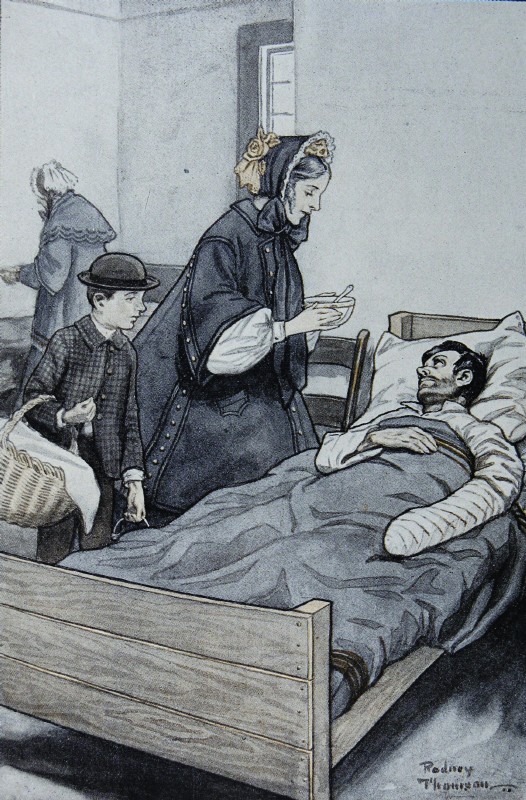 A HOSPITAL VISITOR Andrews'
shoes were
cut up for relics. I brought home one of the pieces, and also a piece
of the
cord that bound his hands. I was quite elated to be the possessor of
such
prizes. When I reached home I ran in and said, "Ma, I've got a piece of
Andrews' shoe." "Take it
out
of the house," she ordered. She wasn’t stuck on that kind of relics. For some
time
afterward throngs of people were going out to see the place where the
raider
was hung and buried. The very next week a young man was standing over
the
grave, and he stuck his walking-stick down into the earth. A hissing
sound
came up the hole, and the young man threw a fit and had to be carried
home. The
body stayed there twenty-five years. Then it was removed to the Federal
cemetery at Chattanooga. The other
condemned
raiders were hung all together very quietly not long after Andrews had
been
disposed of, Only a few were present at the hanging except the
military, It
wasn’t an entire success. Some nooses had been hitched to a beam, and
two of
the ropes broke, but the guards tied 'em together and dropped the men
again. The next
year
another execution stirred us up here. A man who belonged to the
Confederate army
deserted and returned to his home region up in North Georgia and went
to
bushwhacking. The fellow had a regular organized gang and made a
business of
stealing cattle, robbing houses, and murdering. He committed so many
depredations that the authorities arrested him, and he was brought to
Atlanta,
tried, and sentenced to be shot. They had an old dray at the jail, and
on the
appointed day he rode in that, sitting on his coffin, to a grove in
what is now
a busy part of the city. Just cheap little houses were scattered about
there
then. They confined him to a big pine tree, and a squad of men stood
and fired
their guns at him. His relatives carried off his body to North Georgia.
I
believe he was a prominent man up there. About the
first of
May, 1864, Sherman began to move down this way from Chattanooga, and a
great
many people whose homes were in the region he was invading refugeed
here on the
railroad or came in wagons. There was nothing but excitement and
sensations
from then on. One battle followed another, and after each fight every
train
that came in brought wounded to be cared for. The ladies organized
relief
societies and took turns in going to the different hospitals to
distribute
food. My younger brother, who was a great big chunk of a boy, used to
go with
Mother to help carry the heavy baskets. They took soup, coffee,
sandwiches,
pies, cakes — everything. I was in a
cavalry
regiment, which at that time was campaigning in Virginia, but in the
early
summer my horse was killed, and I returned home to get a new one. I
came by
train. It was slow traveling. We spent every night on a siding to leave
the
main track clear for the trains that were carrying troops to the front,
and for
the work trains loaded with darkies going to dig trenches and throw up
dirt for
breastworks. Whenever
our train
stopped at any station the ladies in the neighborhood were sure to be
on hand
with pies and other good things to eat. There'd always be a table
waiting. I reached
home and
found the family anxious to refugee. So I went down in middle Georgia
and
looked around for a house that we could rent. After a while I ran
across a
beautiful place that just suited me. The owner was a man who was
playin' out of
the army. At first he thought I was an enrolling officer, and when I
called he
was in bed with a big cabbage leaf on his head. A cabbage leaf with
vinegar on
it applied in that way was an old remedy for the neuralgia and the
headache. The man
recovered
at once when he learned what I was after. He got up and was very
sociable and
gave me a drink of whiskey. I stayed to supper and feasted on fried
chicken,
corn-muffins, milk, and butter. He agreed to rent the house for a year
at a
hundred dollars a month and I paid him five hundred dollars in cash and
took
his receipt. As soon as
I got
back home we prepared to move. Atlanta
was
evidently doomed. The invaders had fifteen men to our one, and the
place had no
chance whatever. We felt that the Southern cause was lost. But I'll
tell you
when I first decided that the South would eventually be beaten — it was
when
the Yankees began to get troops from Europe by paying 'em five hundred
dollars
bounty. Lots of those fellows in your army couldn’t speak a word of
English.
But we fought on. Not another nation on earth could have stood what the
South
did. The fact of it is that the Rebels got hungry, and when a man's
hungry
he'll fight. At the
time we
refugeed, Father was with us on a leave of absence, and as he was an
army
officer, he was able to get government wagons for our use. They were
old
schooner wagons that dipped in the middle and had bows above with
canvas over
'em. Each wagon was drawn by four or six mules and had two soldiers
detailed to
it. The left wheel mule was saddled, and a man rode on it. He had a
check line
that went to the right wheel mule and a long line to the left front
mule, and
he guided the team with those lines. A steady pull meant to go to the
right and
one or more jerks to go to the left. If horses or oxen had been hitched
to the
wagons we would have driven 'em in the same way. I had a
very large
bay horse hitched to a lighter wagon that we loaded with provisions.
There was
meat and flour, and a sack of coffee and a sack of rice and the like of
that,
and a keg of whiskey. Whiskey was better than money then. A quart of it
in the
latter part of the war would sell for one hundred dollars in
Confederate money.
Of course,
we
couldn’t carry everything, but we took along most of our best carpets
and rugs,
some feather beds, our piano, and our set of china. We left our
sewing-machine
— and at that time sewing-machines were n't very plentiful — and we
left a lot
of flour. There was enough flour to fill two of the house rooms that
were each
sixteen feet square. It wasn’t just for our own family. We owned
negroes and
had to feed them, and we'd bought up the flour to be prepared for hard
times.
There was plenty of bacon in the house, too — bacon that was made from
our own
hogs. My father
had a
distillery on the edge of the town, and I went out to it just before we
started. We kept our hogs there and fed 'em on the still slop. I
counted eighty
in the pen. We didn’t bring 'em away and the soldiers got 'em. The
shells were
falling around there when I drove off. We left a
nigger
man in charge of our house. His name was Ike. My mother considered him
her most
reliable servant, and as we were going about the house deciding what to
take
and what not to take she would point out one thing after another and
say:
"Leave that here. Ike can take care of it." "Yes,"
Ike would respond, "leave everything to me. I'll take care of this
whole
house. Don't you worry about anything." Pa was a
hustler
and a man of excellent judgment. He looked ahead and calculated what
was coming
with such accuracy that he left on the last train to go out of the city
and
came back on the first, eleven months later. All of the family except
me were
on that last train which started at about one o'clock in the afternoon
of July
17th. It was believed that the track had been damaged by the enemy and
they
didn’t know what minute the train was going to be ditched, or when it
might run
off into the river beside which they traveled a part of the time. The
danger
was not altogether imaginary, for after two or three hours they came to
where
the track had been so torn up by a Yankee raiding party that they had
to wait
till after midnight while it was being repaired. The
weather was
awful hot — it was a hot year anyway — and there was very little water
on the
train. The cars were jammed full so that many of the people had to
stand. A
part of the train was made up of passenger coaches and a part of box
cars. But
the refugees were thankful to get any kind of a conveyance, and they
regarded a
box car about the same as we regard a Pullman now. It was one of those
cars
that my folks were on. Some slats were knocked out to let in air and
light. The
passengers were
afraid to get off during that long wait lest the train should start on
and
leave them. It would have been a relief to walk up and down the track
for a
little exercise, but the uncertainty as to when the train would resume
its
journey, and the fancy that the Yankees might pounce on them, deterred
the
refugees from venturing. They were looking all the time for something
in the
rear to develop or something in the front to happen. It seemed to them
that the
enemy might let in on 'em at any time. My sister says that the weather
and the
anxiety and the hardships of the journey had made her the sickest human
that
ever was, but there she stayed right on the crowded car until the track
was
repaired and the train moved on. I went
with the
wagons, and I had two of our niggers with me on my vehicle. One of 'em
left the
second night out. While I was asleep in our camp by the roadside, he
took a
couple of blankets and walked off. I never saw him afterward. Well, I
didn’t
care. I wouldn’t have gone fifty yards to look for him. We had put
Ike in
charge at our residence, but no sooner were we gone than he began to
sell off
our belongings. He disposed of a great many valuable things for
whatever he
could get. However,
as a
general thing, the niggers could be trusted then where you couldn’t
trust 'em
now. Father would leave his children in their care with no fear at all.
They
were loyal to their masters and would even fight for 'em. They'd steal
a few
eggs and take a chicken occasionally, but such stealing wasn’t counted
against
'em. That was all right. We expected it. Ike was
one of the
few who were unfaithful. He had things his own way until after the city
had
been captured, when he one day told some Yankees he would take them out
to a
place in the woods and show them where a lot of money was buried. They
went
with him, but ran into a troop of Confederate soldiers. Most of 'em
were
captured. Ike and a few others escaped. The Yankees who got away
thought Ike
had led 'em into a trap, and they hung him to a big post-oak tree. I
was wholly
ignorant as to his fate until I came home after the war. Then one of
the
niggers told me. They all know about each other. Some of
the
townspeople didn’t refugee, but were in the place when the battle of
Atlanta
was fought on its southern outskirts. There was a bombardment which
lasted a
considerable number of days, and all who were able to do so dug a hole
to
accommodate their families. The niggers did the bulk of the digging,
but the
white people helped, and sometimes the soldiers helped, too. There was
fighting
right along roundabout until Sherman captured the city on September
1st. Ile
was here for six weeks. Practically all the inhabitants who had
hitherto
remained were sent away, and Atlanta became simply a military center.
The
soldiers tore things to pieces a good deal, for they took anything they
could
get their hands on that would be of use in fixing up their camp. When they
started
on their raid down through the state they set the town on fire. Not
much was
left except ashes and brick. The business part was all gone, and the
few
buildings that escaped the fire were nearly all damaged by shells. Our
house
was large and roomy, and some general used it for headquarters. It
wasn’t
burned, but everything we left in it was gone at the time we came back.
After Ike
had been
disposed of, some woman had taken possession and claimed that the house
was
hers. When the people of the city were ordered to leave they were
allowed to
choose which way They'd go — north or south. If they went north they
were given
free transportation with their baggage. The woman in our house said
she'd go up
to Kentucky, and she took our mahogany furniture with her. The soldiers
loaded
it onto government wagons and carried it across the river on the ferry
to the
railroad. At the close of the war Father went up to Kentucky to try to
get it,
but affairs were very much unsettled, proving his claim was not easy,
and he
accomplished nothing. Sherman
made a
clean sweep of everything in this region so that for quite a while
afterward it
was almost impossible to get supplies of any sort. Prices were way out
of
sight. Another soldier and I paid ten dollars for five dozen eggs. We
made one
meal of 'em. Dave e't twenty-eight, and I e't thirty-two. But bear in
mind that
we hadn’t eaten for three days except a few hardtack crackers. What we
did was
nothing remarkable in those times. I've seen a Rebel soldier draw two
days'
rashions, and as soon as he could cook what needed cooking he'd sit
down and
eat all he'd drawn. Well, you know, he was empty down to his feet, and
he
wanted to make sure of what was in sight. Prices
were at
their highest when the Confederacy was about to go up. My sister tells
of
riding on a public coach and stopping in a town to buy a fine-tooth
comb. There
were soldiers riding on the coach, and they were full of body lice. She
felt
like the lice were all over her and thought she must get a fine-tooth
comb, no
matter what it cost. She paid thirty dollars for one, and she paid
seventy-two
dollars for a pair of slippers. The last
piece of
tobacco I bought in war-time was a half plug for ten dollars. I
remember that
as if it was yesterday. It took twenty-seven hundred dollars to buy a
hundred pounds
of sugar and seventeen hundred dollars to buy a hundred pounds of salt.
Other
things cost in proportion, though there wasn’t many other things to
proportion,
to tell the truth. In the
final days
of the war I was in a town one evening, and a cavalryman stopped his
horse in
front of where I was standing and asked me to get him some peanuts. I
got a
little sackful — possibly a quart — and he gave a thousand dollar bond
for 'em.
The Confederate money was soon no good at all. Several thousand dollars
were
blowing around our backyard. Pa had a satchel and a trunk full. There
was
forty-seven thousand dollars to the best of my recollection, and the
children
took the money and played with it. ______________ 1 I spent an evening
with him in a
pleasant home near the business center of the city. Youth was past, but
he had
as yet robust health and an unbent form. |
 Click the book image to turn
to the next Chapter.
Click the book image to turn
to the next Chapter.