
Web
and Book design,
Copyright, Kellscraft Studio 1999-2007 (Return to Web Text-ures) |
 (HOME)
|
|
XXXIX The Miner's Son 1 THEY used to work a gold mine here in the Wilderness, a little south of the Rapidan, and my father was the manager. The mine employed over a hundred men, and I reckon there was all of twenty-five houses clustered around it. My father had cleared a few acres and built a frame house, and we tended the land almost like a garden spot. Most of the farm work was done by us boys, but Father helped after his working hours at the mine, and we hired some. We raised corn and potatoes, and we had a few cattle that run on the commons in summer and that we kept in stables during the winter and fed from our hay and fodder stacks, It was pretty well a thicket all around outside of the village. About the
first
year of the war the mine broke up. A good many of the men went into the
army,
and the families scattered till I s'pose half the houses was empty. The battle
was
fought here early in May, 1864. It was nothing new for us to see
soldiers. We
were on a main highway, and thar 'd often been a dash through of
cavalry or
infantry. In fact, we were on the lookout for 'em all the time. If we
heard 'em
a-comin' my father always went into the house. The Confederates was
getting as
many men as they could for their army, and an officer had told him that
if he
was caught out they might conscript him. He was sixty years old, but
the
officer said they'd very likely take him whether he was an old man or
not. We fared
pretty
hard the year befo' the Battle of the Wilderness, when General Meade
was through
here. It was in November, and I was twelve years old. Meade had been
down
farther south, but he had to fall back, and a drove of his men come to
the mine
village. I think they was some that just followed the main army
butchering hogs
and cattle and gathering up food for the troops. We heard, befo' they
got here,
how they was robbing people and burning every vacant house, and we knew
they'd
get our chickens sure if they saw 'em runnin' around. So we killed all
our
fowls up and dressed 'em, and put 'em in tubs and salted 'em down. Thar
was
some thirty or forty. We set the tubs in a closet, and thought we'd
made
certain of havin' those chickens for our own use. But we was just
fixin' 'em in
shape for the raiders. The soldiers come in and searched the house, and
they
was very rough about it. "Get out of the way," they'd say, and they
was tickled enough to find those fowls all ready to cook. They
swarmed over
the whole place, and we couldn’t do anything at all to save our
property. The
house was full, and the yard was full. I s'pose thar was five hundred
inside of
the inclosure. Most of 'em had come to drink from our spring that was
close to
the house. It was a
clear,
sunshiny day, but very cold, and the ground was frozen. Our cattle was
in the
stables. We had about twelve head, and the soldiers got 'em out and
shot 'em
down and skinned 'em. They throwed the four quarters in their wagons to
carry
along and left the balance. Our hogs was served the same way. We had
about
fifty barrels of corn in the crib; and we say five bushels to a barrel
down
here. They took that, and they took about 'leven hundred pounds of
pork; and
all the time the officers just stood back and looked like they'd turned
their
men loose to do as they pleased. Those
soldiers
stole all our clothes. They'd even bust the trunks open and take the
girls'
clothes and their little jewelry and things. If they needed a sack
they'd get a
woman's skirt and tie a string around the top and put a piece of meat
in it, or
whatever they'd picked up. Then they could fasten it to the saddle and
so carry
it. Yes, they'd use a skirt just that-a-way. That was the way they done
it. When they
had
cleared up everything they pulled off and left us destitute. They was
all gone
across the Rapidan befo' night. We didn’t have no supper. Thar wasn’t a
piece
of meat of any kind on the premises, but we had perhaps a bushel of
flour, and
we baked loaf-bread, and every night and morning we'd take our pone and
a glass
of water. I went to bed crying many a night I was so hungry. We just
had to
truck around the best we could to get food. Some of the neighbors who
lived out
of sight more away from the main road didn’t lose as we did, and they'd
perhaps
have a little to spare that we could buy. We had a
very
different experience when General Grant come, He was ready for business
and
thar was no raidin'. But he didn’t have no idea thar'd be a battle here
in this
Wilderness when he crossed the Rapidan on May 4th. Early the next
morning the
Rebels attacked him over on the plain about a mile from whar we lived.
The
skirmish line went right through our yard, and they told us we'd better
go
away. So we went off a half mile toward the Rapidan to a house that had
a
cellar in it. We left the dogs at home and the door unlocked, but the
soldiers
never come in the house, and nothing was touched or harmed at all. We carried
some
chairs and benches down in the cellar and stayed the night out. Thar
must have
been twenty or thirty of us. The Confederates was shelling Northern
reinforcements that was crossing the Rapidan, and when we looked out in
the
evening we could see the Rebel shells flying over our heads. Each shell
showed
like a swift-moving blaze of fire with a short streak behind it. That
shelling
was pretty scarey. I don't s'pose the older people done any sleeping
that
night. They just set thar and listened to the shells goin' over. We
never had
any supper nor breakfast neither. About
sunrise we
went home. The armies had moved on, and the firing line was getting mo'
distant
from us, but all day we could hear the musketry. It was a continual
roll like
distant thunder, for the battle was too far away to distinguish one gun
from
another. The troops were charging each other right in the thickets.
Often
forest fires would break out from the shootin', and that would be awful
for the
wounded. Sometimes the Yankees would be pushed back, and sometimes the
Rebels,
but at last the Rebels withdrew, and only four days later they fought
Grant
again down at Spotsylvania. It was a
great
relief when the fighting here was over. We were just simply glad it had
passed
off — like a storm, you know. The armies had lost nearly thirty
thousand men in
all, and that battlefield was a dreadful thing after they'd gone.
Besides the
dead men and dead horses thar was anything you could think of that an
army
would carry strewed around in the woods. The men had thrown the things
away as
they left, and not much of it was Southern property, for the South had
mighty
little to throw away, Every day
we'd go
out through the woods to pick up things, and so did all the neighbors.
The
armies had no time to come back for what they had left, and we took
what we
could use. We could find anything we wanted. Thar was army clothing of
all
kinds, and saddles and bridles and tents, and thar was any number of
guns. We
find some of them guns now. We could have got wagon loads of blankets,
and whar
the soldiers cooked their rashions we'd find plenty of knives, spoons,
and
coffee boilers. The coffee boilers was tin pots with a handle on one
side and a
spout on the other, Sometimes we'd come across a whole bar'l of
hardtacks.
Co'se thar was a good deal of meat left, but we didn’t care for that in
among
the dead men. The battle
day was
very warm for the time of year, and men who were killed when the
weather was
hot like that would swell as much as their clothes would let 'em and
turn just
as black in the face as your coat. I never want to butt up against
nothing else
like that. The whole air was tainted. It was a horrid smell, and it was
made
worse by the refuse left whar the cattle was butchered. I was glad we
didn’t
live right on the battlefield in among all that the way some people
did. Just as
soon as the
fighting was over the wounded were picked up, but thar was quite a
number that
the searchers never got, We found one right on the side of the turnpike
three
or four days after the battle, His brains were running out from a hole
in the
back of his head, He couldn’t talk, but he made a sign for water, and
my father
told me to take one of those coffee boilers and get some. I went a quarter of a mile to a branch and filled the coffee boiler and brought it back. We held his head up, but he couldn’t drink. It seem like the water strangled him. But we got him some hardtack, and he dipped that in the water and let it saturate, and then he could suck it. The flies bothered him, and Father broke a bush and gave it to him. He had the strength to use his hands and scare the flies off. He was three mile from our house, and we left him thar layin' on the pine needles. 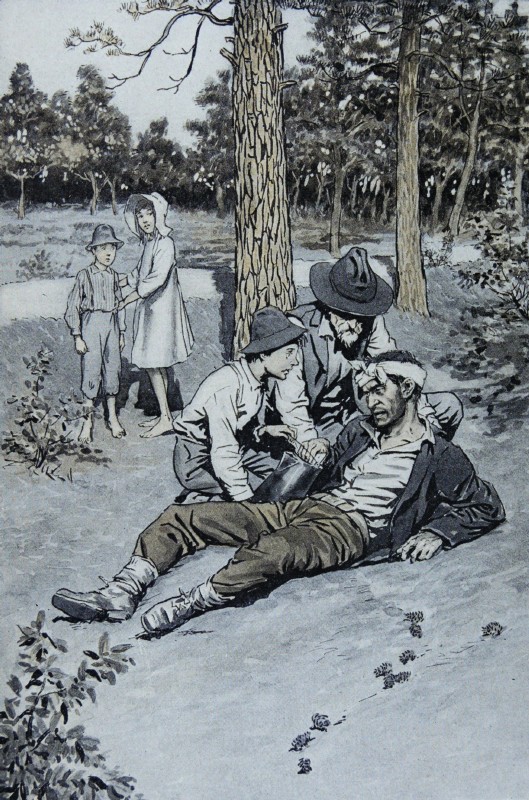 THE WOUNDED MAN AND HIS HARDTACK We come
back to him
every day for eight or ten days as long as he lived. It was awful to
see the
poor fellow. He had a pretty hard time after he got so he couldn’t
fight the
flies. Finally we come thar one morning and found him dead, and we left
his
body whar it was. While we
was
lookin' around on the battlefield we noticed one of the men who'd been
killed
layin' with his coat thrown back, and we could see the edge of a
Testament in
an inside pocket. Father said to me, "Boy, get that." But I
didn’t have
the courage, and he took it and give it to me. The name of the
soldier's
mother, and her address — Beaver, Maine — was written on the flyleaf. I
kept
that Testament for fifteen years afterward. Then I wrote to the flyleaf
address, and I got a reply and sent the book to the dead soldier's
folks. In
return they sent me a nice Bible. I s'pose they was mighty glad to get
that
little Testament. Hundreds of those who perished in the battle here were not buried, but laid scattered around on the ground. The men who did the burying missed 'em in the thick brush, and their bones was thar till after the war. We can find bones on the battlefield sometimes now, but the government sent a burial corps here soon after the war ended, and they gathered up most of the bones and carried 'em to the National Cemetery at Fredericksburg. About the same time a lot of the bones of the horses that was killed during the battle was carted off to be ground up for fertilizer.
_____________ 1 He was getting along in years, but he was still stout-framed and vigorous. His home was in the Wilderness, but it was one of several in a cleared tract of considerable extent where there was grassland and cornfields. I visited with him in a rather barren apartment whose chief article of furniture was a bed, and whose most cheerful feature was a fireplace in which a few sticks of wood were burning with a pleasant crackle and leaping of ruddy flames. |
 Click the book image to turn
to the next Chapter.
Click the book image to turn
to the next Chapter.