
Web
and Book design,
Copyright, Kellscraft Studio 1999-2007 (Return to Web Text-ures) |
 (HOME)
|
|
XXXIV The Girl on the
Mountain 1 MY father was a carpenter here in Chattanooga, but a time came when he had to stop work on account of tuberculosis. The physicians in town had given him up. However, he decided to move to the top of Lookout Mountain and try the rest and air cure. He rented a little log cabin up there. That was in 1851 when I was two years old, We carried our goods up an Indian trail on packmules. Mother took me up in her lap on horseback. Several families were already living on the mountain, and a road was built the next year. Then more families moved there, and Father put up a frame house. His health had improved, and he was now able to work as usual. The
mountain rises
to a height of about three thousand feet. It has a flat top, and our
house was
right on the plateau a mile from the point. We mountain dwellers had
gardens
and orchards and turnip patches, and we kept cows and pigs. Six miles
farther
back on the mountain were farms. Near our home was the Lookout Mountain
Educational Institute. It had some seventy-five pupils boarding right
at the
school and a few day pupils, but most of the families at the point had
governesses to teach their children books and music. Our first
serious
experience in warfare came in August '63 when a Northern detachment
under
Wilder bombarded the town. It was on a Friday that had been set apart
by the
Confederate government for fasting and prayer. A Chattanooga woman who
had a
summer home on the mountain had brought me down to the meeting in her
rockaway.
The church was crowded and the minister was praying when the first
shell came
and exploded just outside. I looked around. I thought the gallery had
fallen. A
woman who sat in the seat in front of me slapped her husband on the
back and
exclaimed, "My God! Mr. Bruce, the Yankees are coming." The
minister kept
right on praying, but the people in the pews all jumped up and got out.
There
was almost a panic, A great many of them went off south without even
going to
their homes. The neighbor who had brought me sent her driver to her
town house,
and he got as much as he could carry in a sheet, and then we hurried
back to
the mountain. The bombardment damaged the town buildings more or less
and a
number of people were hit, including a little girl who was killed on
the
street. But the Yankees didn’t cross the river. A great
many
Confederate soldiers were stationed on the mountain, and they had very
little
to eat. We owned five elegant cows, but the soldiers killed them and
issued
them out as rations. They got our pigs and chickens, too, and we didn’t
have
anything left but a flock of guineas. The guineas could fly up in the
trees,
and they escaped. The country was scoured over by both armies,
everything was
demoralized, and food wasn’t to be bought for love or money. We just
lived from
hand to mouth. Salt was
one of the
scarcest commodities. That's one thing we couldn’t get along without.
People
even dug up the ground in their smokehouses to get it. You see meat
that had
been pickled in brine had been hung in there year after year, and the
drippings
had fallen to the dirt below. By putting the earth in a hopper and
letting
water run through it the salt would be carried along. Then, when the
water was
boiled down, the salt would crystallize, of course it was unrefined,
but it was
better than none at all. My father
was a
Union man, and he had to stay pretty close. Once he was ordered to
report to
the headquarters of General Bragg who was the chief commander of the
Confederates in this vicinity. He had been betrayed by a neighbor
woman. She
had a grudge against him because he had refused to let our wagon go to
town to
haul supplies for her. A Confederate officer was sick at our house. We
nursed a
good many sick soldiers of both armies and so made friends. Mother was
terribly
distressed about Father's summons, and she told that sick officer of
our
trouble. So the officer wrote a letter and sent it by an orderly to
General
Bragg, and Father was let off. When the
battle of
Chickamauga was fought it was a very dry time. The springs were all
dried up
and the dust was ankle deep. Many of the soldiers who marched past our
house
carried their shoes their feet hurt so. We could see the battleground
about a
dozen miles off to the south and trace the movements of the armies by
the dust
and smoke. We could hear the cannonading, too. It was terrible and made
us feel
as if nobody could live through it. After the
battle
the Union army was cooped up here in Chattanooga with only one rough
mountain road
over which to draw supplies from Bridgeport, sixty miles distant.
Sometimes
raiders captured the wagon trains and the teams wouldn’t get to bring
anything
through. When the soldiers had flour they'd take it to some townswoman,
and
she'd make light bread for them and get a part of the flour in pay. She
took
toll like a miller. A relative of ours gave some of the soldiers two
sacks of
shelled corn at a time when they were suffering for food. They filled
the
little pint cups they drank their coffee out of, and they parched the
corn and
ate it and were glad to get it. Ten
thousand horses
and mules died here within a month for want of food. Their bodies lay
all along
the road. I counted as many as thirteen in one pile. They made the air
in the
valley just stifling. It was all the soldiers could do to bury the men
who
died, and they didn’t bother with the horses and mules. There was
always
lots of sickness in the army. Sometimes there'd be an epidemic of
measles,
That's a serious disease for grown persons. A man would get delirious
and
wander out of the tent or house where he was, and he'd be out over
night and
catch cold and die. There was smallpox galore toward the end of the
war. Lots
of soldiers, too, died from scurvy. Scurvy was caused by eating too
much salt
meat, and men sick with it were just crazy to get onions or any kind of
vegetables. That was the kind of food they needed if they were going to
recover. The diseases that ravaged the armies spread to the homes. The
colored
troops were a special menace in carrying the infection, so many of them
were
gadding about the country and getting into families. While the
Union
troops were besieged here there was great lack of firewood in the
place.
Cameron Hill, which was covered with beautiful trees was soon swept
bare, and
the soldiers even dug up the stumps to burn in their fires. No barns or
outbuildings were left anywhere. Grant
arrived late
in October, and a wagon road was established to a point down the river
where
supplies could be brought by boat. Then Sherman came with
reinforcements, and
on November 24th Fighting Joe Hooker assailed Lookout Mountain which
was held
by the Confederates. We sometimes have a fog here in a gloomy rainy
spell so
dense that you can't see anybody fifty yards away. It was raining that
morning,
and one of those thick fogs was hanging about the mountain sides. The
Confederates couldn’t see the movements of the Union troops and were
not aware
of their approach until they had reached the base of the mountain. The
plateau
at the summit is bounded by a palisade or precipice of rocks with
stony, wooded
slopes below. Some of the Federals fought their way up to the palisade
on the
north side of the mountain. The
Confederates
had fortified themselves on the plateau, but they were expecting to be
attacked
from the other direction. However, they readjusted themselves, and they
formed
a line of battle extending from the summit to the valley. In the
fighting that
followed they were gradually pushed back along the mountain side and
around its
eastern end. The contending troops under the point at the foot of the
palisades
were above the clouds, and they were all invisible from the valley.
They fought
until after dark. The firing sounded like the popping of popcorn in a
skillet. A good
many people
took their bedding and things and went down under the cliffs on the
other side
of the mountain and stayed all night. Our family didn’t run. We were up
till
late, and then there was a lull in the battle and we went to sleep as
usual. Some of
the signal
corps had been stopping at our house. The mountain was an excellent
place to
signal from, and on many a night we had watched the waving of answering
signal
torches on distant high points. The signal corps men had to leave in a
hurry,
and they told us a retreat had been ordered and that the commissary
stores,
which were in a vacant house near by, would have to be left behind.
They wanted
us to have some of those stores. Mother and
I and
Father hurried to the vacant house and brought away what we could carry
in our
arms and hid the things in the attic, We had hardly done that when some
Union
troops came and searched the house. They looked up in the attic, but
they
didn’t find our commissary stores. We went out and walked about later in the day, and I remember seeing a dead sharpshooter. He had established himself in a crevice of a mountain cliff, and from there had been picking off the Union troops. But finally they saw and shot him, and he fell all in a heap down in the crevice. His body was there for several days. 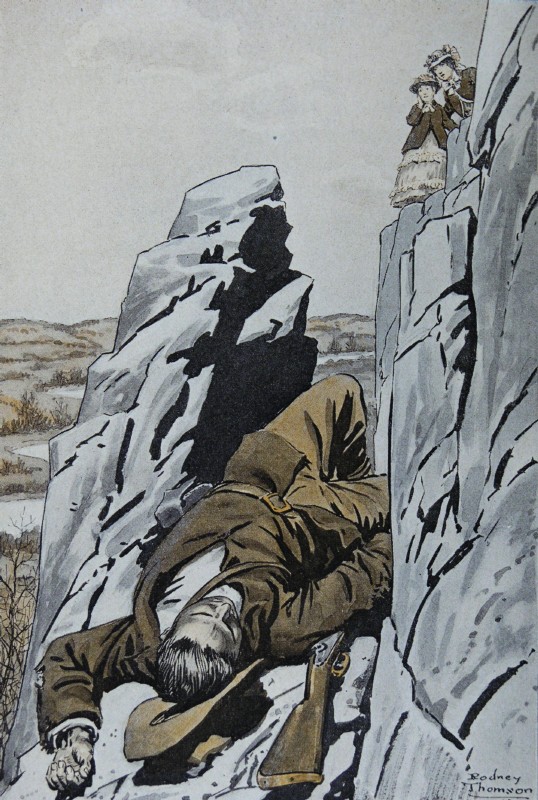 THE SHARPSHOOTER AFTER THE BATTLE Missionary
Ridge
rises south of the town to the height of a few hundred feet, and on its
crest
were posted fifteen thousand Confederates with cannon. The very day
that Hooker
completed his conquest of Lookout Mountain the Union troops
successfully stormed
Missionary Ridge. The assault was made at three o'clock in the
afternoon, and
we could see the men as they charged up the slope with the sun shining
on their
accouterments. It was a wonderful sight. The battle was short and
decisive. The
Confederates fled in wild disorder, and the guns that they abandoned
were
turned against them. There was great loss of life, a host of wounded, and numerous prisoners. The fighting forces were still further reduced by desertions. Back on the mountain a score of miles was a wild, isolated region that was full of deserters from both armies. The poor country folks out there lost all they had. Yes, the army played havoc in one way or another with every section it was in. ________________ 1 She was a serene,
white-haired
woman in an attractive home of more than ordinary refinement. I was her
guest
one evening while she recalled for my benefit her childhood life in war
days. |
 Click the book image to turn
to the next Chapter.
Click the book image to turn
to the next Chapter.