
Web
and Book design,
Copyright, Kellscraft Studio 1999-2007 (Return to Web Text-ures) |
 (HOME)
|
|
V The Farmer's
Daughter1 WHEN the
battle of
Bull Run was fought back in 1861 my people lived hyar where I do now in
this
same little of farmhouse. Well, it's funny, I live hyar by myself, and
this is
a very retired place, but every now and then some stranger walks in on
me. So
you're from way up in Yankee land. Do you see that old white gobbler
out there
on the woodpile in the yard? He's my watchdog, and he warned me some
one was
comin' befo' you got to the gate. What wet
weather
we're havin'! My stove always smokes such days. I wish somebody would
stick
their hat up in that hole in the sky where the water comes from so the
rain
would stop and give me a chance to work in my garden. I reckon this
rain has
played the mischief with a heap of people. My brother was tellin' me he
drove
through the ford down hyar at the battlefield, and the water come right
up into
his buggy. That stream is only a common little old branch, too. Sunday,
July 21st,
was the date of the battle. The Henry farm, where there was the hottest
fightin' is about two miles from hyar. The Yankees had marched out from
Washington a few days earlier, and our men had been gettin' ready for
'em; so
we knew the battle was comin' off. The railroad passed along the edge
of our
farm, and the trains were runnin' all Saturday night bringin' Southern
troops.
The rumblin' of the wheels and the whistle for the crossin' hyar would
wake us
up every few minutes. Sunday
came, and we
did our mornin' work as usual. I was eighteen then, and I had four
brothers,
the youngest only three years old. We kept our horses and cattle out in
the
pasture, and the little boys would drive the cows up the first thing
every
mornin', and we'd milk 'em and let 'em go. Another thing we did befo'
breakfast
was feeding the fowls and the calves. I do that yet. All the animals
have got
to be fed befo' I'm fed. The
mornin' was one
of the prettiest I ever see in my life, and for a while everything was
very
still, but about six o'clock, just as breakfast was ready, a Yankee
cannon that
we called Ol' Tom let loose. Paw had the boys go and get the colt from
the
pasture and put the saddle on him, and as soon as Paw was through
eating he got
on the colt and went down to the Henry house. If he hadn’t been too old
and his
health too bad he'd have been in the army. Anyway, he did what he could
to
help, and he never went to camp that he didn’t carry something to the
soldiers.
This time he took along a tall black bottle of wine and a little glass
to drink
from. That glass belonged to me. Grandmother gave it to me when I was a
little
bit of a tot. I have it yet, and I'm goin' to hang on to it as long as
I live.
The wine was blackberry wine. Maw made a lot of that every year. Paw got in
with
some Southern soldiers, and they went half a mile west along the pike.
Then a
battery at the Henry house mistook 'em for Yankees and fired a six
pound cannon
at 'em. The soldiers thought they'd better go back to where that
battery was
at. So Paw got out his wine and gave 'em each a drink, and away they
went. After Paw
had put
the glass and bottle in the saddle-pockets he mounted his horse and
came over
in this direction through a wheatfield. The wheat had been cut and
stood there
in shocks. As he was a-goin' along in the stubble he was close enough
to the
Union lines to hear the officers givin' commands, but they didn’t seem
to
notice him. Paw was a man of mighty cool nerve and he didn’t get
frightened. On this
side of the
wheatfield was the Widow Dogan's pasture with a great, big, right-new
worm
fence around it. The colt wouldn’t jump the fence, and Paw took off the
top
rail. But the colt balked just the same, and he had to take a whole
panel down
except two rails. The widow's cows were in the pasture, and Paw thought
it
wouldn’t do to leave the fence down, because the cattle would get into
the
wheat. So he put up every bit of the fence as he found it and came on
up to
Groveton. The ground is high there, and the people from the scattered
farmhouses were out on the hills watchin.' Ol' Mrs. Dogan was there
with all
her children, and other women with their children, and lots of darkies
were
lookin', too. Some of
the Yankees
came across there later, and they picked up Mrs. Dogan's overseer. He
had all
the house-keys, and I don't know what she'd have done if they hadn’t
let him go
so he got home in time for supper. All
through the
early mornin' there was an artillery shot every now and then, and about
nine
o'clock firin' commenced with small arms. The first round had the
funniest
sound — just like throwin' a whole lot of lumber down. From that on the
battle
was hot. I was hyar
with the
children and Maw, and I was sittin' on the stake and rider fence out in
front
of the house when that first volley was fired. We had a tremendous
wheat rick,
and a great long ladder was leanin' against it. The children and I
climbed up
and stood on the top of the stack. But the trees down below hyar shut
off all
sight of the battlefield, and we could only see the bombs exploding.
They were
n't very near, though, and I don't remember hearin' a bomb whiz. The trains
were
still comin' on the railroad, but by and by a Union scout stopped one
of 'em
hyar at the crossin'. He'd slipped around from Sudley, and the rascal
stayed
two or three days in the woods near by. He told the officers on the
train some
story that he thought would keep their troops from gettin' to the
battlefield,
but he failed to accomplish his purpose. The soldiers left the train
and some
of 'em came right down the road that passes our house and stopped to
ask where
they could fill their canteens. I directed
'em to
our spring at the foot of the hill. I always was spokesman when Paw was
away,
and there were a few times I had to be spokesman when he was at home
and 'fraid
to open his mouth. A woman somehow has her wits about her and can get
around an
enemy the way a man can't. Often, during the war, if Paw was goin'
somewhere on
his horse, he'd take me up behind him rather than go unprotected alone.
Those
soldiers who
spoke to me that July morning were so anxious to get in the fight that
they
double-quicked it to the spring, and they went on from there at a
gallop down
as far as I could see. They were Jackson's foot cavalry, and Jackson's
men
always did double-quick. There was an officer among 'em who rode the
prettiest
dapple-gray I ever see, and the men on foot were running in front of
him and
pulling the fences down. Another train full of troops was stopped by a man who lived two miles back hyar at Gainesville. He got on his horse and rode clear up to Thoroughfare Gap, six or seven miles, and told the officers on the train that our men were whipped. The man was just actin' the traitor, for he knew better. Well, he was always mean from the time he was little. The South Car'linians found out his trickery later in the day, and they was huntin' for him, but he was hid. They'd 'a' swung him up there in Gainesville in front of his mother's house. They wouldn’t 'a' cared. You know they're hotheaded people, anyhow. 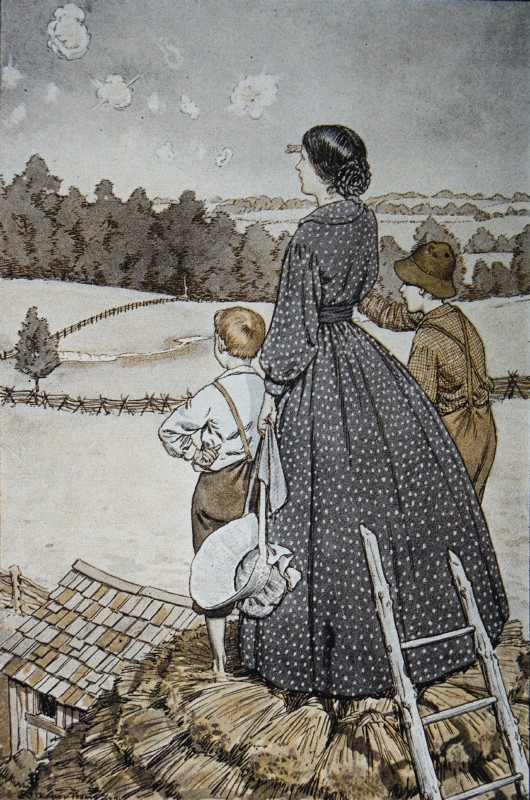 WATCHING THE BURSTING BOMBS While the
fightin'
was goin' on that mornin' the children and I rambled all over the place
hyar,
and then I did something I guess nobody else on earth would do — I went
upstairs and lay down and had a good sleep. When I get tired I want a
nap. The
battle wasn’t a-botherin' me. Early in the day, when it was first
startin', the
thought came into my head —"Oh my God, if the Yankees should whip
us!" But I said
to
myself, "They're not a-goin' to do it"; and I was just as easy the
rest of the day as if there was nothin' goin' on. I was confident they
wasn’t
goin' to whip us noway. We had our
dinner
at the usual time, and we sat hyar watchin' the bombs explode. They
exploded
mighty high in the sky. I thought they wasn’t doin' much damage. Father
was
still away, but we set there laughin' and talkin', and Mother never let
on that
she was anxious. He got home about two, and said the Yankees had driven
our men
more 'n a mile till they came to Jackson's brigade. That was where
Jackson
earned his nickname. His men stood like a stone wall. 'Bout the
time Paw
finished eatin' dinner, hyar comes a Southern soldier to the house for
water.
He'd been carryin' the wounded, and the front of his pants was all
bloody where
one of the wounded men had fallen against him. After he'd
gone my
two oldest brothers hitched up our ol' Jim horse; and he was a mighty
good ol'
horse, too, and he wasn’t so old either. They hitched him to the spring
wagon,
and they helped Paw put in a keg and a ten gallon lard can and fill 'em
with
water. Besides, they put in a basket with some victuals in it. There
was a ham
we'd cooked, and a whole lot of light bread—that's bread made with
yeast. Paw took
all those
things in his wagon and drove around a back way and got two citizens to
go
along with him. They were nearly down to Wheeler's house when they saw
some
cavalry around there, and they didn’t know whether the cavalrymen were
Southerners or Northerners. One of the citizens rolled out of the wagon
in a
hurry to get away. He was 'fraid the Yankees was goin' to ketch him.
Paw was
left in the road with the other man. They concluded it was safe to
proceed, and
they kept on toward the battlefield. Pretty soon they saw a wounded
Yankee
lyin' in a fence corner, and he was beggin' for water. They gave him a
drink
and fixed him as comfortable as they could and went on. After that it
was
wounded and wounded all along. By that
time the
fightin' was over. The Union troops had kept chargin' up the hill at
the Henry
farm, but our side was constantly receivin' reinforcements, and finally
our men
charged. The Yankees fell back, and presently they got panic-stricken.
They
thought the Confederates were chasing 'em, and they hurried on till
late in the
night, and some never stopped short of Washington, which is thirty
miles from
the battlefield. In the
afternoon we
were settin' around the house till it was time to do the evenin' work,
and we
could see the black smoke and the red dust on the Sudley road where our
men had
got the Yankees runnin' — and if 't wasn’t the biggest dust ever kicked
up! Paw never
come home
till just befo' day, and he found us all asleep. We knew he knew how to
take
care of himself. He'd been haulin' wounded off the field in his wagon.
Lots of
people's teams was doin' the same. Every house in all that country was
a
hospital, and they had field hospitals, too. Monday
morning,
after Paw had slept a while, he went back to the battlefield. My oldest
brother
wanted to go with him, but Paw said the sights were too horrid for a
boy of
sixteen. All the wounded had been picked up when Paw got there except
some of
the Yankees. They'd crawled everywhere they were so afraid the Rebels
were
goin' to murder 'em. If they'd stayed where they were at when they were
shot
they'd have been cared for. Some crawled to the wheat shocks and pulled
the
bundles down over 'em. They hid in all sorts of places. More than
twenty years
afterward a couple of men out huntin' found a Yankee, way in a thick
clump of
pines, fallen between two trees. It looked like he'd been settin'
leanin'
against one of the trees till his strength failed him; and there were
his bones
and shoes and some scraps of clothing. Soon after
the
battle ended one of our officers noticed something in the hand of a
Yankee who
was lyin' on the ground apparently dead. The officer got down and
opened the
man's hand, and in it was a white kid glove. The man happened to still
have a
little life left, and he opened his eyes. Then the officer put the
glove back,
and the fingers closed over it again. I suppose the man had married
just befo'
he left home. A second
battle was
fought hyar the next summer. Some of the fightin' was done right around
our
place and I had a chance to hear the Rebel yell. It sounded like a
whole lot of
schoolboys runnin' a rabbit. Indeed, the Southern soldiers were mo'
like
schoolboys runnin' a rabbit than anything else. They were full of
mischief —
cram full of it. A great
many men
were killed in that battle, and there were places where the ground was
so
soaked with blood that not one thing would grow on those spots for
years. You'd be
surprised
how careless the Yankees were about burying their dead. The
Confederates did
their part all right. Our men were buried so deep no ploughshare or
anything
will ever touch 'em. There they'll stay till the Day of Judgment. Some
soldiers
were sent hyar from Washington to bury the Union dead, and they just
joked and
talked politics with the old men in the neighborhood, and run on
foolishness
with the little white boys and little niggers. of co'se they made some
pretense
at doin' their work, but often they'd leave a corpse right on top of
the ground
and throw on a little dirt, or turn half a log over it. One man had
rocks piled
on him, and another they put in a little narrow ravine and laid some
rails on
top. A detachment of artillery drove across the rails afterward, but a
day or
two later the man was removed — I reckon by soldiers who knew him. They
buried
him near an oak tree and cut his initials on the tree-trunk. Frequently
I'd go
to walk over the battlefield just to be at it, and I'd always pass a
place
where one of those men was layin' half buried on top of the ground.
Enough dirt
had been thrown over him to cover all except his head and one arm that
was
stretched out from his body. There was a road near him, and a big pear
tree.
I'd go and look at him out of curiosity. He was a sharp-featured man
with a
long face and sandy hair and a sandy moustache. His eyes were closed,
and he
lay there just like he was asleep. Our men
buried some
of the Yankees. A railroad had been begun hyar and abandoned, and they
gathered
up six hundred and eighty-three Yankees and piled 'em up good at the
end of
this railroad embankment and then threw dirt down on top of 'em and
covered 'em
deep. Along in '64 and later Northern people used to come out hyar all
in a
cahoot from Washington to see the battlefield. They had it in their
heads that
a lot of Rebels were buried at the end of that embankment, and they
went on
their horses and hawhawed and rode all over the spot just for the fun
of it.
You people don't know how they behaved down hyar. I don't think devils
could
have been so mean. They wore the dirt off the bodies, and the citizens
would go
and throw it back on. One day I
was
standin' by the roadside with some friends down at Groveton when a
Yankee
doctor come ridin' along on his horse, and he had a leather strap full
of
skulls. The strap was run through at the ears. He held it up and said
to us
laughing, "Look at these Rebel skulls I've got." "Where'd
you
get 'em?" I asked. "Out hyar at the end of the embankment," he said. "Indeed,
then, they're not Rebel
skulls," I said. "They're skulls of your own men." But he
took 'em
along just the same. I hope they were always grinning at him and
wouldn’t let
him sleep nights. Plenty of
Yankees
in the army, too, were no more a credit to the North than those people
from
Washington. If you knew what we know about the letters found on your
dead and
wounded hyar on the battlefield you'd be ashamed to say that any of
your
ancestors were in the Northern army. One letter was from a woman who
asked her
husband to send her some Rebel furniture, because she was tired of
boarding and
wanted to go to housekeeping. The top of the man's head was blown off,
and my
brother said, "He's got the Rebel furniture all right." The
letters were
written by people who had no education scarcely. We hear tell 'bout New
England
education and how Boston is the top of the pot, but the writers of
those
letters couldn’t even spell. From what
I've
heard of the folks who live in Vermont and New Hampshire and your
Northern
mountains a stranger can hardly get a civil answer to a question. It's
different down hyar. Our mountain people are polite and nice. I can
tell you
another thing — when I get on a train and set with a stranger I always
know
which section of country the stranger is from. If he's chatty he's
Southern —
if not, Northern. There's a
lot mo'
class distinction in the North than in the South. An officer come hyar
one
evening and wanted supper, and he had his orderly with him. Well, the
hateful
old thing kept the orderly settin' out on his horse while he himself
was in
gettin' warm by the fire. We were havin' misty, damp, foggy, wet
weather just
as we always do in the fall of the year, and Paw spoke to the officer
'bout the
man outside. "Oh! he's
only
an orderly," the officer said. But Paw
went out
and told the man to come in. He came, and yet as long as he was in the
room
with the officer he looked just like he was on a hot griddle. Quite a
lot of your
Northern men was hyar some six or seven years ago to dedicate a
monument, and
they was wantin' whiskey, whiskey all the time. They had puffy bodies
and
purplish cheeks, and I never saw such a funnylookin' set of people in
my life.
It seemed as if you might touch a match to some of 'em, and they'd be
set on
fire. In the
spring of
'65 the government sent men to dig up the remains of the Northern
soldiers and
carry 'em to Arlington, but they only just took the big bones, and not
all of
those. There were lots of arm and leg bones out hyar in the woods where
the
doctors did their amputating that they never got at all. It seems to me
I don't
want to be livin' at the resurrection when all the people's bones will
get
together to make their bodies complete. I might get hit. They'd be
flyin'
around so thick it would be dangerous — it would so. I remember
there
was one skull layin' out on the pike a long time. The boys thought it
was fun
to see how far they could kick it. They couldn’t break it to save their
lives,
and everything that come along — horses and all — give that skull a
kick and
never broke a piece off of it. I don't know whatever became of it —
whether it
got kicked in the branch, or what happened to it, but it disappeared. Once some
of us
young people were goin' along side of Bull Run through the bushes. I
was ahead,
and the first thing I knew I was face to face with a Yankee skull some
one had
set up there on a black stump about five feet high. I couldn’t help but
laugh.
It didn’t scare me. I'd seen too many. Yes, some of the most ridiculous
things
happened during the war, and some of the saddest and some of the
meanest. We had the
Yankee
soldiers around hyar most of the time, and some of 'em were posted as
guards
close by at the railroad crossin'. They wouldn’t allow any citizen to
go over
the crossin' unless they were satisfied he was all right. In order to
stop any
one who might try to go along after dark they fixed wires across the
road to
take a man riding on horseback just below the chin. But our boys found
out
about the wires, and they'd duck their heads and ride under 'em. Black
Frank Lewis
had an ol' hog that used to ramble all about the country, and one night
the hog
was rootin' in the leaves near the crossin', and the Yankees swore it
was the
Rebels. They caught a glimpse of it by the light of their lantern and
shot and
killed it. Then they skinned it right there, and some wrote home that
they had
shot a panther which measured five feet from the tip of its nose to the
end of
its tail. A good
many of these
Yankees had joined the army to get a bounty with the understanding that
they'd
only be used to protect the capital. But you know the United States
government
never kept a promise, and they were awful afraid they'd be sent down to
fight
around Richmond. Some of 'em cut up Jack and were mean as the Ol'
Scratch, but
we tried our best not to have any trouble with 'em. "Better have the
good
will of a dog than the bad," Mother said. Tongue-lashin'
'em
didn’t pay. Sometimes my youngest brother made us anxious, for he was
the
greatest little rascal, and he'd say things befo' 'em. But he lisped,
and they
couldn’t understand him. The rest of us wouldn’t never say much to 'em,
but if
they got cuttin' up too high and stealin' we'd save what we could. Ol'
Doctor Stewart
up hyar kept a hatchet sharpened to split their heads open, and he let
'em know
it. They told him if there was mo' ready that way, they'd behave
themselves. Once a
prowler come
round to where we had all our fowls fastened in the paddock. The wretch
started
to crawl in there and had got half way under the high log fence when my
little
brother saw him. The boy took a good stout apple-stick and gave him the
biggest
lamming I ever looked at, and the feller was glad to back out and slink
off. Another
time I
found a Yankee in our yard chasin' the chickens, and I told him to let
'em
alone. He said: "I'll leave you two. You can be thankful I won't take
'em
all. You can raise a dom sight from two." But he
didn’t carry
off any at all. He'd got 'em to runnin' and he couldn’t ketch 'em. We
had some
guineas, but the soldiers never bothered them. They thought guineas
wasn’t fit
to eat, and that we just kept 'em to scare off hawks. For a
while we had
our hens underneath the kitchen. There was forty or fifty — a whole
gang of
'em. The kitchen was underpinned all around, but some of the rocks were
loose
near the back door so we could pull 'em out, and my younger brothers
would get
in there and hunt for the eggs. They were little chaps who could crawl
everywhere. Under the stove was a hole that had got burnt through the
floor,
and we'd laid a piece of board over it. We threw the chickens' feed
down that
hole. A guard who had been detailed to stay at the house and protect
our
property heard one of the chickens squawk when another pecked it, and
he said;
"Oh! you-all got your chickens under hyar. I never knew that befo', and
I
been hyar with you nearly three weeks." Besides
our ol' Jim
horse we had another horse named Barney. It was funny to see Barney
sometimes.
Once some Yankee cavalrymen got after him and chased him into our
potato patch.
We saw 'em racin' around there and doin' their best to ketch him, and
he was so
smart he wouldn’t let 'em do it. He'd stop short off and they'd go on
past him,
and he played that same trick on 'em again and again. It's a wonder
they didn’t
shoot him. They did some tall cussin', and if every oath had been a
Parrott
shot they would have killed all the people within range. Pretty soon an
officer
came, and he made 'em go away. If I'd been him I'd have taken my saber
and
whacked some of 'em. Barney went down in the woods and stayed there
till they
were all out of the country. One of
Barney's
hoofs was too long. I don't know what had happened to him. He wasn’t
lame, but
that hoof made him walk lame, though we could work him anywhere and
ride him.
I've ridden him many a time. After bein' chased by the Yankees he never
could
bear the sight of a blue coat. It would make him jump like he was goin'
to jump
out of his skin. We had a neighbor who wore an old blue army overcoat
he'd
picked up on the battlefield. Once I went to where he lived on some
errand, and
I rode Barney. I got to the man's gate, and he come out of the house
wearin'
that coat, and I told him to stop where he was. But he walked right
along to
the gate, and Barney drew himself up in a hump and bucked. If I'd had a
sidesaddle I could have stayed on, but I had a cavalry saddle, and I
went over
backwards onto a pile of stones. I hurt my thumb — that was all. When
the ol'
fool in the blue overcoat saw what he'd done he kept back, and the
horse stood
still. I got on Barney and rode away. I could have killed that man, but
I never
said no mo' to him. I'm one of these that treat a man with silent
contempt when
they have no use for him. This was
such a
small of house that most of the soldiers thought there was nothin'
inside worth
takin', but we had some silver spoons and a few other small articles
that were
of value. Women wore hoops then, and I made a big pocket and put our
valuables
in it and wore it under my hoops when the Yankees were around. They used
to help
themselves to the potatoes in our potato patch. They didn’t get many,
though,
for they only had bayonets and spoons and such things to dig with. The Ohio,
Indiana,
and Illinois men — they were the meanest — except the riffraff from the
cities,
and one regiment from Michigan. The colonel of that regiment was as
mean as the
men were, and there was a major who was meaner 'n any of 'em. Long
after dark,
one warm September night, that major and two or three of his men come
in hyar
without knockin'. I was up, but Maw and the children had gone to bed.
Paw was
away. An officer had sent for him to come and pilot some of the troops
on an
expedition they were makin' that night, and Paw said they were shootin'
at
every cedar bush along the way takin' it for a Rebel. The major
wanted to
boil some coffee, and I said, "I'll boil it for you." I wasn’t
goin' to
let 'em in the kitchen to save their necks, because I and my third
brother had
a pet sheep fastened up there. She kept mighty mum that night and never
bleated
once. The coffee
hadn’t
hardly come to a boil when the men wanted it. I brought it to 'em, and
they sat
around a table on the porch and drank it. They'd brought brown sugar
for
sweetening and they had some of crackers to eat. I gave 'em a lamp.
That was
befo' coal oil days, and we burnt butter in it. While they sat there
they were
makin' mean remarks 'bout one of the local women. I wish she'd heard
what they
said. She would jaw and abuse the Yankees and say all sorts of hateful
things
to 'em, and yet later she turned right around and married a Yankee
soldier. Those men
stayed
hyar till morning. We had a great big stack of hay next to the barn,
and they
would have fed their horses at it, but Paw had put briery hay on the
outside on
purpose, and when they got their hands into it they thought it was no
good.
Half of our garden was full of the biggest cabbages I ever see, and
they just
stripped that garden of cabbages and everything else. Besides they
killed all
the turkeys on the place. It wasn’t that they wanted the things for
food, but
they thought they were starvin' us Rebels. When they left they loaded
themselves up, and they scattered turkeys and cabbages along the road
half way
to Gainesville. We see
hard times
in the war. The women had to turn their dresses upside down and
wrongside fore
and inside out to make 'em last. My youngest brother had pants made out
of
pretty gray cloth that had been some Southern soldier's saddle-blanket,
and his
jacket was made out of a blue army overcoat. The battlefields was quite
a help
to us, for you could find almost anything on 'em — all but a steam
engine. I
never went out on 'em that I didn’t bring back a load of plunder.
That's where
we got materials for our shoes. Cartridge boxes were good for soles,
tent
canvas would turn water and was all right for the upper part, and we
tipped 'em
with patent leather from soldiers' belts. Paw could make the rougher
shoes. But
a fellow who lived out across the battlefield made shoes for all over
the
country. We took the stuff for our best shoes right to his house to be
made up.
Well, I've told you 'bout the fightin' round hyar. It makes me mad when people talk in favor of war. I've got no use for it, and I've got no use for battle vessels or big guns. It would pay a heap better to put the money into missions. _________ 1 Her home was an old,
low-roofed
farmhouse. It was small and much patched and stood in a thin grove of
trees
where the wild flowers grew in the grass, and the turkeys and chickens
rambled
freely about. We sat in the little kitchen the greater part of one
mild,
showery day. The door was open, and we could look forth on the misty
fields and
woodlands. My hostess had reached the age of three score years and ten,
but her
tall form was unbent, her features retained their natural ruggedness,
and there
was all the fire of youth in her lively and unconventional
conversation. |
 Click the book image to turn
to the next Chapter.
Click the book image to turn
to the next Chapter.