VI
NINE
POINTS OF THE LAW.
“WELL,” said Raffles, “what
do you make of it?”
I
read the advertisement once
more before replying. It was in the last column of the Daily
Telegraph,
and it ran: —
TWO THOUSAND
POUNDS REWARD.
—
The above sum may be earned
by any one qualified to undertake delicate mission
and prepared to run certain
risk. — Apply by telegram, Security, London.
“I think,” said I, “it’s the
most extraordinary advertisement that ever got into print!”
Raffles
smiled.
“Not quite all that, Bunny;
still, extraordinary enough, I grant you.”
“Look
at the figure!”
“It is certainly large.”
“And
the mission — and the risk!”
“Yes; the combination is
frank, to say the least of it. But the really original point is
requiring
applications by telegram to a telegraphic address! There’s something in
the
fellow who thought of that, and something in his game; with one word
he chokes
off the million who answer an advertisement every day — when they can
raise
the stamp. My answer cost me five bob; but then I prepaid another.”
“You
don’t mean to say that
you’ve applied?”
“Rather,” said Raffies. “I
want two thousand pounds as much as any man.”
“Put your own name?”
“Well — no, Bunny,
I didn’t.
In point of fact I smell something interesting and illegal, and you
know what a
cautious chap I am. I signed myself Glasspool, care of Hickey, 38,
Conduit
Street; that’s my tailor, and after sending the wire I went round and
told him
what to expect. He promised to send the reply along the moment it came.
I
shouldn’t be surprised if that’s it!”
And
he was gone before a
double-knock on the outer door had done ringing through the rooms, to
return
next minute with an open telegram and a face full of news.
“What do you think?” said
he. “Security’s that fellow Addenbrooke, the police-court lawyer, and
he wants
to see me instanter!”
“Do you
know him, then?”
“Merely
by repute. I only
hope he doesn’t know me. He’s the chap who got six weeks for sailing
too close
to the wind in the Sutton-Wilmer case; everybody wondered why he
wasn’t struck
off the rolls. Instead of that he’s got a first-rate practice on the
seamy
side, and every blackguard with half a case takes it straight to
Bennett
Addenbrooke. He’s probably the one man who would have the cheek to put
in an advertisement
like that, and the one man who could do it without exciting suspicion.
It’s
simply in his line; but you may be sure there’s something shady at the
bottom
of it. The odd thing is that I have long made up my mind to go to
Addenbrooke myself
if accidents should happen.”
“And you’re going to him
now?”
“This minute,” said Raffles,
brushing his hat; “and so are you.”
“But I came in to
drag you
out to lunch.”
“You
shall lunch with me
when we’ve seen -this fellow. Come on, Bunny, and we’ll choose your
name on the
way. Mine’s Glasspool, and don’t you forget it.”
Mr. Bennett Addenbrooke occupied
substantial offices in Wellington Street, Strand, and was out when we
arrived;
but he had only just gone “over the way to the court;” and five minutes
sufficed to produce a brisk, fresh-coloured, resolute-looking man, with
a very
confident, rather festive air, and black eyes that opened wide at the
sight of
Raffles.
“Mr. — Glasspool?” exclaimed
the lawyer.
“My name,” said
Raffles,
with dry effrontery.
“Not
up at Lord’s however!”
said the other, slyly. “My dear sir, I have seen you take far too many
wickets
to make any mistake!”
For a single
moment Raffles looked venomous; then he shrugged and
smiled, and the smile grew into a little cynical chuckle. “So you have
bowled
me out in my turn?” said he. “Well, I don’t think there’s anything to
explain.
I am harder up than I wished to admit under my own name, that’s all,
and I want
that thousand pounds reward.”
“Two thousand,” said the
solicitor. “And the man who is not above an alias happens to be just
the sort
of man I want; so don’t let that worry you, my dear sir. The matter,
however,
is of a strictly private and confidential character.” And he looked
very hard
at me.
“Quite so,” said
Raffles. “But
there was something about a risk?”
“A
certain risk is
involved.”
“Then surely three heads
will be better than two. I said I wanted that thousand pounds; my
friend here
wants the other. We are both cursedly hard up, and we go into this
thing
together or not at all. Must you have his name too? I should give him
my real
one, Bunny.”
Mr. Addenbrooke raised his
eyebrows over the card I found for him; then he drummed upon it with
his finger-nail,
and his embarrassment expressed itself in a puzzled smile.
“The fact is, I
find myself
in a difficulty,” he confessed at last. “Yours is the first reply I
have
received; people who can afford to send long telegrams don’t rush to
the
advertisements in the Daily Telegraph; but,
on the other hand, I was not quite prepared to hear from men like
yourselves.
Candidly, and on consideration, I am not sure that you
are the stamp of men for me — men who belong to good clubs! I
rather intended to appeal to the — er — adventurous classes.”
“We
are adventurers,” said Raffles
gravely.
“But you respect the law?”
The black eyes gleamed
shrewdly.
“We are not
professional
rogues, if that’s what you mean,” said Raffles, smiling. “But on our
beam-ends we
are; we would do a good deal for a thousand pounds apiece, eh, Bunny?”
“
Anything,” I murmured. The
solicitor rapped his desk.
“I’ll tell you what I want
you to do. You can but refuse. It’s illegal, but it’s illegality in a
good cause;
that’s the risk, and my client is prepared to pay for it. He will pay
for the
attempt, in case of failure; the money is as good as yours once you
consent to
run the risk. My client is Sir Bernard Debenham, of Broom Hall,
Esher.”
“I know his son,” I remarked.
Raffles knew him
too, but
said nothing, and his eye drooped disapproval in my direction. Bennett
Addenbrooke turned to me.
“Then,”
said he, “you have
the privilege of knowing one of the most complete young blackguards
about
town, and the fons et origo of the whole trouble. As you know
the son,
you may know the father too, at all events by reputation; and in that
case I
needn’t tell you that he is a very peculiar man. He lives alone in a
storehouse
of treasures which no eyes but his ever behold. He is said to have the
finest
collection of pictures in the south of England, though nobody ever
sees them
to judge; pictures, fiddles and furniture are his hobby, and he is
undoubtedly
very eccentric. Nor can one deny that there has been considerable
eccentricity
in his treatment of his son. For years Sir Bernard paid his
debts,
and the other day, without the slightest warning, not only refused to
do so any
more, but absolutely stopped the lad’s allowance. Well, I’ll tell you
what has
happened; but first of all you must know, or you may remember, that I
appeared
for young Debenham in a little scrape he got into a year or two ago. I
got him
off all right, and Sir Bernard paid me handsomely on the nail. And no
more did
I hear or see of either of them until one day last week.”
The lawyer drew his chair
nearer ours, and leant forward with a hand on either knee.
“On Tuesday of last
week I
had a telegram from Sir Bernard; I was to go to him at once. I found
him
waiting for me in the drive; without a word he led me to the
picture-gallery, which
was locked and darkened, drew up a blind, and stood simply pointing to
an
empty picture-frame. It was a long time before I could get a word out
of him.
Then at last he told me that that frame had contained one of the rarest
and
most valuable pictures in England — in the world — an original
Velasquez. I
have checked this,” said the lawyer, “and it seems literally true; the
picture
was a portrait of the Infanta Maria Teresa, said to be one of the
artist’s
greatest works, second only to another portrait of one of the Popes in
Rome —
so they told me at the National Gallery, where they had its history by
heart.
They say there that the picture is practically priceless. And young
Debenham has
sold it for five thousand pounds!”
“The
deuce he has,” said
Raffles. I inquired who had bought it.
“A Queensland legislator of
the name of Craggs — the Hon. John Montagu Craggs, M.L.C., to give him
his full
title. Not that we knew anything about him on Tuesday last; we didn’t
even know
for certain that young Debenham had stolen the picture. But he had gone
down
for money on the Monday evening, had been refused, and it was plain
enough that
he had helped himself in this way; he had threatened revenge, and this
was it.
Indeed, when I hunted him up in town on the Tuesday night, he confessed
as much
in the most brazen manner imaginable. But he wouldn’t tell me who was
the
purchaser, and finding out took the rest of the week; but I did find
out, and a
nice time I’ve had of it ever since! Backwards and forwards between
Esher and
the Métropole, where the Queenslander is staying,
sometimes
twice
a day; threats, offers, prayers, entreaties, not one of them a bit of
good!”
“But,” said
Raffles, “surely
it’s a clear case? The sale was illegal; you can pay him back his money
and
force him to give the picture up.”
“Exactly;
but not without an
action and a public scandal, and that my client declines to face. He
would
rather lose even his picture than have the whole thing get into the
papers; he
has disowned his son, but he will not disgrace him; yet his picture he
must
have by hook or crook, and there’s the rub! I am to get it back by fair
means
or foul. He gives me carte blanche in
the matter, and, I verily believe, would throw in a blank cheque if
asked. He offered
one to the Queenslander, but Craggs simply tore it in two; the one old
boy is
as much a character as the other, and between the two of them I’m at my
wits’
end.”
“So you put that
advertisement in the paper?” said Raffles, in the dry tones he had
adopted
throughout the interview.
“As a last resort. I did.”
“And you wish us to
steal
this picture?”
It
was magnificently said;
the lawyer flushed from his hair to his collar.
“I knew you were not the
men!” he groaned. “I never thought of men of your stamp! But it’s not
stealing,” he exclaimed heatedly; “it’s recovering stolen property.
Besides,
Sir Bernard will pay him his five thousand as soon as he has the
picture; and,
you’ll see, old Craggs will be just as loth to let it come out as Sir
Bernard
himself. No, no — it’s an enterprise, an adventure, if you like — but
not
stealing.”
“You yourself mentioned the
law,” murmured Raffles.
“And the risk,” I
added.
“We
pay for that,” he said
once more.
“But not enough.” said
Raffles, shaking his head. “My good sir, consider what it means to us.
You
spoke of those clubs; we should not only get kicked out of them, but
put in
prison like common burglars! It’s true we’re hard up, but it simply
isn’t worth
it at the price. Double your stakes, and I for one am your man.”
Addenbrooke wavered.
“Do you think you
could
bring it off?”
“We
could try.”
“But you have no —”
“Experience? Well, hardly!”
“And you would
really run
the risk for four thousand pounds?”
Raffles
looked at me. I
nodded.
“We would,” said he, “and
blow the odds!”
“It’s more than I can ask my
client to pay,” said Addenbrooke, growing firm.
“Then it’s more
than you can
expect us to risk.”
“You
are in earnest?”
“God wot!”
“Say three thousand if you
succeed!”
“Four is our
figure, Mr. Addenbrooke.”
“Then
I think it should be
nothing if you fail.”
“Doubles or quits?” cried Raffles.
“Well, that’s sporting. Done!” Addenbrooke opened his lips, half rose,
then sat
back in his chair, and looked long and shrewdly at Raffles — never once
at me. “I
know your bowling,” said he reflectively. “I go up to Lord’s whenever I
want an
hour’s real rest, and I’ve seen you bowl again and again — yes, and
take the
best wickets in England on a plumb pitch. I don’t forget the last
Gentleman and
Players; I was there. You’re up to every trick — every one ...I’m
inclined to
think that if anybody could bowl out this old Australian... Damme, I
believe
you’re my very man!”...
The bargain was clinched at
the Café Royal, where Bennett Addenbrooke insisted on playing host at
an
extravagant luncheon. I remember that he took his whack of champagne
with the
nervous freedom of a man at high pressure, and have no doubt I kept
him in
countenance by an equal indulgence; but Raffles, ever an exemplar in
such
matters, was more abstemious even than his wont, and very poor company
to
boot. I can see him now, his eyes in his plate — thinking — thinking. I
can see
the solicitor glancing from him to me in an apprehension of which I did
my best
to disabuse him by reassuring looks. At the close Raffles apologized
for his
preoccupation, called for an A.B.C. time-table, and announced his
intention
of catching the 3.2 to Esher.
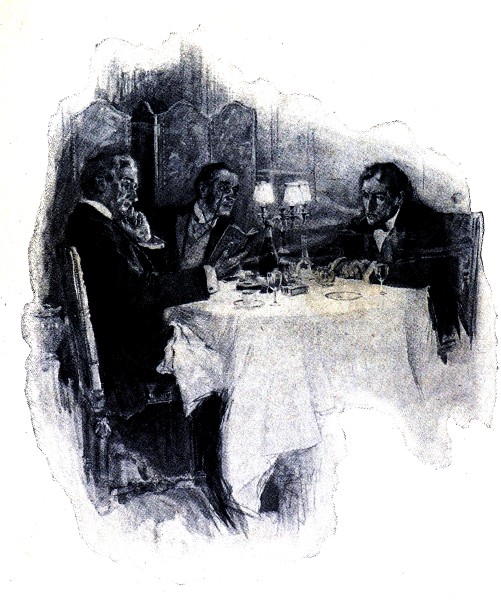
Raffles announced his intention of catching the 3.2 from Esher.
“You
must excuse me, Mr. Addenbrooke,”
said he, “but I have my own idea, and for the moment I should much
prefer to
keep it to myself. It may end in fizzle, so I would rather not speak
about it
to either of you just yet. But speak to Sir Bernard I must, so will you
write
me one line to him on your card? Of course, if you wish, you must come
down
with me and hear what I say; but I really don’t see much point in it.”
And as usual Raffles had his
way, though Bennett Addenbrooke showed some temper when he was gone,
and I
myself shared his annoyance to no small extent. I could only tell him
that it
was in the nature of Raffles to be self-willed and secretive, but that
no man
of my acquaintance had half his audacity and determination; that I for
my part
would trust him through and through, and let him gang his own gait
every time.
More I dared not say, even to remove those chill misgivings with which
I knew
that the lawyer went his way.
That day I saw no more of
Raffles, but a telegram reached me when I was dressing for dinner:
“Be in your rooms
to-morrow from
noon and keep rest of day clear, Raffles.”
It
had been sent off from
Waterloo at 6.42.
So Raffles was back in town;
at an earlier stage of our relations I should have hunted him up then
and
there, but now I knew better. His telegram meant that he had no desire
for my
society that night or the following forenoon; that when he wanted me I
should
see him soon enough.
And see him I did, towards
one o’clock next day. I was watching for him from my window in Mount
Street,
when he drove up furiously in a hansom, and jumped out without a word
to the
man. I met him next minute at the lift gates, and he fairly pushed me
back into
my rooms.
“Five
minutes,
Bunny!”
he cried. “Not
a moment more.”
And he tore off his coat
before flinging himself into the nearest chair.
“I’m fairly on the rush,” he
panted; “having the very devil of a time! Not a word till I tell you
all I’ve
done. I settled my plan of campaign yesterday at lunch. The first thing
was to
get in with this man Craggs; you can’t break into a place like the Métropole,
it’s got to be done from the inside. Problem one, how to get at the
fellow.
Only one sort of pretext would do — it must be something to do with
this
blessed picture, so that I might see where he’d got it and all that.
Well, I
couldn’t go and ask to see it out of curiosity, and I couldn’t go as a
second
representative of the other old chap, and it was thinking how I could
go that
made me such a bear at lunch. But I saw my way before we got up. If I
could
only lay hold of a copy of the picture I might ask leave to go and
compare it
with the original. So down I went to Esher to find out if there was a
copy in
existence, and was at Broom Hall for one hour and a half yesterday
afternoon.
There was no copy there, but they must exist, for Sir Bernard himself
(there’s
‘copy’ there!) has allowed a couple
to be made since the picture has been in his possession. He hunted up
the
painters’ addresses, and the rest of the evening I spent in hunting up
the
painters themselves; but their work had been done on commission; one
copy had
gone out of the country, and I’m still on the track of the other.”
“Then
you haven’t seen Craggs
yet?”
“Seen him and made friends
with him, and if possible he’s the funnier old cuss of the two; but you
should
study ‘em both. I took the bull by the horns this morning, went in and
lied
like Ananias, and it was just as well I did — the old ruffian sails for
Australia by to-morrow’s boat. I told him a man wanted to sell me a
copy of the
celebrated Infanta Maria Teresa of Velasquez, that I’d been down to
the
supposed owner of the picture, only to find that he had just sold it to
him.
You should have seen his face when I told him that! He grinned all
round his
wicked old head. ‘Did old Debenham admit the sale?’ says he;
and when I
said he had he chuckled to himself for about five minutes. He was so
pleased
that he did just what I hoped he would do; he showed me the great
picture —
luckily it isn’t by any means a large one — also the case he’s got it
in. It’s
an iron map-case in which he brought over the plans of his land in
Brisbane; he
wants to know who would suspect it of containing an Old Master, too?
But he’s
had it fitted with a new Chubb’s lock, and I managed to take an
interest in the
key while he was gloating over the canvas. I had the wax in the palm of
my
hand, and I shall make my duplicate this afternoon.”
Raffles looked at his watch
and jumped up saying he had given me a minute too much.
“By the way,” he
added, “you’ve
got to dine with him at the Métropole to-night!”
“I?”
“Yes; don’t look so scared.
Both of us are invited — I swore you were dining with me. I accepted
for us
both; but I sha’n’t be there.”
His clear eye was upon me,
bright with meaning and with mischief. I implored him to tell me what
his
meaning was.
“You will dine in
his
private sitting-room,” said Raffles; “it adjoins his bedroom. You
must keep
him sitting as long as possible, Bunny, and talking all the time!”
In
a flash I saw his plan.
“You’re going for the
picture while we’re at dinner?”
“I am.”
“If he hears you!”
“He
sha’n’t.”
“But if he does!”
And I fairly trembled at the
thought.
“If he does,” said Raffles,
“there
will be a collision, that’s all. Revolver would be out of place in the
Métropole,
but I shall certainly take a life-preserver.”
“But it’s ghastly!” I cried.
“To sit and talk to an utter stranger and to know that you’re at work
in the
next room!”
“Two thousand apiece,” said
Raffles, quietly.
“Upon my soul I
believe I
shall give it away!”
“Not
you, Bunny. I know you
better than you know yourself.”
He put on his coat and his
hat.
“What time have I to be
there?” I asked him, with a groan.
“Quarter to eight.
There
will be a telegram from me saying I can’t turn up. He’s a terror to
talk,
you’ll have no difficulty in keeping the ball rolling; but head him off
his
picture for all you’re worth. If he offers to show it you, say you must
go. He
locked up the case elaborately this afternoon; and there’s no earthly
reason
why he should unlock it again in this hemisphere.”
“Where
shall I find you when
I get away?”
“I shall be down at Esher. I
hope to catch the 9.55.”
“But surely I can see you
again this afternoon?” I cried in a ferment, for his hand was on the
door. “I’m
not half coached up yet! I know I shall make a mess of it!”
“Not you,” he said
again, “but
I shall if I waste any more time. I’ve got a deuce of a lot of rushing
about to
do yet. You won’t find me at my rooms. Why not come down to Esher
yourself by
the last train? That’s it — down you come with the latest news! I’ll
tell old Debenham
to expect you: he shall give us both a bed. By Jove! he won’t be able
to do us
too well if he’s got his picture.”
“If!”
I groaned as he nodded
his adieu; and he left me limp with apprehension, sick with fear, in a
perfectly pitiable condition of pure stage-fright.
For, after all, I had only
to act my part; unless Raffles failed where he never did fail, unless
Raffles the
neat and noiseless was for once clumsy and inept, all I had to do was
indeed to
“smile and smile and be a villain.” I practised that smile half the
afternoon.
I rehearsed putative parts in hypothetical conversations. I got up
stories. I
dipped in a book on Queensland at the club. And at last it was 7.45,
and I was
making my bow to a somewhat elderly man with a small bald head and a
retreating
brow.
“So you’re Mr. Raffles’s friend?”
said he, overhauling me rather rudely with his light small eyes. “Seen
anything
of him? Expected him early to show me something, but he’s never come.”
No more, evidently,
had his
telegram, and my troubles were beginning early. I said I had not seen
Raffles
since one o’clock, telling the truth with unction while I could; even
as we
spoke there came a knock at the door; it was the telegram at last, and,
after
reading it himself, the Queenslander handed it to me.
“Called
out of town!” he
grumbled. “Sudden illness of near relative! What near relatives has he
got?”
I knew of none, and for an
instant I quailed before the perils of invention; then I replied that I
had
never met any of his people, and again felt fortified by my veracity.
“Thought you were bosom
pals?” said he, with (as I imagined) a gleam of suspicion in his crafty
little
eyes.
“Only in town,” said I.
“I’ve never been to his place.”
“Well,” he growled, “I
suppose it can’t be helped. Don’t know why he couldn’t come and have
his dinner
first. Like to see the death-bed I’d go to without my
dinner;
it’s a full-skin billet, if you ask me. Well, must just dine without
him, and
he’ll have to buy his pig in a poke after all. Mind touching that bell?
Suppose
you know what he came to see me about? Sorry I sha’n’t see him again,
for his
own sake. I liked Raffles — took to him amazingly. He’s a cynic. Like
cynics.
One myself. Rank bad form of his mother or his aunt, and I hope she
will go and
kick the bucket.”
I connect these specimens
of
his conversation, though they were doubtless detached at the time, and
interspersed with remarks of mine here and there. They filled the
interval
until dinner was served, and they gave me an impression of the man
which his
every subsequent utterance confirmed. It was an impression which did
away with
all remorse for my treacherous presence at his table. He was that
terrible
type, the Silly Cynic, his aim a caustic commentary of all things and
all men,
his achievement mere vulgar irreverence and unintelligent scorn.
Ill-bred and
ill-informed, he had (on his own showing) fluked into fortune on a rise
in
land; yet cunning he possessed, as well as malice, and he chuckled till
he
choked over the misfortunes of less astute speculators in the same
boom. Even
now I cannot feel much compunction for my behaviour by the Hon. J. M.
Craggs,
M.L.C.
But never shall I forget
the
private agonies of the situation, the listening to my host with one ear
and for
Raffles with the other! Once I heard him — though the rooms were not
divided by
the old-fashioned folding-doors, and though the door that did divide
them was
not only shut but richly curtained, I could have sworn I heard him
once. I
spilt my wine and laughed at the top of my voice at some coarse sally
of my
host’s. And I heard nothing more, though my ears were on the strain.
But later,
to my horror, when the waiter had finally withdrawn, Craggs himself
sprang up
and rushed to his bedroom without a word. I sat like stone till he
returned.
“Thought I heard a door
go,”
he said. “Must have been mistaken..., imagination... gave me quite a
turn.
Raffles tell you priceless treasure I got in there?”
It was the picture at
last;
up to this point I had kept him to Queensland and the making of his
pile. I
tried to get him back there now, but in vain. He was reminded of his
great
ill-gotten possession. I said that Raffles had just mentioned it, and
that set
him off. With the confidential garrulity of a man who has dined too
well, he
plunged into his darling topic, and I looked past him at the clock. It
was only
a quarter to ten.
In common decency I could
not go yet. So there I sat (we were still at port) and learnt what had
originally fired my host’s ambition to possess what he was pleased to
call a “real,
genuine, twin-screw, double-funnelled, copper-bottomed Old Master”; it
was to “go
one better” than some rival legislator of pictorial proclivities. But
even an
epitome of his monologue would be so much weariness; suffice it that it
ended
inevitably in the invitation I had dreaded all the evening.
“But you must see it. Next
room. This way.”
“Isn’t it packed up?” I
inquired
hastily. “Lock and key. That’s all.”
“Pray don’t trouble,” I
urged.
“Trouble be hanged!” said
he. “Come along.”
And all at once I saw that
to resist him further would be to heap suspicion upon myself against
the moment
of impending discovery. I therefore followed him into his bedroom
without
further protest, and suffered him first to show me the iron map-case
which
stood in one corner; he took a crafty pride in this receptacle, and I
thought
he would never cease descanting on its innocent appearance and its
Chubb’s lock.
It seemed an interminable age before the key was in the latter. Then
the ward
clicked, and my pulse stood still.
“By Jove!” I cried next
instant.
The canvas was in its
place
among the maps!
“Thought it would knock
you,” said Craggs, drawing it out and unrolling it for my benefit.
“Grand
thing, ain’t it? Wouldn’t think it had been painted two hundred and
thirty
years? It has, though, my word! Old Johnson’s face will be a
treat when he
sees it; won’t go bragging about his pictures much more. Why, this
one’s worth
all the pictures in Colony o’ Queensland put together. Worth fifty
thousand
pounds, my boy — and I got it for five!”
He dug me in the ribs, and
seemed in the mood for further confidences. My appearance checked him,
and he
rubbed his hands.
“If you take it like
that,”
he chuckled, “how will old Johnson take it? Go out and hang himself to
his own picture-rods,
I hope!”
Heaven knows what I
contrived to say at last. Struck speechless first by my relief, I
continued
silent from a very different cause. A new tangle of emotions tied my
tongue.
Raffles had failed — Raffles had failed! Could I not succeed? Was it
too late?
Was there no way?
“So long,” he said, taking
a
last look at the canvas before he rolled it up — ”so long till we get
to
Brisbane.”
The flutter I was in as he
closed the case! “For the last time,” he went on, as his keys jingled
back into
his pocket. “It goes straight into the strong-room on board.”
For the last time! If I
could but send him out to Australia with only its legitimate contents
in his
precious map-case! If I could but succeed where Raffles had failed!
We returned to the other
room. I have no notion how long he talked, or what about. Whisky and
soda-water
became the order of the hour. I scarcely touched it, but he drank
copiously,
and before eleven I left him incoherent. And the last train for Esher
was the 11.50
out of Waterloo.
I took a hansom to my
rooms.
I was back at the hotel in thirteen minutes. I walked upstairs. The
corridor
was empty; I stood an instant on the sitting-room threshold, heard a
snore
within, and admitted myself softly with my gentleman’s own key, which
it had
been a very simple matter to take away with me.
Craggs never moved; he was
stretched on the sofa fast asleep. But not fast enough for me. I
saturated my
handkerchief with the chloroform I had brought, and I laid it gently
over his
mouth. Two or three stentorous breaths, and the man was a log.
I removed the
handkerchief;
I extracted the keys from his pocket. In less than five minutes I put
them
back, after winding the picture about my body beneath my Inverness
cape. I
took some whisky and sodawater before I went.
The train was easily
caught
— so easily that I trembled for ten minutes in my first-class smoking
carriage
— in terror of every footstep on the platform, in unreasonable terror
till the
end. Then at last I sat back and lit a cigarette, and the lights of
Waterloo
reeled out behind.
Some men were returning
from
the theatre. I can recall their conversation even now. They were
disappointed
with the piece they had seen. It was one of the later Savoy operas, and
they
spoke wistfully of the days of “Pinafore” and “Patience.” One of them
hummed a
stave, and there was an argument as to whether the air was out of
“Patience” or
the “Mikado.” They all got out at Surbiton, and I was alone with my
triumph for
a few intoxicating minutes. To think that I had succeeded where
Raffles had
failed! Of all our adventures this was the first in which I had played
a commanding
part; and, of them all, this was infinitely the least discreditable. It
left me
without a conscientious qualm; I had but robbed a robber, when all was
said.
And I had done it myself, single-handed — ipse egomet!
I pictured Raffles, his
surprise, his delight. He would think a little more of me in future.
And that
future, it should be different. We had two thousand pounds apiece —
surely enough
to start afresh as honest men — and all through me!
In a glow I sprang out at
Esher, and took the one belated cab that was waiting under the bridge.
In a
perfect fever I beheld Broom Hall, with the lower storey still lit up,
and saw
the front door open as I climbed the steps.
“Thought it was you,” said
Raffles cheerily. “It’s all right. There’s a bed for you. Sir Bernard’s
sitting
up to shake your hand.”
His good spirits
disappointed me. But I knew the man: he was one of those who wear their
brightest smile in the blackest hour. I knew him too well by this time
to be
deceived.
“I’ve got it!” I cried in
his ear. “I’ve got it!”
“Got what?” he asked me,
stepping back.
“The picture!”
“What?”
“The picture. He showed it
me. You had to go without it; I saw that. So I determined to have it.
And here
it is.”
“Let’s see,” said Raffles
grimly.
I threw off my cape and
unwound the canvas from about my body. While I was doing so an untidy
old
gentleman made his appearance in the hall, and stood looking on with
raised eyebrows.
“Looks pretty fresh for an
Old Master, doesn’t she?” said Raffles.
His tone was strange. I
could only suppose that he was jealous of my success.
“So Craggs said. I hardly
looked at it myself.”
“Well, look now — look
closely. By Jove, I must have faked her better than I thought!”
“It’s a copy!” I cried.
“It’s the copy,”
he
answered. “It’s the copy I’ve been tearing all over the country to
procure.
It’s the copy I faked back and front, so that, on your own showing, it
imposed
upon Craggs, and might have made him happy for life. And you go and rob
him of
that!”
I could not speak.
“How did you manage it?”
inquired Sir Bernard Debenham.
“Have you killed him?”
asked
Raffles sardonically.
I did not look at him; I
turned to Sir Bernard Debenham, and to him I told my story, hoarsely,
excitedly, for it was all that I could do to keep from breaking down.
But as I
spoke I became calmer, and I finished in mere bitterness, with the
remark that
another time Raffles might tell me what he meant to do.
“Another time!” he cried
instantly. “My dear Bunny, you speak as though we were going to turn
burglars
for a living!”
“I trust you won’t,” said
Sir Bernard, smiling, “for you are certainly two very daring young men.
Let us
hope our friend from Queensland will do as he said, and not open his
map-case till
he gets back there. He will find my cheque awaiting him, and I shall be
very
much surprised if he troubles any of us again.”
Raffles and I did not
speak
till I was in the room which had been prepared for me. Nor was I
anxious to do
so then. But he followed me and took my hand.
“Bunny,” said he, “don’t
you
be hard on a fellow! I was in the deuce of a hurry, and didn’t know
that I
should ever get what I wanted in time, and that’s a fact. But it serves
me
right that you should have gone and undone one of the best things I
ever did.
As for your handiwork, old chap, you won’t mind my saying that
I didn’t
think you had it in you. In future —”
“Don’t talk to me about
the future!”
I cried. “I hate the whole thing! I’m going to chuck it up!”
“So am I,” said
Raffles,
“when I’ve made my pile.” |


 Click the
book image to turn
to the next Chapter.
Click the
book image to turn
to the next Chapter.