 Web
and Book design image, Web
and Book design image,Copyright, Kellscraft Studio 1999-2007 (Return to Web Text-ures) |
Click
here to return to
The Adventures of Odysseus and the Tale of Troy Content Page Return to the Previous Chapter |
 (HOME)
|
|
PART
II
HOW
ODYSSEUS LEFT CALYPSO'S ISLAND AND CAME TO THE LAND OF THE PHÆACIANS;
HOW HE TOLD HE FARED WITH THE CYCLÔPES AND WENT PAST THE
TERRIBLE SCYLLA. AND CHARYBDIS AND CAME TO THE ISLAND OF THRINACIA
WHERE HIS MEN SLAUGHTERED THE CATTLE OF THE SUN; HOW HE WAS GIVEN A
SHIP BY T HE PHÆACIANS AND CAME TO HIS OWN LAND; HOW HE OVER
THREW THE WOOERS WHO WASTED HIS SUBSTANCE AND CAME TO REIGN AGAIN AS
KING OF ITHAKA
 I
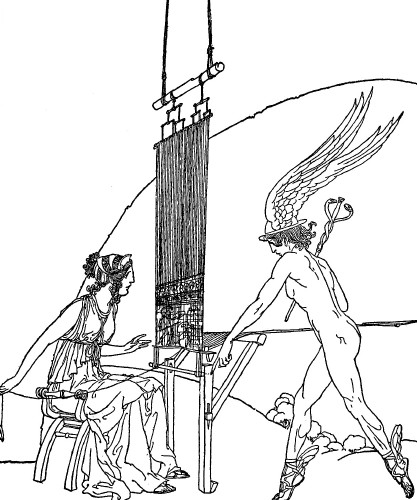
Beautiful indeed was that Island. All round the cave where Calypso lived was a blossoming wood — alder, poplar and cypress trees were there, and on their branches roosted long-winged birds — falcons and owls and chattering sea-crows. Before the cave was a soft meadow in which thousands of violets bloomed, and with four fountains that gushed out of the ground and made clear streams through the grass. Across the cave grew a straggling vine, heavy with clusters of grapes. Calypso was within the cave, and as Hermes came near, he heard her singing one of her magic songs. She was before a loom weaving the threads with a golden shuttle. Now she knew Hermes and was pleased to see him on her Island, but as soon as he spoke of Odysseus and how it was the will of Zeus that he should be permitted to leave the Island, her song ceased and the golden shuttle fell from her hand. 'Woe to me,' she said, 'and woe to any immortal who loves a mortal, for the gods are always jealous of their love. I do not hold him here because I hate Odysseus, but because I love him greatly, and would have him dwell with me here, — more than this, Hermes, I would make him an immortal so that he would know neither old age nor death.' 'He does not desire to be freed from old age and death,' said Hermes, 'he desires to return to his own land and to live with his dear wife, Penelope, and his son, Telemachus. And Zeus, the greatest of the gods, commands that you let him go upon his way.' 'I have no ship to give him,' said Calypso, 'and I have no company of men to help him to cross the sea.' 'He must leave the Island and cross the sea — Zeus commands it,' Hermes said. 'I must help him to make his way across the sea if it must be so,' Calypso said. Then she bowed her head and Hermes went from her. Straightway Calypso left her cave and went down to the sea. By the shore Odysseus stayed, looking across the wide sea with tears in his eyes. She came to him and she said, 'Be not sorrowful any more, Odysseus. The time has come when thou mayst depart from my Island. Come now. I will show how I can help thee on thy way.'
Then Odysseus started to hew down the timber. Twenty trees he felled with his axe of bronze, and he smoothed them and made straight the line. Calypso came to him at the dawn of the next day; she brought augers for boring and he made the beams fast. He built a raft, making it very broad, and set a mast upon it and fixed a rudder to guide it. To make it more secure, he wove out of osier rods a fence that went from stem to stern as a bulwark against the waves, and he strengthened the bulwark with wood placed behind. Calypso wove him a web of cloth for sails, and these he made very skilfully. Then he fastened the braces and the halyards and sheets, and he pushed the raft with levers down to the sea. That was on the fourth day. On the fifth Calypso gave him garments for the journey and brought provision down to the raft — two skins of wine and a great skin of water; corn and many dainties. She showed Odysseus how to guide his course by the star that some call the Bear and others the Wain, and she bade farewell to him. He took his place on the raft and set his sail to the breeze and he sailed away from Ogygia, the island where Calypso had held him for so long. But not easily or safely did he make his way across the sea. The winds blew upon his raft and the waves dashed against it; a fierce blast came and broke the mast in the middle; the sail and the arm-yard fell into the deep. Then Odysseus was flung down on the bottom of the raft. For a long time he lay there over whelmed by the water that broke over him. The winds drove the raft to and fro — the South wind tossed it to the North to bear along, and the East wind tossed it to the West to chase. In the depths of the sea there was a Nymph who saw his toils and his troubles and who had pity upon him. Ino was her name. She rose from the waves in the likeness of a seagull and she sat upon the raft and she spoke to Odysseus in words. 'Hapless man,' she said, 'Poseidon, the god of the sea, is still wroth with thee. It may be that the waters will destroy the raft upon which thou sailest. Then there would be no hope for thee. But do what I bid thee and thou shalt yet escape. Strip off thy garments and take this veil from me and wind it around thy breast. As long as it is upon thee thou canst not drown. But when thou reachest the mainland loose the veil and cast it into the sea so that it may come back to me.' She gave him the veil, and then, in the likeness of a seagull, she dived into the sea and the waves closed over her. Odysseus took the veil and wound it around his breast, but he would not leave the raft as long as its timbers held together.
Then a great wave came and shattered the raft. He held himself on a single beam as one holds himself on a horse, and then, with the veil bound across his breast, he threw himself into the waves. For two nights and two days he was tossed about on the waters. When on the third day the dawn came and the winds fell he saw land very near. He swam eagerly towards it. But when he drew nearer he heard the crash of waves as they struck against rocks that were all covered with foam. Then indeed was Odysseus afraid. A great wave took hold of him and flung him towards the shore. Now would his bones have been broken upon the rocks if he had not been ready-minded enough to rush towards a rock and to cling to it with both hands until the wave dashed by. Its backward drag took him and carried him back to the deep with the skin stripped from his hands. The waves closed over him. When he rose again he swam round looking for a place where there might be, not rocks, but some easy opening into the land. At last he saw the mouth of a river. He swam towards it until he felt its stream flowing through the water of the sea. Then in his heart he prayed to the river. 'Hear me, O River,' was what he said, 'I am come to thee as a suppliant, fleeing from the anger of Poseidon, god of the sea. Even by the gods is the man pitied who comes to them as a wanderer and a hapless man. I am thy suppliant, O River; pity me and help me in my need.' Now the river water was smooth for his swimming, and he came safely to its mouth. He came to a place where he might land, but with his flesh swollen and streams of salt water gushing from his mouth and nostrils. He lay on the ground without breath or speech, swooning with the terrible weariness that was upon him. But in a while his breath came back to him and his courage rose. He remembered the veil that the Sea-nymph had given him and he loosened it and let it fall back into the flowing river. A wave came and bore it back to Ino who caught it in her hands. But Odysseus was still fearful, and he said in his heart, 'Ah me! what is to befall me now? Here am I, naked and forlorn, and I know not amongst what people I am come. And what shall I do with myself when night comes on? If I lie by the river in the frost and dew I may perish of the cold. And if I climb up yonder to the woods and seek refuge in the thickets I may become the prey of wild beasts.' He went from the cold of the river up to the woods, and he found two olive trees growing side by side, twining together so that they made a shelter against the winds. He went and lay between them upon a bed of leaves, and with leaves he covered himself over. There in that shelter, and with that warmth he lay, and sleep came on him, and at last he rested from perils and toils.
II
She came to the Palace of the King, and, passing through all the doors, came to the chamber where the King's daughter, Nausicaa slept. She entered into Nausicaa's dream, appearing to her in it as one of her girl-comrades. And in the dream she spoke to the Princess: 'Nausicaa,' she said, 'the garments of your household are all uncared for, and the time is near when, more than ever, you have need to have much and beautiful raiment. Your marriage day will be soon. You will have to have many garments ready by that time — garments to bring with you to your husband's house, and garments to give to those who will attend you at your wedding. There is much to be done, Nausicaa. Be ready at the break of day, and take your maidens with you, and bring the garments of your household to the river to be washed. I will be your mate in the toil. Beg your father to give you a wagon with mules to carry all the garments that we have need to wash.' So
in her dream Pallas Athene spoke to the Princess in the likeness of
her girl-friend. Having put the task of washing into her mind, the
goddess left the Palace of the King and the country of the
Phæacians. 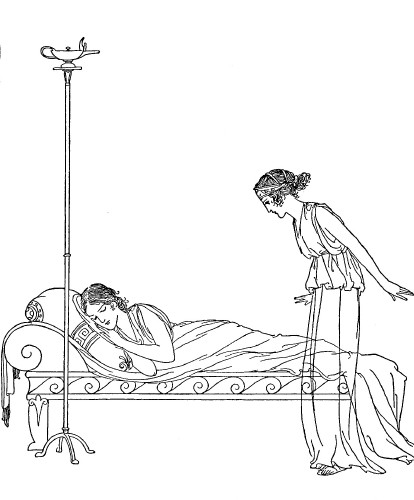
Nausicaa, when she rose, thought upon her dream, and she went through the Palace and found her father. He was going to the assembly of the Phæacians. She came to him, but she was shy about speaking of that which had been in her dream — her marriage day — since her parents had not spoken to her about such a thing. Saying that she was going to the river to wash the garments of the household, she asked for a wagon and for mules. 'So many garments have I lying soiled,' she said. 'Yea, and thou too, my father, should have fresh raiment when you go forth to the assembly of the Phæacians. And in our house are the two unwedded youths, my brothers, who are always eager for new washed garments wherein to go to dances.' Her father smiled on her and said, 'The mules and wagon thou mayst have, Nausicaa, and the servants shall get them ready for thee now.' He called to the servants and bade them get ready the mules and the wagon. Then Nausicaa gathered her maids together and they brought the soiled garments of the household to the wagon. And her mother, so that Nausicaa and her maids might eat while they were from home, put in a basket filled with dainties and a skin of wine. Also she gave them a jar of olive-oil so that they might rub themselves with oil when bathing in the river. Young Nausicaa herself drove the wagon. She mounted it and took the whip in her hands and started the mules, and they went through fields and by farms and came to the river-bank. The girls brought the garments to the stream, and leaving them in the shallow parts trod them with their bare feet. The wagon was unharnessed and the mules were left to graze along the river side. Now when they had washed the garments they took them to the sea-shore and left them on the clean pebbles to dry in the sun. Then Nausicaa and her companions went into the river and bathed and sported in the water. When they had bathed they sat down and ate the meal that had been put on the wagon for them. The garments were not yet dried and Nausicaa called on her companions to play. Straightway they took a ball and threw it from one to the other, each singing a song that went with the game. And as they played on the meadow they made a lovely company, and the Princess Nausicaa was the tallest and fairest and noblest of them all. Before they left the river side to load the wagon they played a last game. The Princess threw the ball, and the girl whose turn it was to catch missed it. The ball went into the river and was carried down the stream. At that they all raised a cry. It was this cry that woke up Odysseus who, covered over with leaves, was then sleeping in the shelter of the two olive trees. 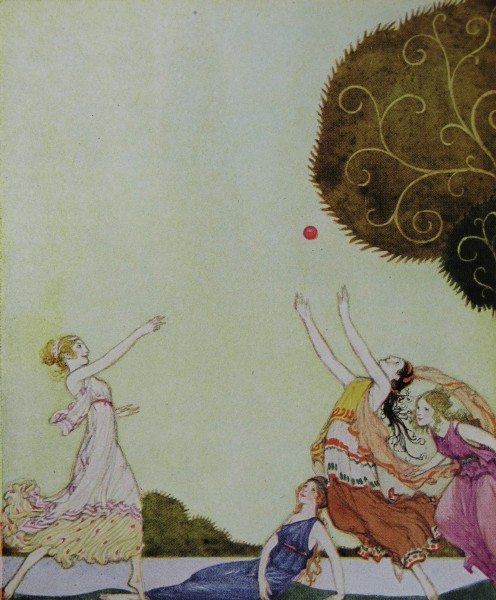 He crept out from under the thicket, covering his nakedness with leafy boughs that he broke off the trees. And when he saw the girls in the meadow he wanted to go to them to beg for their help. But when they looked on him they were terribly frightened and they ran this way and that way and hid themselves. Only Nausicaa stood still, for Pallas Athene had taken fear from her mind. Odysseus stood a little way from her and spoke to her in a beseeching voice. 'I supplicate thee, lady, to help me in my bitter need. I would kneel to thee and clasp thy knees only I fear thine anger. Have pity upon me. Yesterday was the twentieth day that I was upon the sea, driven hither and thither by the waves and the winds.'
She spoke to him as a Princess should, seeing that in spite of the evil plight he was in, he was a man of worth. 'Stranger,' she said, 'since thou hast come to our land, thou shalt not lack for raiment nor aught else that is given to a suppliant. I will show thee the way to the town also.' He asked what land he was in. 'This, stranger,' she said, 'is the land of the Phæacians, and Alcinous is King over them. And I am the King's daughter, Nausicaa.' Then she called to her companions. 'Do not hide yourselves,' she said. 'This is not an enemy, but a helpless and an unfriended man. We must befriend him, for it is well said that the stranger and the beggar are from God.' The girls came back and they brought Odysseus to a sheltered place and they made him sit down and laid a garment beside him. One brought the jar of olive oil that he might clean himself when he bathed in the river. And Odysseus was very glad to get this oil for his back and shoulders were all crusted over with flakes of brine. He went into the river and bathed and rubbed himself with the oil. Then he put on the garment that had been brought him. So well he looked that when he came towards them again the Princess said to the maids: 'Look now on the man who a while ago seemed so terrifying! He is most handsome and stately. Would that we might see more of him. Now, my maidens, bring the stranger meat and drink.' They came to him and they served him with meat and drink and he ate and drank eagerly, for it was long since he had tasted food. And while he ate, Nausicaa and her companions went down to the seashore and gathered the garments that were now dried, singing songs the while. They harnessed the mules and folded the garments and left them on the wagon. When they were ready to go Nausicaa went to Odysseus and said to him, 'Stranger, if thou wouldst make thy way into the city come with us now, so that we may guide thee. But first listen to what I would say. While we are going through the fields and by the farms walk thou behind, keeping near the wagon. But when we enter the ways of the City, go no further with us. People might speak unkindly of me if they saw me with a stranger such as thou. They might say, "Who does Nausicaa bring to her father's house? Someone she would like to make her husband, most likely." So that we may not meet with such rudeness I would have thee come alone to my father's house. Listen now and I will tell thee how thou mayst do this.' 'There is a grove kept for the goddess Pallas Athene within a man's shout of the city. In that grove is a spring, and when we come near I would have thee go and rest thyself by it. Then when thou dost think we have come to my father's house, enter the City and ask thy way to the palace of the King. When thou hast come to it, pass quickly through the court and through the great chamber and come to where my mother sits weaving yarn by the light of the fire. My father will be sitting near, drinking his wine in the evening. Pass by his seat and come to my mother, and clasp your hands about her knees and ask for her aid. If she become friendly to thee thou wilt be helped by our people and wilt be given the means of returning to thine own land.' So Nausicaa bade him. Then she touched the mules with the whip and the wagon went on. Odysseus walked with the maids behind. As the sun set they came to the grove that was outside the City — the grove of Pallas Athene. Odysseus went into it and sat by the spring. And while he was in her grove he prayed to the goddess, 'Hear me, Pallas Athene, and grant that I may come before the King of this land as one well worthy of his pity and his help.'
III
Below it was a vineyard showing clusters of grapes. That orchard and that vineyard were marvels, for in them never fruit fell or was gathered but other fruit ripened to take its place; from season to season there was fruit for the gathering in the king's close.
Odysseus stood before the threshold of bronze and many thoughts were in his mind. But at last with a prayer to Zeus he crossed the threshold and went through the great hall. Now on that evening the Captains and the Councillors of the Phæacians sat drinking wine with the King. Odysseus passed by them, and stayed not at the King's chair, but went where Arete, the Queen, sat. And he knelt before her and clasped her knees with his hands and spoke to her in supplication: 'Arete, Queen! After many toils and perils I am come to thee and to thy husband, and to these, thy guests! May the gods give all who are here a happy life and may each see his children in safe possession of his halls. I have come to thee to beg that thou wouldst put me on my way to my own land, for long have I suffered sore affliction far from my friends.' Then, having spoken, Odysseus went and sat down in the ashes of the hearth with his head bowed. No one spoke for long. Then an aged Councillor who was there spoke to the King. 'O Alcinous,' he said, 'it is not right that a stranger should sit in the ashes by thy hearth. Bid the stranger rise now and let a chair be given him and supper set before him.' Then Alcinous took Odysseus by the hand, and raised him from where he sat, and bade his son Laodamas give place to him. He sat on a chair inlaid with silver and the housedame brought him bread and wine and dainties. He ate, and King Alcinous spoke to the company and said: 'To-morrow I shall call you together and we will entertain this stranger with a feast in our halls, and we shall take counsel to see in what way we can convoy him to his own land.' The Captains and Councillors assented to this, and then each one arose and went to his own house. Odysseus was left alone in the hall with the King and the Queen. Now Arete, looking closely at Odysseus, recognized the mantle he wore, for she herself had wrought it with her handmaids. And when all the company had gone she spoke to Odysseus and said: 'Stranger, who art thou? Didst thou not speak of coming to us from across the deep? And if thou didst come that way, who gave thee the raiment that thou hast on?'
Then said Alcinous the King, 'Our daughter did not do well when she did not bring thee straight to our house.' Odysseus said, 'My Lord, do not blame the maiden. She bade me follow with her company, and she was only careful that no one should have cause to make ill-judged remarks upon the stranger whom she found.' Then Alcinous, the King, praised Odysseus and said that he should like such a man to abide in his house and that he would give him land and wealth, in the country of the Phæacians. 'But if it is not thy will to abide with us,' he said, 'I shall give thee a ship and a company of men to take thee to thy own land, even if that land be as far as Euboea, which, our men say, is the farthest of all lands.' As he said this Odysseus uttered a prayer in his heart, 'O Father Zeus, grant that Alcinous the King may fulfil all that he has promised — and for that may his fame never be quenched — and that I may come to my own land.' Arete now bade the maids prepare a bed for Odysseus. This they did, casting warm coverlets and purple blankets upon it. And when Odysseus came to the bed and lay in it, after the tossing of the waves, rest in it seemed wonderfully good. At dawn of day he went with the King to the assembly of the Phæacians. When the Princes and Captains and Councillors were gathered together, Alcinous spoke to them saying: 'Princes and Captains and Councillors of the Phæacians! This stranger has come to my house in his wanderings, and he desires us to give him a ship and a company of men, so that he may cross the sea and come to his own land. Let us, as in times past we have done for others, help him in his journey. Nay, let us even now draw down a black ship to the sea, and put two and fifty of our noblest youths upon it, and let us make it ready for the voyage, But before he departs from amongst us, come all of you to a feast that I shall give to this stranger in my house. And moreover, let us take with us the minstrel of our land, blind Demodocus, that his songs may make us glad at the feast.' So the King spoke, and the Princes, Captains and Councillors of the Phæacians went with him to the palace. And at the same time two and fifty youths went down to the shore of the sea, and drew down a ship and placed the masts and sails upon it, and left the oars in their leathern loops. Having done all this they went to the palace where the feast was being given and where many men had gathered. The henchman led in the minstrel, blind Demodocus. To him the gods had given a good and an evil fortune — the gift of song with the lack of sight. The henchman led him through the company, and placed him on a seat inlaid with silver, and hung his lyre on the pillar above his seat. When the guests and the minstrel had feasted, blind Demodocus took down the lyre and sang of things that were already famous — of the deeds of Achilles and Odysseus. Now when he heard the words that the minstrel uttered, Odysseus caught up his purple cloak and drew it over his head. Tears were falling down his cheeks and he was ashamed of their being seen. No one marked his weeping except the King, and the King wondered why his guest should be so moved by what the minstrel related. When they had feasted and the minstrel had sung to them, Alcinous said, 'Let us go forth now and engage in games and sports so that our stranger guest may tell his friends when he is amongst them what our young men can do.' All went out from the palace to the place where the games were played. There was a foot-race, and there was a boxing-match, and there was wrestling and weight-throwing. All the youths present went into the games. And when the sports were ending Laodamas, the son of King Alcinous, said to his friends: 'Come, my friends, and let us ask the stranger whether he is skilled or practised in any sport,' And saying this he went to Odysseus and said, 'Friend and stranger, come now and try thy skill in the games. Cast care away from thee, for thy journey shall not be long delayed. Even now the ship is drawn down to the sea, and we have with us the company of youths that is ready to help thee to thine own land.' 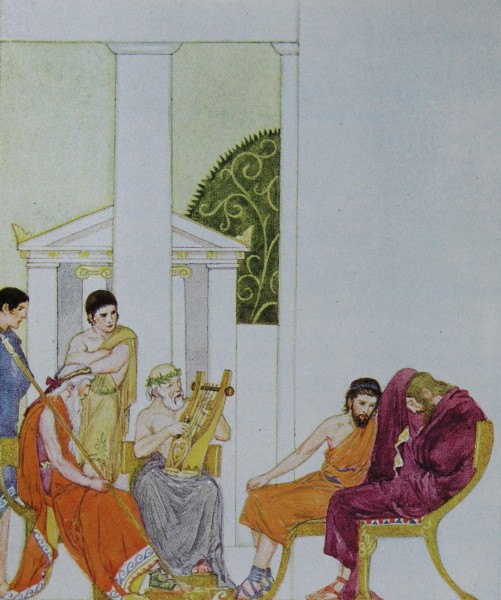 Said Odysseus, 'Sorrow is nearer to my heart than sport, for much have I endured in times that are not far past.' Then a youth who was with Laodamas, Euryalus, who had won in the wrestling bout, said insolently, 'Laodamas is surely mistaken in thinking that thou shouldst be proficient in sports. As I look at thee I think that thou art one who makes voyages for gain — a trader whose only thought is for his cargo and his gains.' Then said Odysseus with anger. 'Thou hast not spoken well, young man. Thou hast beauty surely, but thou hast not grace of manner nor speech. And thou hast stirred the spirit in my breast by speaking to me in such words.' Thereupon, clad as he was in his mantle, Odysseus sprang up and took a weight that was larger than any yet lifted, and with one whirl he flung it from his hands. Beyond all marks it flew, and one who was standing far off cried out, 'Even a blind man, stranger, might know that thy weight need not be confused with the others, but lies far beyond them, In this bout none of the Phæacians can surpass thee.' And Odysseus, turning to the youths, said, 'Let who will, pass that throw, And if any of you would try with me in boxing or wrestling or even in the foot-race, let him stand forward — any one except Laodamas, for he is of the house that has befriended me. A rude man he would surely be who should strive with his host.'
All kept silence, Then Alcinous the King said, 'So that thou shalt have something to tell thy friends when thou art in thine own land, we shall show thee the games in which we are most skilful. For we Phæacians are not perfect boxers or wrestlers, but we excel all in running and in dancing and in pulling with the oar, Lo, now, ye dancers! Come forward and show your nimbleness, so that the stranger may tell his friends, when he is amongst them, how far we surpass all men in dancing as well as in seamanship and speed of foot.'
At the end of the day Alcinous spoke to his people and said, 'This stranger, in all that he does and says, shows himself to be a wise and a mighty man. Let each of us now give him the stranger's gift. Here there are twelve princes of the Phæacians and I am the thirteenth. Let each of us give him a worthy gift, and then let us go back to my house and sit down to supper. As for Euryalus, let him make amends to the stranger for his rude ness of speech as he offers him his gift.' All assented to the King's words, and Euryalus went to Odysseus and said, Stranger, if I have spoken aught that offended thee, may the storm winds snatch it and bear it away. May the gods grant that thou shalt see thy wife and come to thine own country. Too long hast thou endured afflictions away from thy friends.' So saying, Euryalus gave Odysseus a sword of bronze with a silver hilt and a sheath of ivory. Odysseus took it and said, 'And to you, my friend, may the gods grant all happiness, and mayst thou never miss the sword that thou hast given me. Thy gracious speech hath made full amends.' Each of the twelve princes gave gifts to Odysseus, and the gifts were brought to the palace and left by the side of the Queen. And Arete herself gave Odysseus a beautiful coffer with raiment and gold in it, and Alcinous, the King, gave him a beautiful cup, all of gold. In the palace the bath was prepared for Odysseus, and he entered it and was glad of the warm water, for not since he had left the Island of Calypso did he have a warm bath, He came from the bath and put on the beautiful raiment that had been given him and he walked through the hall, looking a king amongst men. Now the maiden, Nausicaa, stood by a pillar as he passed, and she knew that she had never looked upon a man who was more splendid. She had thought that the stranger whom she had saved would have stayed in her father's house, and that one day he would be her husband. But now she knew that by no means would he abide in the land of the Phæacians. As he passed by, she spoke to him and said, 'Farewell, O Stranger! And when thou art in thine own country, think sometimes of me, Nausicaa, who helped thee.' Odysseus took her hand and said to her, 'Farewell, daughter of King Alcinous! May Zeus grant that I may return to my own land. There every day shall I pay homage to my memory of thee, to whom I owe my life.' 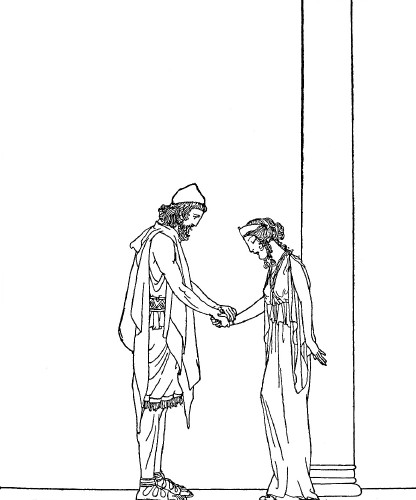 He passed on and he came to where the Princes and Captains and Councillors of the Phæacians sat. His seat was beside the King's. Then the henchman brought in the minstrel, blind Demodocus, and placed him on a seat by a pillar. And when supper was served Odysseus sent to Demodocus a portion of his own meat. He spoke too in praise of the minstrel saying, 'Right well dost thou sing of the Greeks and all they wrought and suffered — as well, methinks, as if thou hadst been present at the war of Troy. I would ask if thou canst sing of the Wooden Horse that brought destruction to the Trojans. If thou canst, I shall be a witness amongst all men how the gods have surely given thee the gift of song.' Demodocus took down the lyre and sang. His song told how one part of the Greeks sailed away in their ships and how others with Odysseus to lead them were now in the center of Priam's City all hidden in the great Wooden Horse which the Trojans themselves had dragged across their broken wall, So the Wooden Horse stood, and the people gathered around talked of what should be done with so wonderful a thing — whether to break open its timbers, or drag it to a steep hill and hurl it down on the rocks, or leave it there as an offering to the gods. As an offering to the gods it was left at last. Then the minstrel sang how Odysseus and his comrades poured forth from the hollow of the horse and took the City. As the minstrel sang, the heart of Odysseus melted within him and tears fell down his cheeks. None of the company saw him weeping except Alcinous the King. But the King cried out to the company saying, 'Let the minstrel cease, for there is one amongst us to whom his song is not pleasing. Ever since it began the stranger here has wept with tears flowing down his cheeks.' The minstrel ceased, and all the company looked in surprise at Odysseus, who sat with his head bowed and his mantle wrapped around his head. Why did he weep? each man asked. No one had asked of him his name, for each thought it was more noble to serve a stranger without knowing his name. Said the King, speaking again, 'In a brother's place stands the stranger and the suppliant, and as a brother art thou to us, O unknown guest. But wilt thou not be brotherly to us? Tell us by what name they call thee in thine own land. Tell us, too, of thy land and thy city. And tell us, too, where thou wert borne on thy wanderings, and to what lands and peoples thou camest. And as a brother tell us why thou dost weep and mourn in spirit over the tale of the going forth of the Greeks to the war of Troy. Didst thou have a kinsman who fell before Priam's City — a daughter's husband, or a wife's father, or someone nearer by blood? Or didst thou have a loving friend who fell there — one with an understanding heart who wast to thee as a brother?' Such questions the King asked, and Odysseus taking the mantle from around his head turned round to the company.
IV
'But first of all I will declare to you my name and my country. I am ODYSSEUS, SON OF LAERTES, and my land is Ithaka, an island around which many islands lie. Ithaka is a rugged isle, but a good nurse of hardy men, and I, for one, have found that there is no place fairer than a man's own land. But now I will tell thee, King, and tell the Princes and Captains and Councillors of the Phæacians, the tale of my wanderings.' 'The wind bore my ships from the coast of Troy, and with our white sails hoisted we came to the cape that is called Malea. Now if we had been able to double this cape we should soon have come to our own country, all unhurt. But the north wind came and swept us from our course and drove us wandering past Cythera.' 'Then for nine days we were borne onward by terrible winds, and away from all known lands. On the tenth day we came to a strange country. Many of my men landed there. The people of that land were harmless and friendly, but the land itself was most dangerous. For there grew there the honey-sweet fruit of the lotus that makes all men forgetful of their past and neglectful of their future. And those of my men who ate the lotus that the dwellers of that land offered them became forgetful of their country and of the way before them, They wanted to abide forever in the land of the lotus. They wept when they thought of all the toils before them and of all they had endured. I led them back to the ships, and I had to place them beneath the benches and leave them in bonds. And I commanded those who had ate of the lotus to go at once aboard the ships. Then, when I had got all my men upon the ships, we made haste to sail away.' 'Later we came to the land of the Cyclôpes, a giant people. There is a waste island outside the harbour of their land, and on it there is a well of bright water that has poplars growing round it. We came to that empty island, and we beached our ships and took down our sails.' 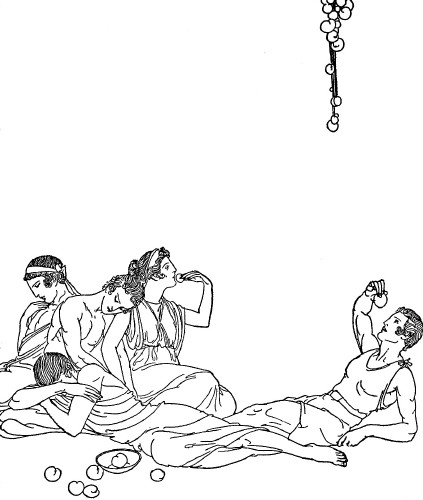 'As soon as the dawn came we went through the empty island, starting the wild goats that were there in flocks, and shooting them with our arrows. We killed so many wild goats there that we had nine for each ship. Afterwards we looked across to the land of the Cyclôpes, and we heard the sound of voices and saw the smoke of fires and heard the bleating of flocks of sheep and goats,' 'I called my companions together and I said, "It would be well for some of us to go to that other island. With my own ship and with the company that is on it I shall go there. The rest of you abide here. I will find out what manner of men live there, and whether they will treat us kindly and give us gifts that are due to strangers — gifts of provisions for our voyage."'
'While we were in the cave, he whose dwelling it was, returned to it. He carried on his shoulder a great pile of wood for his fire. Never in our lives did we see a creature so frightful as this Cyclops was. He was a giant in size, and, what made him terrible to behold, he had but one eye, and that single eye was in his forehead, He cast down on the ground the pile of wood that he carried, making such a din that we fled in terror into the corners and recesses of the cave. Next he drove his flocks into the cave and began to milk his ewes and goats. And when he had the flocks within, he took up a stone that not all our strengths could move and set it as a door to the mouth of the cave.'
'The Cyclops kindled his fire, and when it blazed up he saw us in the corners and recesses. He spoke to us. We knew not what he said, but our hearts were shaken with terror at the sound of his deep voice.' 'I spoke to him saying that we were Agamemnon's men on our way home from the taking of Priam's City, and I begged him to deal with us kindly, for the sake of Zeus who is ever in the company of strangers and suppliants, But he answered me saying, "We Cyclôpes pay no heed to Zeus, nor to any of thy gods. In our strength and our power we deem that we are mightier than they. I will not spare thee, neither will I give thee aught for the sake of Zeus, but only as my own spirit bids me. And first I would have thee tell me how you came to our land."' 'I knew it would be better not to let the Cyclops know that my ship and my companions were at the harbour of the island. Therefore I spoke to him guilefully, telling him that my ship had been broken on the rocks, and that I and the men with me were the only ones who had escaped utter doom.' 'I begged again that he would deal with us as just men deal with strangers and suppliants, but he, without saying a word, laid hands upon two of my men, and swinging them by the legs, dashed their brains out on the earth. He cut them to pieces and ate them before our very eyes. We wept and we prayed to Zeus as we witnessed a deed so terrible.' 'Next the Cyclops stretched himself amongst his sheep and went to sleep beside the fire. Then I debated whether I should take my sharp sword in my hand, and feeling where his heart was, stab him there. But second thoughts held me back from doing this. I might be able to kill him as he slept, but not even with my companions could I roll away the great stone that closed the mouth of the cave.' 'Dawn came, and the Cyclops awakened, kindled his fire and milked his flocks. Then he seized two others of my men and made ready for his mid-day meal. And now he rolled away the great stone and drove his flocks out of the cave.' 'I had pondered on a way of escape, and I had thought of something that might be done to baffle the Cyclops. I had with me a great skin of sweet wine, and I thought that if I could make him drunken with wine I and my companions might be able for him. But there were other preparations to be made first. On the floor of the cave there was a great beam of olive wood which the Cyclops had cut to make a club when the wood should be seasoned. It was yet green. I and my companions went and cut off a fathom's length of the wood, and sharpened it to a point and took it to the fire and hardened it in the glow. Then I hid the beam in a recess of the cave.' 'The Cyclops came back in the evening, and opening up the cave drove in his flocks. Then he closed the cave again with the stone and went and milked his ewes and his goats. Again he seized two of my companions. I went to the terrible creature with a bowl of wine in my hands. He took it and drank it and cried out, " Give me another bowl of this, and tell me thy name that I may give thee gifts for bringing me this honey-tasting drink."' 'Again I spoke to him guilefully and said, "Noman is my name. Noman my father and my mother call me."' '"Give me more of the drink, Noman," he shouted. "And the gift that I shall give to thee is that I shall make thee the last of thy fellows to be eaten."' 'I gave him wine again, and when he had taken the third bowl he sank backwards with his face upturned, and sleep came upon him. Then I, with four companions, took that beam of olive wood, now made into a hard and pointed stake, and thrust it into the ashes of the fire. When the pointed end began to glow we drew it out of the flame. Then I and my companions laid hold on the great stake and, dashing at the Cyclops, thrust it into his eye. He raised a terrible cry that made the rocks ring and we dashed away into the recesses of the cave.'
'Polyphemus then, groaning with pain, rolled away the stone and sat before the mouth of the cave with his hands outstretched, thinking that he would catch us as we dashed out. I showed my companions how we might pass by him. I laid hands on certain rams of the flock and I lashed three of them together with supple rods. Then on the middle ram I put a man of my company. Thus every three rams carried a man. As soon as the dawn had come the rams hastened out to the pasture, and, as they passed, Polyphemus laid hands on the first and the third of each three that went by. They passed out and Polyphemus did not guess that a ram that he did not touch carried out a man.' 'For myself, I took a ram that was the strongest and fleeciest of the whole flock and I placed myself under him, clinging to the wool of his belly. As this ram, the best of all his flock, went by, Polyphemus, laying his hands upon him, said, " Would that you, the best of my flock, were endowed with speech, so that you might tell me where Noman, who has blinded me, has hidden himself." The ram went by him, and when he had gone a little way from the cave I loosed myself from him and went and set my companions free.' 'We gathered together many of Polyphemus' sheep and we drove them down to our ship. The men we had left behind would have wept when they heard what had happened to six of their companions. But I bade them take on board the sheep we had brought and pull the ship away from that land. Then when we had drawn a certain distance from the shore I could not forbear to shout my taunts into the cave of Polyphemus. "Cyclops," I cried, "you thought that you had the company of a fool and a weakling to eat. But you have been worsted by me, and your evil deeds have been punished."' 'So I shouted, and Polyphemus came to the mouth of the cave with great anger in his heart. He took up rocks and cast them at the ship and they fell before the prow. The men bent to the oars and pulled the ship away or it would have been broken by the rocks he cast. And when we were further away I shouted to him: "Cyclops, if any man should ask who it was set his mark upon you, say that he was Odysseus, the son of Laertes."' 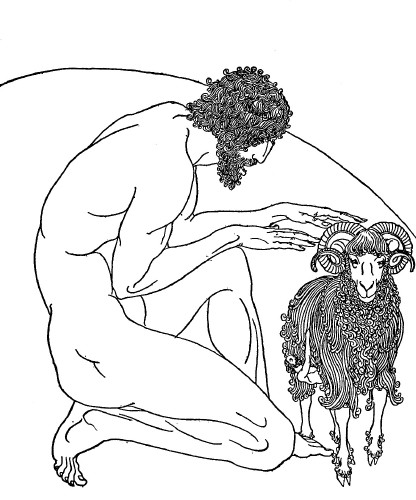 'Then I heard Polyphemus cry out, " I call upon Poseidon, the god of the sea, whose son I am, to avenge me upon you, Odysseus. I call upon Poseidon to grant that you, Odysseus, may never come to your home, or if the gods have ordained your return, that you come to it after much toil and suffering, in an evil plight and in a stranger's ship, to find sorrow in your home."' 'So Polyphemus prayed, and, to my evil fortune, Poseidon heard his prayer. But we went on in our ship rejoicing at our escape. We came to the waste island where my other ships were. All the company rejoiced to see us, although they had to mourn for their six companions slain by Polyphemus. We divided amongst the ships the sheep we had taken from Polyphemus' flock and we sacrificed to the gods. At the dawn of the next day we raised the sails on each ship and we sailed away.'
V
'For nine days we sailed with the West Wind driving us, and on the tenth day we came in sight of Ithaka, our own land. We saw its coast and the beacon fires upon the coast and the people tending the fires. Then I thought that the curse of the Cyclops was vain and could bring no harm to us. Sleep that I had kept from me for long I let weigh me down, and I no longer kept watch.' 'Then even as I slept, the misfortune that I had watched against fell upon me. For now my men spoke together and said, " There is our native land, and we come back to it after ten years' struggles and toils, with empty hands. Different it is with our lord, Odysseus. He brings gold and silver from Priam's treasure-chamber in Troy. And Æolus too has given him a treasure in an ox-hide bag. But let us take something out of that bag while he sleeps."' 'So they spoke, and they unloosed the mouth of the bag, and behold! all the winds that were tied in it burst out. Then the winds drove our ship towards the high seas and away from our land. What became of the other ships I know not. I awoke and I found that we were being driven here and there by the winds. I did not know whether I should spring into the sea and so end all my troubles, or whether I should endure this terrible misfortune. I muffled my head in my cloak and lay on the deck of my ship.' 'The winds brought us back again to the floating Island. We landed and I went to the dwelling of the Lord of the Winds. I sat by the pillars of his threshold and he came out and spoke to me. "How now, Odysseus?" said he. "How is it thou hast returned so soon? Did I not give thee a fair wind to take thee to thine own country, and did I not tie up all the winds that might be contrary to thee?"' '"My evil companions," I said, "have been my bane. They have undone all the good that thou didst for me, O King of the Winds. They opened the bag and let all the winds fly out. And now help me, O Lord Æolus, once again."' 'But Æolus said to me, "Far be it from me to help such a man as thou — a man surely accursed by the gods. Go from my Island, for nothing will I do for thee." Then I went from his dwelling and took my way down to the ship.'
'So Eurylochus went with two and twenty men. In the forest glades they came upon a house built of polished stones. All round that house wild beasts roamed — wolves and lions. But these beasts were not fierce. As Eurylochus and his men went towards the house the lions and wolves fawned upon them like house dogs.' 'But the men were affrighted and stood round the outer gate of the court. They heard a voice within the house singing, and it seemed to them to be the voice of a woman, singing as she went to and fro before a web she was weaving on a loom. The men shouted, and she who had been singing opened the polished doors and came out of the dwelling. She was very fair to see. As she opened the doors of the house she asked the men to come within and they went into her halls.' 'But Eurylochus tarried behind, He watched the woman and he saw her give food to the men. But he saw that she mixed a drug with what she gave them to eat and with the wine she gave them to drink. No sooner had they eaten the food and drunk the wine than she struck them with a wand, and behold! the men turned into swine. Then the woman drove them out of the house and put them in the swine-pens and gave them acorns and mast and the fruit of the cornel tree to eat.' 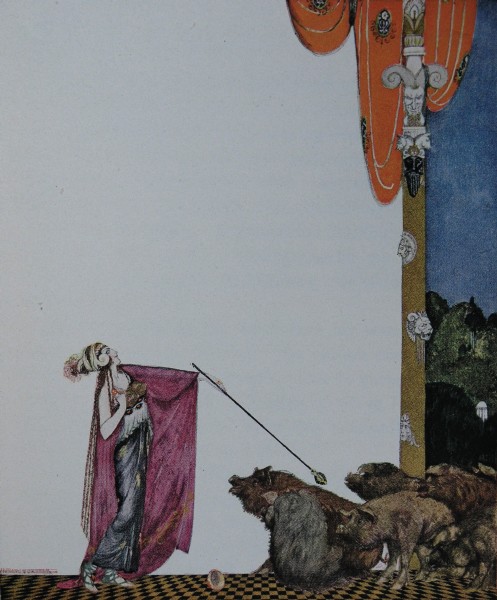 'Eurylochus, when he saw these happenings, ran back through the forest and told me all. Then I cast about my shoulder my good sword of bronze, and, bidding Eurylochus stay by the ships, I went through the forest and came to the house of the enchantress. I stood at the outer court and called out. Then Circe the Enchantress flung wide the shining doors, and called to me to come within. I entered her dwelling and she brought me to a chair and put a footstool under my feet. Then she brought me in a golden cup the wine into which she had cast a harmful drug.' 'As she handed me the cup I drew my sword and sprang at her as one eager to slay her. She shrank back from me and cried out, "Who art thou who art able to guess at my enchantments? Verily, thou art Odysseus, of whom Hermes told me. Nay, put up thy sword and let us two be friendly to each other. In all things I will treat thee kindly."' 'But I said to her, "Nay, Circe, you must swear to me first that thou wilt not treat me guilefully."' 'She swore by the gods that she would not treat me guilefully, and I put up my sword. Then the handmaidens of Circe pre pared a bath, and I bathed and rubbed myself with olive oil, and Circe gave me a new mantle and doublet. The handmaidens brought out silver tables, and on them set golden baskets with bread and meat in them, and others brought cups of honey-tasting wine. I sat before a silver table but I had no pleasure in the food before me.' 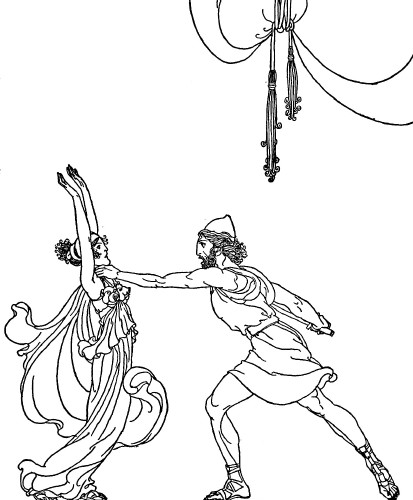 'When Circe saw me sitting silent and troubled she said, "Why, Odysseus, dost thou sit like a speechless man? Dost thou think there is a drug in this food? But I have sworn that I will not treat thee guilefully, and that oath I shall keep."' 'And I said to her, "O Circe, Enchantress, what man of good heart could take meat and drink while his companions are as swine in swine-pens? If thou wouldst have me eat and drink, first let me see my companions in their own forms."' 'Circe, when she heard me say this, went to the swine-pen and anointed each of the swine that was there with a charm. As she did, the bristles dropped away and the limbs of the man were seen. My companions became men again, and were even taller and handsomer than they had been before.' 'After that we lived on Circe's island in friendship with the enchantress. She did not treat us guilefully again and we feasted in her house for a year.' 'But in all of us there was a longing to return to our own land. And my men came to me and craved that I should ask Circe to let us go on our homeward way. She gave us leave to go and she told us of the many dangers we should meet on our voyage.'
VI
'"To the Sirens first you shall come," said she, "to the Sirens, who sit in their field of flowers and bewitch all men who come near them. He who comes near the Sirens without knowing their ways and hears the sound of their voices — never again shall that man see wife or child, or have joy of his home-coming. All round where the Sirens sit are great heaps of the bones of men. But I will tell thee, Odysseus, how thou mayst pass them."' '"When thou comest near put wax over the ears of thy company lest any of them hear the Sirens' song. But if thou thyself art minded to hear, let thy company bind thee hand and foot to the mast. And if thou shalt beseech them to loose thee, then must they bind thee with tighter bonds. When thy companions have driven the ship past where the Sirens sing then thou canst be unbound."' "'Past where the Sirens sit there is a dangerous place indeed. On one side there are great rocks which the gods call the Rooks Wandering. No ship ever escapes that goes that way. And round these rocks the planks of ships and the bodies of men are tossed by waves of the sea and storms of fire, One ship only ever passed that way, Jason's ship, the Argo, and that ship would have been broken on the rocks if Hera the goddess had not helped it to pass, because of her love for the hero Jason."' '"On the other side of the Rocks Wandering are two peaks through which thou wilt have to take thy ship. One peak is smooth and sheer and goes up to the clouds of heaven. In the middle of it there is a cave, and that cave is the den of a monster named Scylla. This monster has six necks and on each neck there is a hideous head, She holds her heads over the gulf, seeking for prey and yelping horribly. No ship has ever passed that way without Scylla seizing and carrying off in each mouth of her six heads the body of a man."' '"The other peak is near. Thou couldst send an arrow across to it from Scylla's den. Out of the peak a fig tree grows, and below that fig tree Charybdis has her den. She sits there sucking down the water and spouting it forth. Mayst thou not be near when she sucks the water down, for then nothing could save thee. Keep nearer to Scylla's than to Charybdis's rock. It is better to lose six of your company than to lose thy ship and all thy company. Keep near Scylla's rock and drive right on."' "If thou shouldst win past the deadly rocks guarded by Scylla and Charybdis thou wilt come to the Island of Thrinacia. There the Cattle of the Sun graze with immortal nymphs to guard them. If thou comest to that Island, do no hurt to those herds. If thou doest hurt to them I foresee ruin for thy ship and thy men, even though thou thyself shouldst escape."' 'So Circe spoke to me, and having told me such things she took her way up the island. Then I went to the ship and roused my men. Speedily they went aboard, and, having taken their seats upon the benches, struck the water with their oars. Then the sails were hoisted and a breeze came and we sailed away from the Isle of Circe, the Enchantress.' 'I told my companions what Circe had told me about the Sirens in their field of flowers. I took a great piece of wax and broke it and kneaded it until it was soft. Then I covered the ears of my men, and they bound me upright to the mast of the ship. The wind dropped and the sea became calm as though a god had stilled the waters. My company took their oars and pulled away. When the ship was within a man's shout from the land we had come near the Sirens espied us and raised their song.' '"Come hither, come hither, O Odysseus," the Sirens sang, "stay thy bark and listen to our song. None hath ever gone this way in his ship until he hath heard from our own lips the voice sweet as a honeycomb, and hath joy of it, and gone on his way a wiser man. We know all things — all the travail the Greeks had in the war of Troy, and we know all that hereafter shall be upon the earth. Odysseus, Odysseus, come to our field of flowers, and hear the song that we shall sing to thee."' 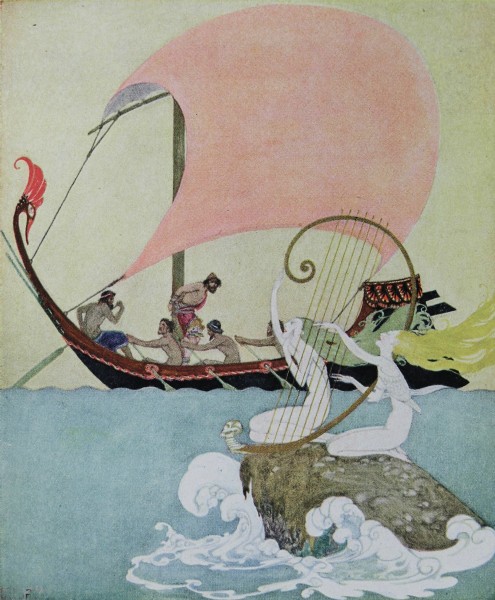 'My heart was mad to listen to the Sirens. I nodded my head to the company commanding them to unloose me, but they bound me the tighter, and bent to their oars and rowed on. When we had gone past the place of the Sirens the men took the wax from off their ears and loosed me from the mast.'
'Having passed the rocks of Scylla and Charybdis we came to the Island of Thrinacia. While we were yet on the ship I heard the lowing of the Cattle of the Sun. I spoke to my company and told them that we should drive past that Island and not venture to go upon it.' 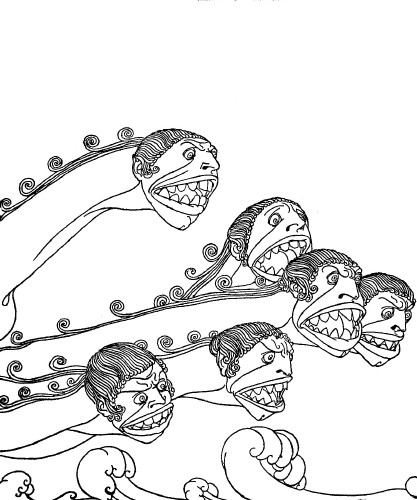 'The hearts of my men were broken within them at that sentence, and Eurylochus answered me, speaking sadly.' "'It is easy for thee, O Odysseus, to speak like that, for thou art never weary, and thou hast strength beyond measure. But is thy heart, too, of iron that thou wilt not suffer thy companions to set foot upon shore where they may rest themselves from the sea and prepare their supper at their ease? "' 'So Eurylochus spoke and the rest of the company joined in what he said. Their force was greater than mine. Then said I, "Swear to me a mighty oath, one and all of you, that if we go upon this Island none of you will slay the cattle out of any herd."' 'They swore the oath that I gave them. We brought our ship to a harbour, and landed near a spring of fresh water, and the men got their supper ready. Having eaten their supper they fell to weeping for they thought upon their comrades that Scylla had devoured. Then they slept.' 'The dawn came, but we found that we could not take our ship out of the harbour, for the North Wind and the East Wind blew a hurricane. So we stayed upon the Island and the days and the weeks went by. When the corn we had brought in the ship was all eaten the men went through the island fishing and hunting. Little they got to stay their hunger.' 'One day while I slept, Eurylochus gave the men a most evil counsel. "Every death," he said, "is hateful to man, but death by hunger is by far the worst. Rather than die of hunger let us drive off the best cattle from the herds of the Sun. Then, if the gods would wreck us on the sea for the deed, let them do it. I would rather perish on the waves than die in the pangs of hunger."' 'So he spoke, and the rest of the men approved of what he said. They slaughtered them and roasted their flesh. It was then that I awakened from my sleep. As I came down to the ship the smell of the roasting flesh came to me. Then I knew that a terrible deed had been committed and that a dreadful thing would befall all of us.' 'For six days my company feasted on the best of the cattle. On the seventh day the winds ceased to blow. Then we went to the ship and set up the mast and the sails and fared out again on the deep.' 'But, having left that island, no other land appeared, and only sky and sea were to be seen. A cloud stayed always above our ship and beneath that cloud the sea was darkened. The West Wind came in a rush, and the mast broke, and, in breaking, struck off the head of the pilot, and he fell straight down into the sea. A thunderbolt struck the ship and the men were swept from the deck. Never a man of my company did I see again.' 'The West Wind ceased to blow but the South Wind came and it drove the ship back on its course. It rushed towards the terrible rocks of Scylla and Charybdis. All night long I was borne on, and, at the rising of the sun, I found myself near Charybdis. My ship was sucked down. But I caught the branches of the fig tree that grew out of the rock and hung to it like a bat. There I stayed until the timbers of my ship were cast up again by Charybdis. I dropped down on them. Sitting on the boards I rowed with my hands and passed the rock of Scylla without the monster seeing me.' 'Then for nine days I was borne along by the waves, and on the tenth day I came to Ogygia where the nymph Calypso dwells. She took me to her dwelling and treated me kindly. But why tell the remainder of my toils? To thee, O King, and to thy noble wife I told how I came from Calypso's Island, and I am not one to repeat a plain-told tale.'
VII
we will land thee in Ithaka, thine own country.' The Princes, Captains and Councillors, marvelling that they had met the renowned Odysseus, went each to his own home. When the dawn had come, each carried down to the ship on which Odysseus was to sail, gifts for him. When the sun was near its setting they all came back to the King's hall to take farewell of him. The King poured out a great bowl of wine as an offering to the gods. Then Odysseus rose up and placed in the Queen's hands a two-handled cup, and he said, 'Farewell to thee, O Queen! Mayst thou long rejoice in thy house and thy children, and in thy husband, Alcinous, the renowned King.' He passed over the threshold of the King's house, and he went down to the ship. He went aboard and lay down on the deck on a sheet and rug that had been spread for him. Straightway the mariners took to their oars, and hoisted their sails, and the ship sped on like a strong sea-bird. Odysseus slept. And lightly the ship sped on, bearing that man who had suffered so much sorrow of heart in passing through wars of men and through troublous seas — the ship sped on, and he slept, and was forgetful of all he had passed through. 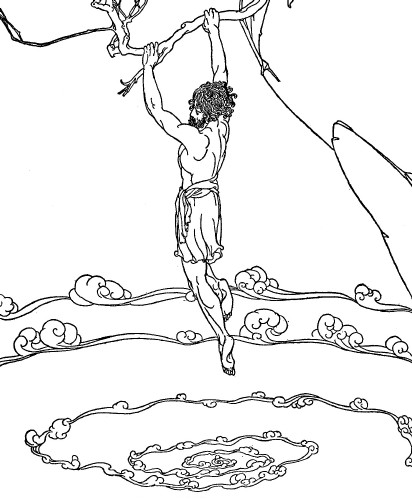 When the dawn came the ship was near to the Island of Ithaka. The mariners drove to a harbour near which there was a great cave. They ran the ship ashore and lifted out Odysseus, wrapped in the sheet and the rugs, and still sleeping. They left him on the sandy shore of his own land. Then they took the gifts which the King and Queen, the Princes, Captains and Councillors of the Phæacians had given him, and they set them by an olive tree, a little apart from the road, so that no wandering person might come upon them before Odysseus had awakened. Then they went back to their ship and departed from Ithaka for their own land. Odysseus awakened on the beach of his own land. A mist lay over all, and he did not know what land he had come to. He thought that the Phæacians had left him forsaken on a strange shore. As he looked around him in his bewilderment he saw one who was like a King's son approaching. Now the one who came near him was not a young man, but the goddess, Pallas Athene, who had made herself look like a young man. Odysseus arose, and questioned her as to the land he had come to. The goddess answered him and said, 'This is Ithaka, a land good for goats and cattle, a land of woods and wells.' Even as she spoke she changed from the semblance of a young man and was seen by Odysseus as a woman tall and fair. 'Dost thou not know me, Pallas Athene, the daughter of Zeus, who has always helped thee?' the goddess said. 'I would have been more often by thy side, only I did not want to go openly against my brother, Poseidon, the god of the sea, whose son, Polyphemus, thou didst blind.' As the goddess spoke the mist that lay on the land scattered and Odysseus saw that he was indeed in Ithaka, his own country — he knew the harbour and the cave, and the hill Neriton all covered with its forest. And knowing them he knelt down on the ground and kissed the earth of his country. Then the goddess helped him to lay his goods within the cave — the gold and the bronze and the woven raiment that the Phæacians had given him. She made him sit beside her under the olive tree while she told him of the things that were happening in his house. 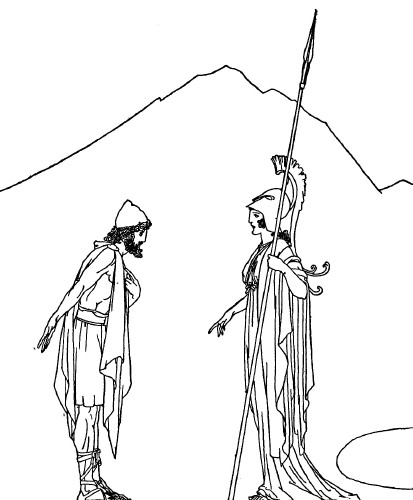 'There is trouble in thy halls, Odysseus,' she said, 'and it would be well for thee not to make thyself known for a time. Harden thy heart, that thou mayest endure for a while longer ill treatment at the hands of men.' She told him about the wooers of his wife, who filled his halls all day, and wasted his substance, and who would slay him, lest he should punish them for their insolence. 'So that the doom of Agamemnon shall not befall thee — thy slaying within thine own halls — I will change thine appearance that no man shall know thee,' the goddess said.
It was then that she came to Telemachus in Sparta and counselled him to leave the house of Menelaus and Helen; and it has been told how he went with Peisistratus, the son of Nestor, and came to his own ship. His ship was hailed by a man who was flying from those who would slay him, and this man Telemachus took aboard. The stranger's name was Theoclymenus, and he was a sooth-sayer and a second-sighted man. And Telemachus, returning to Ithaka, was in peril of his life. The wooers of his mother had discovered that he had gone from Ithaka in a ship. Two of the wooers, Antinous and Eurymachus, were greatly angered at the daring act of the youth. 'He has gone to Sparta for help,' Antinous said, 'and if he finds that there are those who will help him we will not be able to stand against his pride. He will make us suffer for what we have wasted in his house. But let us too act. I will take a ship with twenty men, and lie in wait for him in a strait between Ithaka and Samos, and put an end to his search for his father.' Thereupon Antinous took twenty men to a ship, and fixing mast and sails they went over the sea. There is a little isle between Ithaka and Samos — Asteris it is called — and in the harbour of that isle he and his men lay in wait for Telemachus.
VIII
As he came near the dogs dashed at him, yelping and snapping; and Odysseus might have suffered foul hurt if the swineherd had not run out of the courtyard and driven the fierce dogs away. Seeing before him one who looked an ancient beggar, Eumæus said, 'Old man, it is well that my dogs did not tear thee, for they might have brought upon me the shame of thy death. I have grief and pains enough, the gods know, without such a happening. Here I sit, mourning for my noble master, and fattening hogs for others to eat, while he, mayhap, is wandering in hunger through some friendless city. But come in, old man. I have bread and wine to give thee.' The swineherd led the seeming beggar into the courtyard, and he let him sit down on a heap of brushwood, and spread for him a shaggy goat-skin. Odysseus was glad of his servant's welcome, and he said, 'May Zeus and all the other gods grant thee thy heart's dearest wish for the welcome that thou hast given to me.' Said Eumæus the swineherd, 'A good man looks on all strangers and beggars as being from Zeus himself. And my heart's dearest wish is that my master Odysseus should return. Ah, if Odysseus were here, he would give me something which I could hold as mine own — a piece of ground to till, and a wife to comfort me. But my master will not return, and we thralls must go in fear when young lords come to rule it over them.' He went to the swine-pens and brought out two sucking pigs; he slaughtered them and cut them small and roasted the meat. When all was cooked, he brought portions to Odysseus sprinkled with barley meal, and he brought him, too, wine in a deep bowl of ivy wood. And when Odysseus had eaten and drunken, Eumæus the swineherd said to him: 'Old man, no wanderer ever comes to this land but that our lady Penelope sends for him, and gives him entertainment, hoping that he will have something to tell her of her lord, Odysseus. They all do as thou wouldst do if thou camest to her — tell her a tale of having seen or of having heard of her lord, to win her ear. But as for Odysseus, no matter what wanderers or vagrants say, he will never return — dogs, or wild birds, or the fishes of the deep have devoured his body ere this. Never again shall I find so good a lord, nor would I find one so kind even if I were back in my own land, and saw the faces of my father and my mother. But not so much for them do I mourn as for the loss of my master.' Said Odysseus, 'Thou sayst that thy master will never return, but I notice that thou art slow to believe thine own words. Now I tell thee that Odysseus will return and in this same year. And as sure as the old moon wanes and the young moon is born, he will take vengeance on those whom you have spoken of — those who eat his substance and dishonour his wife and son. I say that, and I swear it with an oath.' 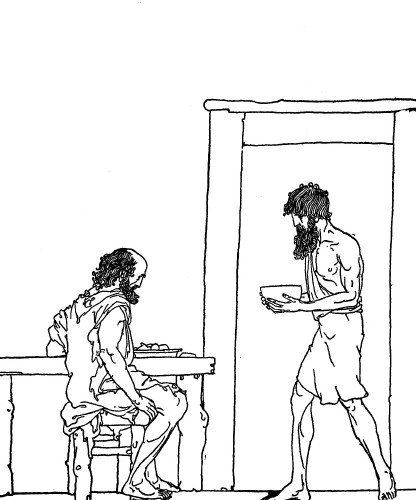 'I do not heed thine oath,' said Eumæus the swineherd. 'I do not listen to vagrant's tales about my master since a stranger came here and cheated us with a story. He told us that he had seen Odysseus in the land of the Cretans, in the house of the hero Idomeneus, mending his ships that had been broken by the storm, and that he would be here by summer or by harvest time, bringing with him much wealth.' As they were speaking the younger swineherds came back from the woods, bringing the drove of swine into the courtyard. There was a mighty din whilst the swine were being put into their pens. Supper time came on, and Eumæus and Odysseus and the younger swineherds sat down to a meal. Eumæus carved the swineflesh, giving the best portion to Odysseus whom he treated as the guest of honour. And Odysseus said, 'Eumæus, surely thou art counselled by Zeus, seeing thou dost give the best of the meat even to such a one as I.' And Eumæus, thinking Odysseus was praising him for treating a stranger kindly, said, 'Eat, stranger, and make merry with such fare as is here.' The night came on cold with rain. Then Odysseus, to test the kindliness of the swineherd, said, 'O that I were young and could endure this bitter night! O that I were better off! Then would one of you swineherds give me a wrap to cover myself from the wind and rain! But now, verily, I am an outcast be cause of my sorry raiment.' Then Eumæus sprang up and made a bed for Odysseus near the fire. Odysseus lay down, and the swineherd covered him with a mantle he kept for a covering when great storms should arise. Then, that he might better guard the swine, Eumæus, wrapping himself up in a cloak, and taking with him a sword and javelin, to drive off wild beasts should they come near, went to lie nearer to the pens. When morning came, Odysseus said, 'I am going to the town to beg, so that I need take nothing more from thee. Send some one with me to be a guide. I would go to the house of Odysseus, and see if I can earn a little from the wooers who are there. Right well could I serve them if they would take me on. There could be no better serving-man than I, when it comes to splitting faggots, and kindling a fire and carving meat.' 'Nay, nay,' said Eumæus, 'do not go there, stranger. None here are at a loss by thy presence. Stay until the son of Odysseus, Telemachus, returns, and he will do something for thee. Go not near the wooers. It is not such a one as thee that they would have to serve them. Stay this day with us.' Odysseus did not go to the town but stayed all day with Eumæus. And at night, when he and Eumæus and the younger swineherds were seated at the fire, Odysseus said, 'Thou, too, Eumæus, hast wandered far and hast had many sorrows. Tell us how thou camest to be a slave and a swineherd.'
THE
STORY OF EUMÆUS THE SWINEHERD
'There came to the city where my father dwelt, a ship with merchants from the land of the Phoenicians. I was a child then, and there was in my father's house a Phoenician slave-woman who nursed me. once, when she was washing clothes, one of the sailors from the Phoenician ship spoke to her and asked her would she like to go back with them to their own land.' 'She spoke to that sailor and told him her story. "I am from Sidon in the Phoenician land," she said, "and my father was named Artybas, and was famous for his riches. Sea robbers caught me one day as I was crossing the fields, and they stole me away, and brought me here, and sold me to the master of yonder house." 'Then the sailor said to her, "Your father and mother are still alive, I know, and they have lost none of their wealth. Wilt thou not come with us and see them again?"' 'Then the woman made the sailors swear that they would bring her safely to the city of Sidon. She told them that when their ship was ready she would come down to it, and that she would bring what gold she could lay her hands on away from her master's house, and that she would also bring the child whom she nursed. "He is a wise child," she said, "and you can sell him for a slave when you come to a foreign land."' 'When the Phoenician ship was ready to depart they sent a message to the woman. The sailor who brought the message brought too a chain of gold with amber beads strung here and there, for my mother to buy. And, while my mother and her handmaids were handling the chain, the sailor nodded to the woman, and she went out, taking with her three cups of gold, and leading me by the hand.' 'The sun sank and all the ways were darkened. But the Phoenician woman went down to the harbour and came to the ship and went aboard it. And when the sailor who had gone to my father's house came back, they raised the mast and sails, and took the oars in their hands, and drew the ship away from our land. We sailed away and I was left stricken at heart. For six days we sailed over the sea, and on the seventh day the woman died and her body was cast into the deep. The wind and the waves bore us to Ithaka, and there the merchants sold me to Laertes, the father of Odysseus.' 'The wife of Laertes reared me kindly, and I grew up with the youngest of her daughters, the lovely Ctimene. But Ctimene went to Same, and was married to one of the princes of that island. Afterwards Laertes' lady sent me to work in the fields. But always she treated me kindly. Now Laertes' lady is dead — she wasted away from grief when she heard no tidings of her only son, Odysseus. Laertes yet lives, but since the death of his noble wife he never leaves his house. All day he sits by his fire, they say, and thinks upon his son's doom, and how his son's sub stance is being wasted, and how his son's son will have but little to inherit.' So Odysseus passed part of the night, Eumæus telling him of his wanderings and his sorrows. And while they were speaking, Telemachus, the son of Odysseus, came to Ithaka in his good ship. Antinous had lain in wait for him, and had posted sentinels to watch for his ship; nevertheless Telemachus had passed by without being seen by his enemies. And having come to Ithaka, he bade one of his comrades bring the ship into the wharf of the city while he himself went to another place. Leav ing the ship he came to the dwelling of the servant he most trusted — to the dwelling of Eumæus, the swineherd.
IX
Then he saw a young man come to the entrance of the courtyard, the swineherd's dogs fawning upon him. When Eumæus saw this young man he let fall the vessels he was carrying, and running to him, kissed his head and his eyes and his hands. While he was kissing and weeping over him, Odysseus heard the swineherd saying: 'Telemachus, art thou come back to us? Like a light in the darkness thou hast appeared! I thought that never again should we see thee when I heard that thou hadst taken a ship to Pylos! Come in, dear son, come in, that I may see thee once again in mine house,' Odysseus raised his head and looked at his son. As a lion might look over his cub so he looked over Telemachus. But neither the swineherd nor Telemachus was aware of Odysseus' gaze. 'I have come to see thee, friend Eumæus,' said Telemachus, 'for before I go into the City I would know whether my mother is still in the house of Odysseus, or whether one of the wooers has at last taken her as a wife to his own house,' 'Thy mother is still in thy father's house,' Eumæus answered. Then Telemachus came within the courtyard. Odysseus in the guise of the old beggar rose from his seat, but the young man said to him courteously: 'Be seated, friend. Another seat can be found for me.' Eumæus strewed green brushwood and spread a fleece upon it, and Telemachus seated himself. Next Eumæus fetched a meal for him — oaten cakes and swine flesh and wine. While they were eating, the swineherd said: 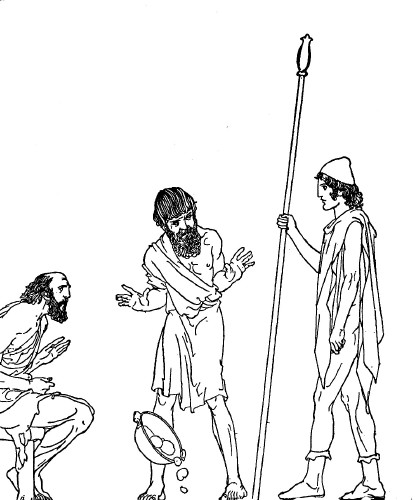 'We have here a stranger who has wandered through many countries, and who has come to my house as a suppliant. Wilt thou take him for thy man, Telemachus?' Said Telemachus, 'How can I support any man? I have not the strength of hand to defend mine own house. But for this stranger I will do what I can. I will give him a mantle and doublet, with shoes for his feet and a sword to defend himself, and I will send him on whatever way he wants to go. But, Eumæus, I would not have him go near my father's house. The wooers grow more insolent each day, and they might mock the stranger if he went amongst them.' Then said Odysseus, speaking for the first time, 'Young sir, what thou hast said seems strange to me. Dost thou willingly submit to insolence in thine own father's house? But perhaps it is that the people of the City hate thee and will not help thee against thine enemies. Ah, if I had such youth as I have spirit, or if I were the son of Odysseus, I should go amongst them this very day, and make myself the bane of each man of them. I would rather die in mine own halls than see such shame as is reported — strangers mocked at, and servants injured, and wine and food wasted.' Said Telemachus, 'The people of the City do not hate me, and they would help me if they could. But the wooers of my mother are powerful men — men to make the City folk afraid. And if I should oppose them I would assuredly be slain in my father's house, for how could I hope to overcome so many?' 'What wouldst thou have me do for thee, Telemachus?' said the swineherd. 'I would have thee go to my mother, friend Eumæus,' Telemachus said, 'and let her know that I am safe-returned from Pylos.' Eumæus at once put sandals upon his feet and took his staff in his hands. He begged Telemachus to rest himself in the hut, and then he left the courtyard and went towards the City. Telemachus lay down on his seat and closed his eyes in weariness, He saw, while thinking that he only dreamt it, a woman come to the gate of the courtyard. She was fair and tall and splendid, and the dogs shrank away from her presence with a whine. She touched the beggar with a golden wand. As she did, the marks of age and beggary fell from him and the man stood up as tall and noble looking. 'Who art thou?' cried Telemachus, starting up. 'Even a moment ago thou didst look aged and a beggar! Now thou dost look a chief of men! Art thou one of the divine ones?' Odysseus looked upon him and said, 'My son, do not speak so to me. I am Odysseus, thy father. After much suffering and much wandering I have come to my own country,' He kissed his son with tears flowing down his cheeks, and Telemachus threw his arms around his father's neck, but scarce believing that the father he had searched for was indeed before him. But no doubt was left as Odysseus talked to him, and told him how he had come to Ithaka in a ship given him by the Phæacians, and how he had brought with him gifts of bronze and raiment that were hidden in the cave, and told him, too, how Pallas Athene had changed his appearance into that of an old beggar. 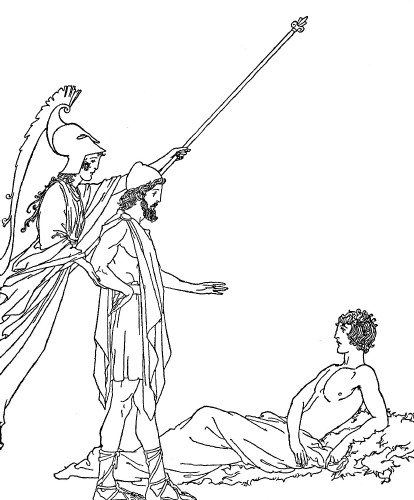 And when his own story was finished he said, 'Come, my son, tell me of the wooers who waste the substance of our house — tell me how many they number, and who they are, so that we may prepare a way of dealing with them.' 'Even though thou art a great warrior, my father, thou and I cannot hope to deal with them. They have come, not from Ithaka alone, but from all the islands around — from Dulichium and Same and Zacynthus. We two cannot deal with such a throng.' Said Odysseus, 'I shall make a plan to deal with them. Go thou home, and keep company with the wooers. Later in the day the swineherd will lead me into the city, and I shall go into the house in the likeness of an old beggar. And if thou shouldst see any of the wooers ill-treat me, harden thine heart to endure it — even if they drag me by the feet to the door of the house, keep quiet thou. And let no one — not even thy mother, Penelope — nor my father Laertes — know that Odysseus hath returned.' Telemachus said, 'My father, thou shalt learn soon what spirit is in me and what wisdom I have.' While they talked together the ship that Antinous had taken, when he went to lie in wait for Telemachus, returned. The wooers assembled and debated whether they should kill Telemachus, for now there was danger that he would draw the people to his side, and so make up a force that could drive the wooers out of Ithaka. But they did not agree to kill him then, for there was one amongst them who was against the deed, Eumæus brought the news to Telemachus and Odysseus of the return of Antinous' ship. He came back to the hut in the afternoon. Pallas Athene had again given Odysseus the appear ance of an ancient beggar-man and the swineherd saw no change in his guest,
X
'Friend Eumæus, I am now going into the City to show myself to my mother, and to let her hear from my own lips the tale of my journey. And I have an order to leave with thee. Take this stranger into the City, that he may go about as he desires, asking alms from the people.' Odysseus in the guise of a beggar said, 'I thank thee, lord Telemachus. I would not stay here, for I am not of an age to wait about a hut and courtyard, obeying the orders of a master, even if that master be as good a man as thy swineherd. Go thy way, lord Telemachus, and Eumæus, as thou hast bidden him, will lead me into the City.' Telemachus then passed out of the courtyard and went the ways until he came into the City. When he went into the house, the first person he saw was his nurse, old Eurycleia, who welcomed him with joy. To Eurycleia he spoke of the guest who had come on his ship, Theoclymenus. He told her that this guest would be in the house that day, and that he was to be treated with all honour and reverence. The wooers came into the hall and crowded around him, with fair words in their mouths. Then all sat down at tables, and Eurycleia brought wheaten bread and wine and dainties. Just at that time Odysseus and Eumæus were journeying towards the City. Odysseus, in the guise of a beggar, had a ragged bag across his shoulders and he carried a staff that the swineherd had given him to help him over the slippery ground. They went by a rugged path and they came to a place where a spring flowed into a basin made for its water, and where there was an altar to the Nymphs, at which men made offerings, As Eumæus and Odysseus were resting at the spring, a servant from Odysseus' house came along. He was a goatherd, and Melanthius was his name. He was leading a flock of goats for the wooers to kill, and when he saw the swineherd with the seeming beggar he cried out: 'Now we see the vile leading the vile. Say, swineherd, whither art thou leading this wretch? It is easy to see the sort of fellow he is! He is the sort to rub shoulders against many doorposts, begging for scraps. Nothing else is he good for. But if thou wouldst give him to me, swineherd, I would make him watch my fields, and sweep out my stalls, and carry fresh water to the kids. He'd have his dish of whey from me. But a fellow like this doesn't want an honest job — he wants to lounge through the country, filling his belly, without doing anything for the people who feed him up. If he goes to the house of Odysseus, I pray that he be pelted from the door.'
Odysseus took thought whether he should strike the fellow with his staff or fling him upon the ground. But in the end he hard ened his heart to endure the insult, and let the goatherd go on his way. But turning to the altar that was by the spring, he prayed: 'Nymphs of the Well! If ever Odysseus made offerings to you, fulfil for me this wish — that he — even Odysseus — may come to his own home, and have power to chastise the insolence that gathers around his house.' They journeyed on, and when they came near they heard the sound of the lyre within the house. The wooers were now feast ing, and Phemius the minstrel was singing to them. And when Odysseus came before his own house, he caught the swineherd by the hand suddenly and with a hard grip, and he said: 'Lo now, I who have wandered in many lands and have walked in pain through many Cities have come at last to the house of Odysseus. There it is, standing as of old, with building beyond building; with its walls and its battlements; its courts and its doors. The house of Odysseus, verily! And lo! unwelcome men keep revel within it, and the smoke of their feast rises up and the sound of the lyre is heard playing for them.' Said Eumæus, 'What wilt thou have me do for thee, friend? Shall I bring thee into the hall and before the company of wooers, whilst I remain here, or wouldst thou have me go in before thee?' 'I would have thee go in before me,' Odysseus said. Now as they went through the courtyard a thing happened that dashed Odysseus' eyes with tears. A hound lay in the dirt of the yard, a hound that was very old. All uncared for he lay in the dirt, old and feeble. But he had been a famous hound, and Odysseus himself had trained him before he went to the wars of Troy. Argos was his name. Now as Odysseus came near, the hound Argos knew him, and stood up before him and whined and dropped his ears, but had no strength to come near him. Odysseus knew the hound and stopped and gazed at him. 'A good hound lies there,' said he to Eumæus, 'once, I think, he was so swift that no beast in the deep places of the wood could flee from him.' Then he went on, and the hound Argos lay down in the dirt of the yard, and that same day the life passed from him. Behind Eumæus, the swineherd, he came into his own hall, in the appearance of a beggar, wretchedly clad and leaning on an old man's staff. Odysseus looked upon the young lords who wooed his wife, and then he sat down upon the threshold and went no further into the hall. 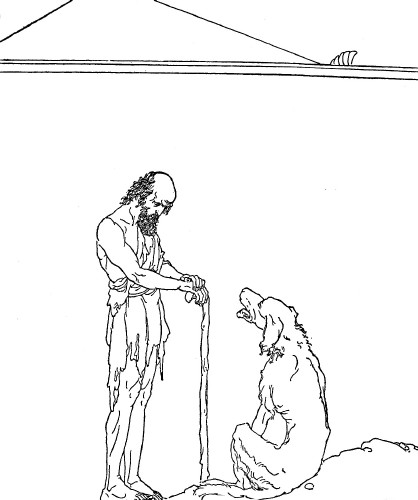 Telemachus was there. Seeing Eumæus he called to him and gave the swineherd bread and meat, and said, Take these, and give them to the stranger at the doorway, and tell him that he may go amongst the company and crave an alms from each.' Odysseus ate whilst the minstrel was finishing his song. When it was finished he rose up, and went into the hall, craving an alms from each of the wooers. Seeing him, Antinous, the most insolent of the wooers, cried out, O notorious swineherd, why didst thou bring this fellow here? Have we not enough vagabonds? Is it nothing to thee that worthless fellows come here and devour thy master's sub stance?' Hearing such a speech from Antinous, Telemachus had to say, 'Antinous, I see that thou hast good care for me and mine. I marvel that thou hast such good care. But wouldst thou have me drive a stranger from the door? The gods forbid that I should do such a thing. Nay, Antinous. Give the stranger something for the sake of the house.' 'If all the company gives him as much as I, he will have some thing to keep him from beggary for a three months' space,' said Antinous, meaning by that that he would work some hurt upon the beggar. Odysseus came before him. 'They say that thou art the noblest of all the wooers,' he said, 'and for that reason thou shouldst give me a better thing than any of the others have given me. Look upon me. I too had a house of mine own, and was accounted wealthy amongst men, and I had servants to wait upon me. And many a time would I make welcome the wanderer and give him something from my store.' 'Stand far away from my table, thou wretched fellow,' said Antinous. Then said Odysseus, 'Thou hast beauty, lord Antinous, but thou hast not wisdom. Out of thine own house thou wouldst not give a grain of salt to a suppliant. And even whilst thou dost sit at another man's table thou dost not find it in thy heart to give something out of the plenty that is before thee.' So Odysseus spoke and Antinous became terribly angered. He caught up a footstool, and with it he struck Odysseus in the back, at the base of the right shoulder. Such a blow would have knocked another man over, but Odysseus stood steadfast under it. He gave one look at Antinous, and then without a word he went over and sat down again upon the threshold. Telemachus had in his heart a mighty rage for the stroke that had been given his father. But he let no tear fall from his eyes and he sat very still, brooding in his heart evil for the wooers. Odysseus, after a while, lifted his head and spoke: 'Wooers
of the renowned queen,' he said, 'hear what the spirit within me bids
me say to you. There is neither pain nor shame in the blow that a man
may get in battle. But in the blow that Antinous has given me — a
blow aimed at a beggar — there is pain and there is shame. And now
I call upon that god who is the avenger of the insult to the poor, to
bring, not a wedding to Antinous, but the issue of death.' 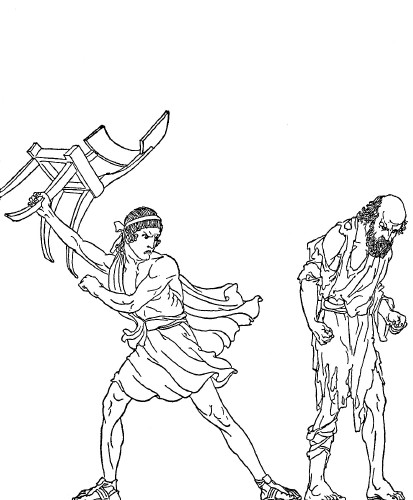 'Sit there and eat thy meat in quiet,' Antinous called out, 'or else thou wilt be dragged through the house by thy heels, and the flesh will be stripped off thy bones.' And now the lady Penelope had come into the hall. Hearing that a stranger was there, she sent for Eumæus and bade the swineherd bring him to her, that she might question him as to what he had heard about Odysseus, Eumæus came and told him of Penelope's request, But Odysseus said, Eumæus, right willing am I to tell the truth about Odysseus to the fair and wise Penelope. But now I may not speak to her. Go to her and tell her that when the wooers have gone I will speak to her. And ask her to give me a seat near the fire, that I may sit and warm myself as I speak, for the clothes I wear are comfortless.' As Eumæus gave the message to the lady Penelope, one who was there, Theoclymenus, the guest who had come in Telemachus' ship, said, O wife of the renowned Odysseus, be sure that thy lord will return to his house. As I came here on the ship of Telemachus, thy son, I saw a happening that is an omen of the return of Odysseus. A bird flew out on the right, a hawk. In his talons he held a dove, and plucked her and shed the feathers down on the ship, By that omen I know that the lord of this high house will return, and strike here in his anger.' Penelope left the hall and went back to her own chamber, Next Eumæus went away to look after his swine, But still the wooers continued to feast, and still Odysseus sat in the guise of a beggar on the threshold of his own house.
XI
'Get away from here, old fellow, lest you be dragged away by the hand or foot. Look you! The lords within the house are giving me the wink to turn you out. But I can't demean myself by touching the like of you. Get up now and go while I'm easy with you.' Odysseus looked at the fellow and said, 'I have not harmed you in deed or word, and I do not grudge you anything of what you may get in this house. The threshold I sit on is wide enough for two of us.' 'What words this fellow has !' said Irus the beggar. 'He talks like an old sit-by-the-fire. I'll not waste more words on him, Get up now, heavy paunch, and strip for the fight, for I'm going to show all the lords that I can keep the door for them.' 'Do not provoke me,' said Odysseus. 'Old as I seem, I may be able to draw your blood.' But Irus kept on shouting, 'I'll knock the teeth out of your jaws.' 'I'll trounce you.' Antinous, the most insolent of the wooers, saw the squabble, and he laughed to see the pair defying each other. 'Friends,' said he, 'the gods are good to us, and don't fail to send us amusement. The strange beggar and our own Irus are threatening each other. Let us see that they don't draw back from the fight. Let us match one against the other.'
Odysseus said, 'Friends, an old man like me cannot fight one who is younger and abler.' But they cried to him, 'Go on, go on. Get into the fight or else take stripes upon your body.' Then said Odysseus, 'Swear to me, all of you, that none of you will show favour to Irus nor deal me a foul blow.' All the wooers cried out that none would favour Irus or deal his opponent a foul blow. And Telemachus, who was there, said, 'The man who strikes thee, stranger, will have to take reckoning from me,' Straightway Odysseus girt up his rags. When his great arms and shoulders and thighs were seen, the wooers were amazed and Irus was frightened. He would have slipped away if Antinous had not caught him and said to him, 'You lubber, you! If you do not stand up before this man I will have you flung on my ship and sent over to King Echetus, who will cut off your nose and ears and give your flesh to his dogs to eat.' He took hold of Irus and dragged him into the ring. The fighters faced each other. But Odysseus with his hands upraised stood for long without striking, for he was pondering whether he should strike Irus a hard or a light blow. It seemed to him better to strike him lightly, so that his strength should not be made a matter for the wooers to note and wonder at. Irus struck first. He struck Odysseus on the shoulder, Then Odysseus aimed a blow at his neck, just below the ear, and the beggar fell to the ground, with the blood gushing from his mouth and nose. The wooers were not sorry for Irus. They laughed until they were ready to fall backwards. Then Odysseus seized Irus by the feet, and dragged him out of the house, and to the gate of the courtyard. He lifted him up and put him standing against the wall. Placing the staff in the beggar's hands, he said, 'Sit there, and scare off the dogs and swine, and do not let such a one as you lord it over strangers. A worse thing might have befallen you.' 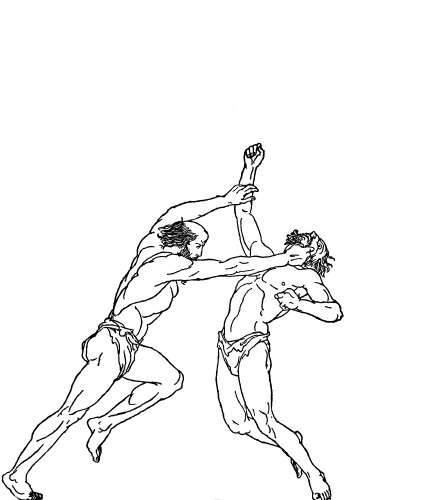 Then back he went to the hall, with his beggar's bag on his shoulder and his clothes more ragged than ever. Back he went, and when the wooers saw him they burst into peals of laughter and shouted out: 'May Zeus, O stranger, give thee thy dearest wish and thy heart's desire. Thou only shalt be beggar in Ithaka.' They laughed and laughed again when Antinous brought out the great pudding that was the prize. Odysseus took it from him, And another of the wooers pledged him in a golden cup, saying, 'May you come to your own, O beggar, and may happiness be yours in time to come.' While these things were happening, the wife of Odysseus, the lady Penelope, called to Eurycleia, and said, 'This evening I will go into the hall of our house and speak to my son, Telemachus. Bid my two handmaidens make ready to come with me, for I shrink from going amongst the wooers alone.' Eurycleia went to tell the handmaidens and Penelope washed off her cheeks the traces of the tears that she had wept that day. Then she sat down to wait for the handmaidens to come to her, As she waited she fell into a deep sleep. And as she slept, the goddess Pallas Athene bathed her face in the Water of Beauty and took all weariness away from her body, and restored all her youthfulness to her. The sound of the hand maidens' voices as they came in awakened her, and Penelope rose up to go into the hall. Now when she came amongst them with her two handmaidens, one standing each side of her, the wooers were amazed, for they had never seen one so beautiful. The hearts of all were en chanted with love for her, and each prayed that he might have her for his wife. Penelope did not look on any of the wooers, but she went to her son, Telemachus, and spoke to him. 'Telemachus,' she said, 'I have heard that a stranger has been ill-treated in this house. How, my child, didst thou permit such a thing to happen?' Telemachus said, 'My lady mother, thou hast no right to be angered at what took place in this hall.' So they spoke to one another, mother and son. Now one of the wooers, Eurymachus by name, spoke to Penelope, saying: 'Lady, if any more than we beheld thee in the beauty thou hast now, by so many more wouldst thou have wooers to-morrow.' 'Speak not so to me, lord Eurymachus,' said Penelope, 'speak not Of my beauty, which departed in the grief I felt when my lord went to the wars of Troy.' Odysseus stood up, and gazed upon his wife who was standing amongst her wooers. Eurymachus noted him and going to him, said, 'Stranger, wouldst thou be my hireling? If thou wouldst work on my upland farm, I should give thee food and clothes, But I think thou art practised only in shifts and dodges, and that thou wouldst prefer to go begging thy way through the country.' 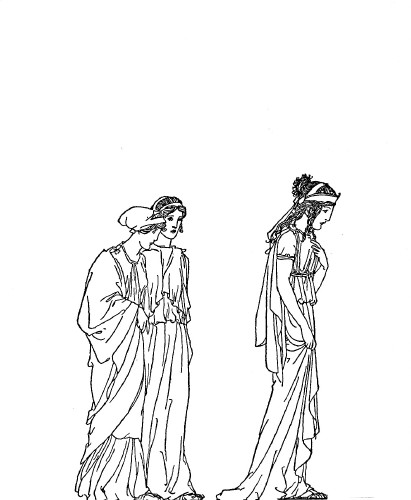 Odysseus, standing there, said to that proud wooer, 'Lord Eurymachus, if there might be a trial of labour between us two, I know which of us would come out the better man. I would that we two stood together, a scythe in the hands of each, and a good swath of meadow to be mown — then would I match with thee, fasting from dawn until evening's dark, Or would that we were set ploughing together. Then thou shouldst see who would plough the longest and the best furrow! Or would that we two were in the ways of war! Then shouldst thou see who would be in the front rank of battle. Thou dost think thyself a great man. But if Odysseus should return, that door, wide as it is, would be too narrow for thy flight.' So angry was Eurymachus at this speech that he would have struck Odysseus if Telemachus had not come amongst the wooers, saying, 'That man must not be struck again in this hall. Sirs, if you have finished feasting, and if the time has come for you, go to your own homes, go in peace I pray you.' All were astonished that Telemachus should speak so boldly. No one answered him back, for one said to the other, 'What he has said is proper. We have nothing to say against it, To misuse a stranger in the house of Odysseus is a shame. Now let us pour out a libation of wine to the gods, and then let each man go to his home.' The wine was poured out and the wooers departed, Then Penelope and her handmaidens went to her own chamber and Telemachus was left with his father, Odysseus.
XII
Telemachus carried the armour and weapons out of the hall and hid them in the women's apartment. Then when the hall was cleared he went to his own chamber. It was then that Penelope came back to the hall to speak to the stranger. One of her handmaidens, Melantho by name, was there, and she was speaking angrily to him. Now this Melantho was proud and hard of heart because Antinous often conversed with her. As Penelope came near she was saying: 'Stranger, art thou still here, prying things out and spying on the servants? Be thankful for the supper thou hast gotten and betake thyself out of this.' Odysseus, looking fiercely at her, said, 'Why shouldst thou speak to me in such a way? If I go in ragged clothes and beg through the land it is because of my necessity. Once I had a house with servants and with much substance, and the stranger who came there was not abused.' The lady Penelope called to the handmaiden and said, 'Thou, Melantho, didst hear it from mine own lips that I was minded to speak to this stranger and ask him if he had tidings of my lord. Therefore, it does not become thee to revile him.' She spoke to the old nurse who had come with her, and said, 'Eurycleia, bring to the fire a bench, with a fleece upon it, that this stranger may sit and tell me his story.' Eurycleia brought over the bench, and Odysseus sat down near the fire. Then said the lady Penelope, 'First, stranger, wilt thou tell me who thou art, and what is thy name, and thy race and thy country?' Said Odysseus, 'Ask me all thou wilt, lady, but inquire not concerning my name, or race, or country, lest thou shouldst fill my heart with more pains than I am able to endure. Verily I am a man of grief. But hast thou no tale to tell me? We know of thee, Penelope, for thy fame goes up to heaven, and no one of mortal men can find fault with thee.' Then said Penelope, 'What excellence I had of face or form departed from me when my lord Odysseus went from this hall to the wars of Troy. And since he went a host of ills has beset me. Ah, would that he were here to watch over my life! The lords of all the islands around — Dulichium and Same and Zacynthus; and the lords of the land of Ithaka, have come here and are wooing me against my will. They devour the substance of this house and my son is being impoverished.' 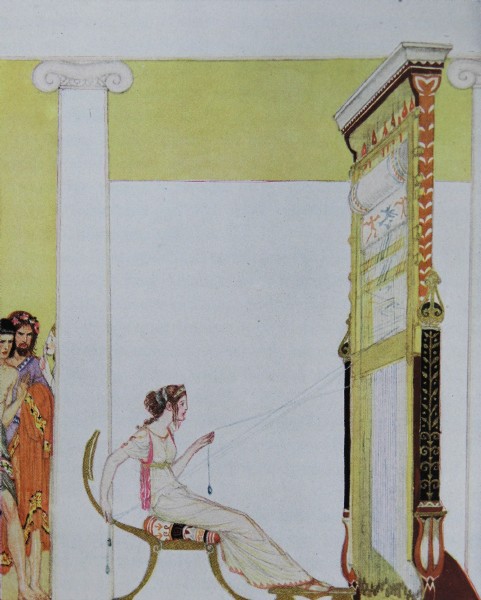 'Long ago a god put into my mind a device to keep marriage with any of them away from me. I set up a great web upon my loom and I spoke to the wooers, saying, "Odysseus is assuredly dead, but I crave that you be not eager to speed on this marriage with me. Wait until I finish the web I am weaving. It is a shroud for Odysseus' father, and I make it against the day when death shall come to him. There will be no woman to care for Laertes when I have left his son's house, and I would not have such a hero lie without a shroud, lest the women of our land should blame me for neglect of my husband's father in his last days."' 'So I spoke, and they agreed to wait until the web was woven. In the daytime I wove it, but at night I unravelled the web. So three years passed away. Then the fourth year came, and my wooers were hard to deal with. My treacherous handmaidens brought them upon me as I was unravelling the web. And now I cannot devise any other plan to keep the marriage away from me. My parents command me to marry one of my wooers. 'My son cannot long endure to see the substance of his house and field being wasted, and the wealth that should be his destroyed. He too would wish that I should marry. And there is no reason why I should not be wed again, for surely Odysseus, my lord, is dead.' Said Odysseus, 'Thy lord was known to me. On his way to Troy he came to my land, for the wind blew him out of his course, sending him wandering past Malea. For twelve days he stayed in my city, and I gave him good entertainment, and saw that he lacked for nothing in cattle, or wine, or barley meal.' When Odysseus was spoken of, the heart of Penelope melted, and tears ran down her cheeks. Odysseus had pity for his wife when he saw her weeping for the man who was even then sitting by her. Tears would have run down his own cheeks only that he was strong enough to hold them back. Said Penelope, 'Stranger, I cannot help but question thee about Odysseus. What raiment had he on when thou didst see him? And what men were with him?'
When he spoke, giving such tokens of Odysseus, Penelope wept again. And when she had wept for a long time she said: 'Stranger, thou wert made welcome, but now thou shalt be honoured in this hall. Thou dost speak of the garments that Odysseus wore. It was I who gave him these garments, folding them myself and bringing them out of the chamber. And it was I who gave him the brooch that thou hast described. Ah, it was an evil fate that took him from me, bringing him to Troy, that place too evil to be named by me.' Odysseus leaned towards her, and said, 'Do not waste thy heart with endless weeping, lady. Cease from lamentation, and lay up in thy mind the word I give thee. Odysseus is near. He has lost all his companions, and he knows not how to come into this house, whether openly or by stealth. I swear it. By the hearth of Odysseus to which I am come, I swear that Odysseus himself will stand up here before the old moon wanes and the new moon is born.' 'Ah, no,' said Penelope. 'Often before have wanderers told me such comfortable things, and I believed them. I know now that thy word cannot be accomplished. But it is time for thee to rest thyself, stranger. My handmaidens will make a bed for thee in the vestibule, and then come to thee and bathe thy feet.' Said Odysseus, 'Thy handmaidens would be loath to touch the feet of a wanderer such as I. But if there is in the house some old wife who has borne such troubles as I have borne, I would have my feet bathed by her.' Said Penelope, 'Here is an ancient woman who nursed and tended that hapless man, Odysseus. She took him in her arms in the very hour he was born. Eurycleia, wash the feet of this man, who knew thy lord and mine.' Thereupon the nurse, old Eurycleia, fetched water, both hot and cold, and brought the bath to the hearth. And standing before Odysseus in the flickering light of the fire, she said, 'I will wash thy feet, both for Penelope's sake and for thine own. The heart within me is moved at the sight of thee. Many strangers have come into this hall, but I have never seen one that was so like as thou art to Odysseus.' Said Odysseus, 'Many people have said that Odysseus and I favour each other.' His feet were in the water, and she put her hand upon one of them. As she did so, Odysseus turned his face away to the darkness, for it suddenly came into his mind that his nurse, old Eurycleia, might recognize the scar that was upon that foot. How came it there, that scar? It had been made long ago When a boar's tusk had ripped up the flesh of his foot. Odysseus was then a youth, and he had gone to the mountain Parnassus to visit there his mother's father.
And now, as Eurycleia, his old nurse, passed her hands along the leg, she let his foot drop suddenly. His knee struck against the bath, and the vessel of water was overturned. The nurse touched the chin of Odysseus and she said, 'Thou art Odysseus.' She looked to where Penelope was sitting, so that she might make a sign to her. But Penelope had her eyes turned away. Odysseus put his hand on Eurycleia's mouth, and with the other hand he drew her to him. 'Woman,' he whispered. 'Say nothing. Be silent, lest mine enemies learn what thou knowest now.' 'Silent I'll be,' said the nurse Eurycleia. 'Thou knowest me. Firm and unyielding I am, and by no sign will I let anyone know that thou hast come under this roof.' So saying she went out of the hall to fetch water in the place of that which had been spilt, She came back and finished bathing his feet, Then Odysseus arranged the rags around his leg to hide the scar, and he drew the bench closer to the fire. 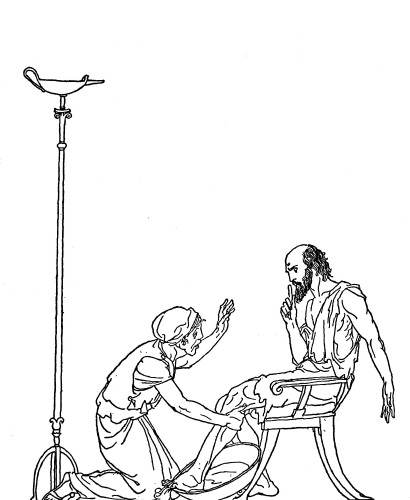 Penelope turned to him again. 'Wise thou art, my guest,' she said, 'and it may be that thou art just such a man as can interpret a dream that comes to me constantly, I have twenty geese in the yard outside. In my dream I see them, and then a great eagle flies down from the mountains, and breaks their necks and kills them all, and lays them in a heap in this hall. I weep and lament for my geese, but then the eagle comes back, and perching on a beam of the roof speaks to me in the voice of a man. "Take heart, O wife of Odysseus," the eagle says, "this is no dream but a true vision. For the geese that thou hast seen are thy wooers, and I, that appeared as an eagle, am thy husband who will swiftly bring death to the wooers." Then the dream goes, and I waken and look out on the daylight and see my geese in the courtyard pecking at the wheat in the trough. Canst thou interpret this dream?' 'Lady,' said Odysseus, 'the dream interprets itself. All will come about as thou hast dreamed.' 'Ah,' said Penelope, 'but it cannot now, for the day of my woe is at hand. I am being forced by my parents to choose a husband from the wooers, and depart from the house of Odysseus.' 'And how wilt thou choose from amongst them?' said Odysseus. 'In this way will I make choice,' said Penelope. 'My husband's great bow is still in the house. The one who can bend that bow, and shoot an arrow through the holes in the backs of twelve axes set one behind the other — him will I choose for my husband.' Said Odysseus, 'Thy device is good, Penelope, and some god hath instructed thee to do this. But delay no longer the contest of the bow. Let it be to-morrow.' 'Is that thy counsel, O stranger?' said Penelope. 'It is my counsel,' said Odysseus. 'I thank thee for thy counsel,' she said. 'And now farewell, for I must go to my rest. And do thou lie down in the vestibule, in the bed that has been made for thee.' So Penelope spoke, and then she went to her chamber with her handmaidens. And in her bed she thought over all the stranger had told her of Odysseus, and she wept again for him.
XIII
And then, as he was going within the house, he heard the voice of a woman who ground barley-meal between stones. She was one of twelve, but the other women had fallen asleep by the quern-stones, She was an ancient, wretched woman, covered all over with the dust of the grain, and, as Odysseus came near her, she lifted up her hands and prayed in a weak voice: 'O Zeus, even for miserable me, fulfil a prayer! May this be the last day that the wooers make their feast in the house of Odysseus! They have loosened my knees with the cruel toil they have made me undergo, grinding for them the barley for the bread they eat. O Zeus, may they to-day sup their last!' Thus the quern-woman spoke, as Odysseus crossed his thresh old. He was glad of her speech, for it seemed to him her words were an omen from Zeus, and that vengeance would soon be wrought upon the proud and hard-hearted men who wasted the goods of the house and oppressed the servants. And now the maids came into the hall from the women's apartment, and some cleaned the tables and others took pitchers and went to the well for water. Then men-servants came in and split the fagots for the fire. Other servants came into the court yard — Eumæus the swineherd, driving fatted swine, the best of his drove, and Philoetius the cattle-herd bringing a calf. The goatherd Melanthius, him whom Odysseus and Eumæus had met on the road the day before, also came, bringing the best goats of his flock to be killed for the wooers' feast. When the cattle-herd, Philoetius, saw a stranger in the guise of a beggar, he called out as he tethered the calf in the yard, 'Hail, stranger friend! My eyes fill with tears as I look on thee, For even now, clad as thou art in rags, thou dost make me think of my master Odysseus, who may be a wanderer such as thou in friendless lands. Ah, that he might return and make a scattering of the wooers in his hall.' Eumæus the swineherd came up to Philoetius and made the same prayer. These two, and the ancient woman at the quern, were the only ones of his servants whom he heard pray for his return. And now the wooers came into the hall. Philoetius the cattle-herd, and Melanthius the evil goatherd, went amongst them, handing them bread and meat and wine. Odysseus stood outside the hall until Telemachus went to him and brought him within, Now there was amongst the wooers a man named Ctesippus, and he was the rudest and the roughest of them all. When he saw Telemachus bringing Odysseus within he shouted out, 'Here is a guest of Telemachus to whom some gift is due from us. It will be unseemly if he should get nothing to-day, Therefore I will bestow this upon him as a token.' Saying this, Ctesippus took up the foot of a slaughtered ox and flung it full at Odysseus. Odysseus drew back, and the ox's foot struck the wall, Then did Odysseus smile grimly upon the wooers. Said Telemachus, 'Verily, Ctesippus, the cast turned out happily for thyself. For if thou shouldst have struck my guest, there would have been a funeral feast instead of a wedding banquet in thy father's house. Assuredly I should have driven my spear through thee.' All the wooers were silent when Telemachus spoke these bold words. But soon they fell laughing at something one of their number said. The guest from Telemachus' ship, Theoclymenus, was there, and he started up and went to leave the hall. 'Why dost thou go, my guest?' said Telemachus. 'I see the walls and the beams of the roof sprinkled with blood,' said Theoclymenus, the second-sighted man. 'I hear the voice of wailing. I see cheeks wet with tears. The men before me have shrouds upon them. The courtyard is filled with ghosts.' So Theoclymenus spoke, and all the wooers laughed at the second-sighted man, for he stumbled about the hall as if it were in darkness. Then said one of the wooers, 'Lead that man out of the house, for surely he cannot tell day from night.' 'I will go from the place,' said Theoclymenus. 'I see death approaching. Not one of all the company before me will be able to avoid it.' 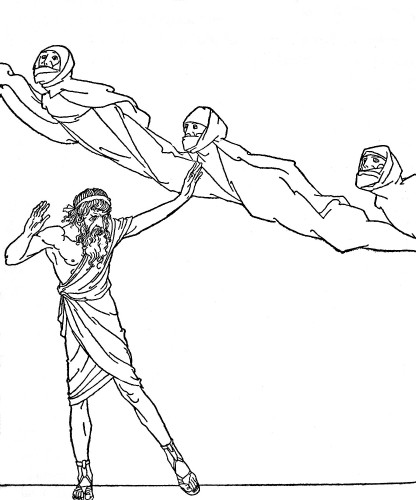 So saying, the second-sighted man went out of the hall. The wooers looking at each other laughed again, and one of them said: 'Telemachus has no luck in his guests. One is a dirty beggar, who thinks of nothing but what he can put from his hand into his mouth, and the other wants to stand up here and play the seer.' So the wooers spake in mockery, but neither Telemachus nor Odysseus paid heed to their words, for their minds were bent upon the time when they should take vengeance upon them.
XIV
To the treasure-chamber Penelope went. She carried in her hand the great key that opened the doors — a key all of bronze with a handle of ivory. Now as she thrust the key into the locks, the doors groaned as a bull groans. She went within, and saw the great bow upon its peg. She took it down and laid it upon her knees, and thought long upon the man who had bent it. Beside the bow was its quiver full of bronze-weighted arrows. The servant took the quiver and Penelope took the bow, and they went from the treasure-chamber and into the hall where the wooers were. When she came in she spoke to the company and said: 'Lords of Ithaka and of the islands around: You have come here, each desiring that I should wed him. Now the time has come for me to make my choice of a man from amongst you. Here is how I shall make choice.' 'This is the bow of Odysseus, my lord who is no more. Who soever amongst you who can bend this bow and shoot an arrow from it through the holes in the backs of twelve axes which I shall have set up, him will I wed, and to his house I will go, forsaking the house of my wedlock, this house so filled with treasure and substance, this house which I shall remember in my dreams.' As she spoke Telemachus took the twelve axes and set them upright in an even line, so that one could shoot an arrow through the hole that was in the back of each axe-head. Then Eumæus, the old swineherd, took the bow of Odysseus, and laid it before the wooers. One of the wooers took up the bow and tried to bend it. But he could not bend it, and he laid it down at the doorway with the arrow beside it. The others took up the bow, and warmed it at the fire, and rubbed it with lard to make it more pliable. As they were doing this, Eumæus, the swineherd, and Philoetius, the cattleherd, passed out of the hall. Odysseus followed them into the courtyard. He laid a hand on each and said, 'Swineherd and cattleherd, I have a word to say to you. But will you keep it to yourselves, the word I say? And first, what would you do to help Odysseus if he should return? Would you stand on his side, or on the side of the wooers? Answer me now from your hearts.' Said Philoetius the cattleherd, 'May Zeus fulfil my wish and bring Odysseus back! Then thou shouldst know on whose side I would stand,' And Eumæus said, If Odysseus should return I would be on his side, and that with all the strength that is in me.' When they said this, Odysseus declared himself. Lifting up his hand to heaven he said, 'I am your master, Odysseus. After twenty years I have come back to my own country, and I find that of all my servants, by you two alone is my homecoming desired. If you need see a token that I am indeed Odysseus, look down on my foot, See there the mark that the wild boar left on me in the days of my youth.' Straightway he drew the rags from the scar, and the swineherd and the cattleherd saw it and marked it well. Knowing that it was indeed Odysseus who stood before them, they cast their arms around him and kissed him on the head and shoulders. And Odysseus was moved by their tears, and he kissed their heads and their hands. As they went back to the hall, he told Eumæus to bring the bow to him as he was bearing it through the hall. He told him, too, to order Eurycleia, the faithful nurse, to bar the doors of the women's apartment at the end of the hall, and to bid the women, even if they heard a groaning and a din, not to come into the hall. And he charged the cattleherd Philoetius to bar the gates of the courtyard. As he went into the hall, one of the wooers, Eurymachus, was striving to bend the bow. As he struggled to do so he groaned aloud: 'Not because I may not marry Penelope do I groan, but because we youths of to-day are shown to be weaklings beside Odysseus, whose bow we can in no way bend.' Then Antinous, the proudest of the wooers, made answer and said, 'Why should we strive to bend the bow to-day? Nay, lay the bow aside, Eurymachus, and let the wine-bearers pour us out a cupful each. In the morning let us make sacrifice to the Archer-god, and pray that the bow be fitted to some of our hands.' Then Odysseus came forward and said, 'Sirs, you do well to lay the bow aside for to-day. But will you not put the bow into my hands, that I may try to bend it, and judge for myself whether I have any of the strength that once was mine?' All the wooers were angry that a seeming beggar should attempt to bend the bow that none of their company were able to bend; Antinous spoke to him sharply and said: 'Thou wretched beggar! Is it not enough that thou art let into this high hall to pick up scraps, but thou must listen to our speech and join in our conversation? If thou shouldst bend that bow we will make short shrift of thee, I promise. We will put thee on a ship and send thee over to King Echetus, who will cut thee to pieces and give thy flesh to his hounds.' Old Eumæus had taken up the bow. As he went with it to Odysseus some of them shouted to him, ' Where art thou going with the bow, thou crazy fellow? Put it down.' Eumæus was confused by their shouts, and he put down the bow. Then Telemachus spoke to him and said, 'Eumæus, beware of being the man who served many masters.' Eumæus, hearing these words, took it up again and brought it to Odysseus, and put the bow into his hands. As Odysseus stood in the doorway of the hall, the bow in his hands, and with the arrows scattered at his feet, Eumæus went to Eurycleia, and told her to bar the door of the women's apart ment at the back. Then Philoetius, the cattleherd, went out of the hall and barred the gates leading out of the courtyard. For long Odysseus stood with the bow in his hands, handling it as a minstrel handles a lyre when he stretches a cord or tightens a peg, Then he bent the great bow; he bent it without an effort, and at his touch the bow-string made a sound that was like the cry of a swallow. The wooers seeing him bend that mighty bow felt, every man of them, a sharp pain at the heart. They saw Odysseus take up an arrow and fit it to the string. He held the notch, and he drew the string, and he shot the bronze-weighted arrow straight through the holes in the back of the axe-heads. Then as Eumæus took up the axes, and brought them outside, he said, 'Thou seest, lord Telemachus, that thy guest does not shame thee through foolish boasting. I have bent the bow of Odysseus, and I have shot the arrow aright, But now it is time to provide the feast for the lords who woo thy lady mother. While it is yet light, the feast must be served to them, and with the feast they must have music and the dance.' 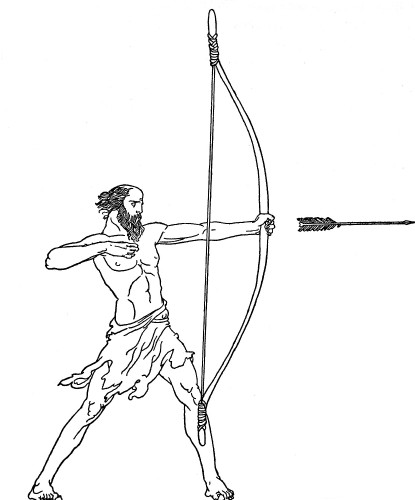 Saying this he nodded to Telemachus, bending his terrible brows, Telemachus instantly girt his sword upon him and took his spear in his hand. Outside was heard the thunder of Zeus. And now Odysseus had stripped his rags from him and was standing upright, looking a master of men. The mighty bow was in his hands, and at his feet were scattered many bronze-weighted arrows.
XV
It was at Antinous he pointed the arrow — at Antinous who was even then lifting up a golden cup filled with wine, and who was smiling, with death far from his thoughts. Odysseus aimed at him, and smote him with the arrow in the throat and the point passed out clean through his neck. The wine cup fell from his hands and Anti nous fell dead across the table. Then did all the wooers raise a shout, threatening Odysseus for sending an arrow astray, It did not come into their minds that this stranger-beggar had aimed to kill Antinous. But Odysseus shouted back to them, 'Ye dogs, ye that said in your hearts that Odysseus would never return to his home, ye that wasted my substance, and troubled my wife, and injured my servants; ye who showed no fear of heaven, nor of the just judgements of men; behold Odysseus returned, and know what death is being loosed on you!' Then Eurymachus shouted out, 'Friends, this man will not hold his hands, nor cease from shooting with the bow, until all of us are slain, Now must we enter into the battle with him. Draw your swords and hold up the tables before you for shields and advance upon him.' But even as he spoke Odysseus, with a terrible cry, loosed an arrow at him and shot Eurymachus through the breast. He let the sword fall from his hand, and he too fell dead upon the floor. One of the band rushed straight at Odysseus with his sword in hand. But Telemachus was at hand, and he drove his spear through this man's shoulders. Then Telemachus ran quickly to a chamber where there were weapons and armour lying, The swineherd and the cattleherd joined him, and all three put armour upon them. Odysseus, as long as he had arrows to defend himself, kept shooting at and smiting the wooers. When all the arrows were gone, he put the helmet on his head and took up the shield that Telemachus had brought, and the two great spears. But now Melanthius, the goatherd — he who was the enemy of Odysseus, got into the chamber where the arms were kept, and brought out spears and shields and helmets, and gave them to the wooers. Seeing the goatherd go back for more arms, Telemachus and Eumæus dashed into the chamber, and caught him and bound him with a rope, and dragged him up near the roof beams, and left him hanging there. Then they closed and bolted the door, and stood on guard. Many of the wooers lay dead upon the floor of the hall. Now one who was called Agelaus stood forward, and directed the wooers to cast spears at Odysseus. But not one of the spears they cast struck him, for Odysseus was able to avoid them all. And now he directed Telemachus and Eumæus and Philoetius to cast their spears. When they cast them with Odysseus, each one struck a man, and four of the wooers fell down. And again Odysseus directed his following to cast their spears, and again they cast them, and slew their men. They drove those who remained from one end of the hall to the other, and slew them all. Straightway the doors of the women's apartment were flung open, and Eurycleia appeared. She saw Odysseus amongst the bodies of the dead, all stained with blood. She would have cried out in triumph if Odysseus had not restrained her. 'Rejoice within thine own heart,' he said, 'but do not cry aloud, for it is an unholy thing to triumph over men lying dead. These men the gods themselves have overcome, because of their own hard and unjust hearts.' As he spoke the women came out of their chambers, carrying torches in their hands. They fell upon Odysseus and embraced him and clasped and kissed his hands. A longing came over him to weep, for he remembered them from of old — every one of the servants who were there. 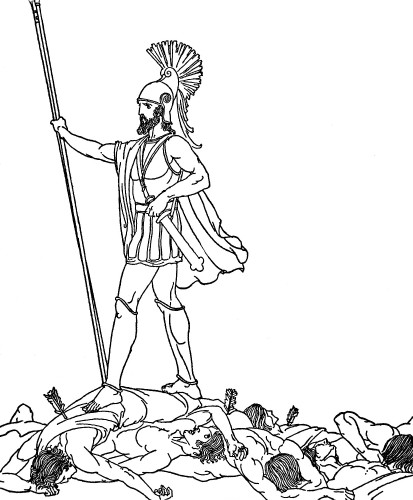
XVI
But Penelope only looked at the nurse, for she thought that her brain had been turned, Still Eurycleia kept on saying, 'In very deed Odysseus is here. He is that guest whom all the wooers dishonour in the hall.' Then hearing Eurycleia say these words, Penelope sprang out of bed and put her arms round the nurse's neck. 'O tell me — if what thou dost say be true — tell me how this stranger slew the wooers, who were so many.' 'I did not see the slaying,' Eurycleia said, 'but I heard the groaning of the men as they were slain. And then I found Odysseus standing amongst many dead men, and it com forted my heart to see him standing there like a lion aroused. Come with me now, lady, that you may both enter into your heart's delight — you that have suffered so much of affliction. Thy lord hath come alive to his own hearth, and he hath found his wife and his son alive and well.' 'Ah no!' said Penelope, 'ah no, Odysseus hath not returned. He who hath slain the wooers is one of the deathless gods, come down to punish them for their injustice and their hardhearted ness, Odysseus long ago lost the way of his returning, and he is lying dead in some far-off land,' 'No, no,' said Eurycleia. 'I can show thee that it is Odysseus indeed who is in the hall. On his foot is the scar that the tusk of a boar gave him in the old days. I spied it when I was washing his feet last night, and I would have told thee of it, but he clapped a hand across my mouth to stop my speech. Lo, I stake my life that it is Odysseus, and none other who is in the hall below.' Saying this she took Penelope by the hand and led her from the upper chamber into the hall. Odysseus was standing by a tall pillar. He waited there for his wife to come and speak to him. But Penelope stood still, and gazed long upon him, and made no step towards him. Then said Telemachus, 'Mother, can it be that thy heart is so hard? Here is my father, and thou wilt not go to him nor question him at all,' Said Penelope, 'My mind is amazed and I have no strength to speak, nor to ask him aught, nor even to look on him face to face. If this is indeed Odysseus who hath come home, a place has to be prepared for him.' Then Odysseus spoke to Telemachus and said, 'Go now to the bath, and make thyself clean of the stains of battle. I will stay and speak with thy lady mother.' 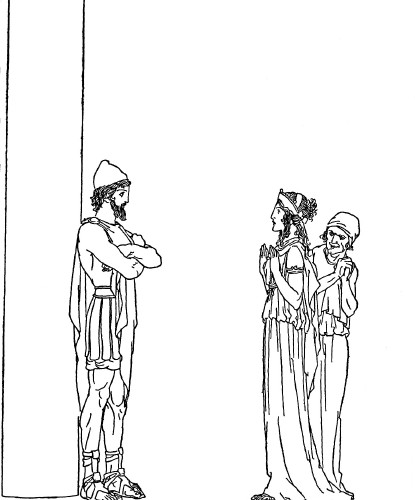 'Strange lady,' said he to Penelope, 'is thy heart indeed so hard? No other woman in the world, I think, would stand so aloof from her husband who, after so much toil and so many trials, has come back after twenty years to his own hearth. Is there no place for me here, and must I again sleep in the stranger's bed?' Said Penelope, 'In no stranger's bed wilt thou lie, my lord. Come, Eurycleia. Set up for him his own bedstead outside his bed-chamber.' Then Odysseus said to her, speaking in anger: 'How comes it that my bed can be moved to this place and that? Not a bed of that kind was the bed I built for myself. Knowest thou not how I built my bed? First, there grew up in the courtyard an olive tree. Round that Olive tree I built a chamber, and I roofed it well and I set doors to it. Then I sheared off all the light wood on the growing olive tree, and I rough-hewed the trunk with the adze, and I made the tree into a bed post. Beginning with this bed post I wrought a bedstead, and when I finished it, I inlaid it with silver and ivory. Such was the bed I built for myself, and such a bed could not be moved to this place or that.' Then did Penelope know assuredly that the man who stood be fore her was indeed her husband, the steadfast Odysseus — none other knew of where the bed was placed, and how it had been built. Penelope fell a-weeping and she put her arms round his neck. 'O Odysseus, my lord,' she said, be not angry with thy wife. Always the fear was in my heart that some guileful stranger should come here professing to be Odysseus, and that I should take him to me as my husband. How terrible such a thing would be! But now my heart is freed from all doubts. Be not angry with me, Odysseus, for not throwing myself on thy neck, as the women of the house did.' Then husband and wife wept together, and Penelope said, 'It was the gods did this to us, Odysseus — the gods who grudged that we should have joy of the days of our youth.' Next they told each other of things that happened in the twenty years they were apart; Odysseus speaking of his own toils and sorrows, and Penelope telling what she had endured at the hands of the wooers. And as they told tales, one to the other, slumber came upon them, and the dawn found them sleeping side by side.
XVII
When he saw him, wasted with age and all uncared for, Odysseus stood still, leaning his hand against a pear tree and sorrowing in his heart. Old Laertes kept his head down as he stood digging at the plant, and he did not see Odysseus until he stood before him and said: 'Old man, thou dost care for this garden well and all things here are flourishing — fig tree, and vine, and olive, and pear, But, if a stranger may say it, thine own self is not cared for well.' 'Who art thou that dost speak to me like this?' old Laertes said, lifting his head. 'I am a stranger in Ithaka,' said Odysseus. 'I seek a man whom I once kindly treated — a man whose name was Odysseus, A stranger, he came to me, and he declared that he was of Ithaka, and that one day he would give me entertainment for the entertainment I had given him. I know not if this man be still alive.' Old Laertes wept before Odysseus. 'Ah,' said he, 'if thou hadst been able to find him here, the gifts you gave him would not have been bestowed in vain. True hospitality thou wouldst have received from Odysseus, my son, But he has perished — far from his country's soil he has perished, the hapless man, and his mother wept not over him, nor his wife, nor me, his father.' 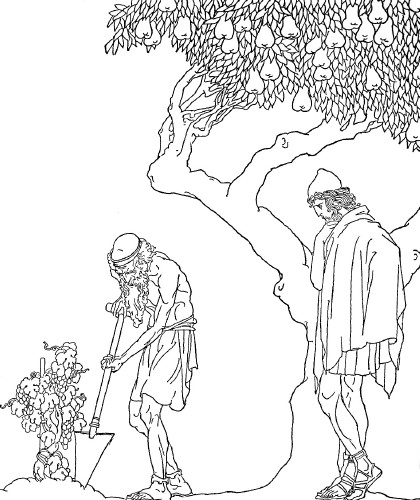 So he spake and then with his hands he took up the dust of the ground, and he strewed it over his head in his sorrow. The heart of Odysseus was moved with grief. He sprang forward and fell on his father's neck and he kissed him, saying: 'Behold I am here, even I, my father. I, Odysseus, have come back to mine own country. Cease thy lamentation until I tell thee of the things that have happened. I have slain the wooers in mine hall, and I have avenged all their injuries and all their wrongful doings. Dost thou not believe this, my father? Then look on what I will show thee. Behold on my foot the mark of the boar's tusk — there it is from the days of my youth.' Laertes looked down on the bare foot, and he saw the scar, but still his mind was clouded by doubt. But then Odysseus took him through the garden, and he told him of the fruit trees that Laertes had set for him when he, Odysseus, was a little child, following his father about the garden — thirteen pear trees, and ten apple trees, and forty fig trees. When Odysseus showed him these Laertes knew that it was his son indeed who stood before him — his son come back after twenty years' wandering. He cast his arms around his neck, and Odysseus caught him fainting to his breast, and led him into the house. Within the house were Telemachus, and Eumæus the swine herd and Philoetius the cattleherd. They all clasped the hand of Laertes and their words raised his spirits. Then he was bathed, and, when he came from the bath, rubbed with olive oil he looked hale and strong, Odysseus said to him, 'Father, surely one of the gods has made thee goodlier and greater than thou wert a while ago,' Said the old hero Laertes: Ah, my son, would that I had such might as when, long before thou wert born, I took the Castle of Nericus there upon the Foreland. Would that in such might, and with such mail upon my shoulders, I stood with thee yesterday when thou didst fight with the wooers.'
There was an assembly of the men of the country, and Eupeithes spake in it, and all who were there pitied him. He told how Odysseus had led away the best of the men of Ithaka, and how he had lost them in his ships. And he told them how, when he returned, he slew the noblest of the men of Ithaka and the Islands in his own hall. He called upon them to slay Odysseus saying, 'If we avenge not ourselves on the slayer of our kin we will be scorned for all time as weak and cowardly men. As for me, life will be no more sweet to me. I would rather die straightway and be with the departed. Up now, and let us attack Odysseus and his followers before they take ship and escape across the sea.' Many in that assembly put on their armour and went out with old Eupeithes. And as they went through the town they met with Odysseus and his following as they were coming from the house of Laertes. Now as the two bands came close to each other — Odysseus with Telemachus and Laertes; with the swineherd and the cattleherd; with Dolius, Laertes' servant, and with the six sons of Dolius — and Eupeithes with his friends — a great figure came between. It was the figure of a tall, fair and splendid woman. Odysseus knew her for the goddess Pallas Athene, 'Hold your hands from fierce fighting, ye men of Ithaka,' the goddess called out in a terrible voice. 'Hold your hands.' Straightway the arms fell from each man's hands. Then the goddess called them together, and she made them enter into a covenant that all bloodshed and wrong would be forgotten, and that Odysseus would be left to rule Ithaka as a King, in peace. 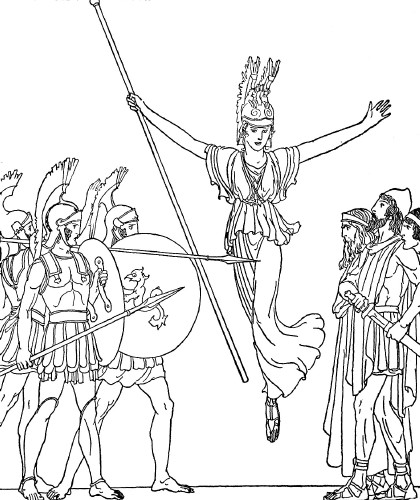 So ends the story of Odysseus who went with King Agamemnon to the wars of Troy; who made the plan of the Wooden Horse by which Priam's City was taken at last; who missed the way of his return, and came to the Land of the Lotus-eaters; who came to the Country of the dread Cyclôpes, to the Island of Æolus and to the house of Circe, the Enchantress; who heard the song of the Sirens, and came to the Rocks Wandering, and to the terrible Charybdis, and to Scylla, past whom no other man had won scatheless; who landed on the Island where the Cattle of the Sun grazed, and who stayed upon Ogygia, the home of the nymph Calypso; so ends the story of Odysseus, who would have been made deathless and ageless by Calypso if he had not yearned always to come back to his own hearth and his own land. And spite of all his troubles and his toils he was fortunate, for he found a constant wife and a dutiful son and a father still alive to weep over him.  |
 VER
mindful was Pallas Athene of Odysseus although she might not help him
openly because of a wrong he had done Poseidon, the god of the sea.
But she spoke at the council of the gods, and she won from Zeus a
pledge that Odysseus would now be permitted to return to his own
land. On that day she went to Ithaka, and, appearing to Telemachus,
moved him, as has been told, to go on the voyage in search of his
father. And on that day, too, Hermes, by the will of Zeus, went to
Ogygia — to that Island where, as the Ancient One of the Sea had
shown Menelaus, Odysseus was held by the nymph Calypso.
VER
mindful was Pallas Athene of Odysseus although she might not help him
openly because of a wrong he had done Poseidon, the god of the sea.
But she spoke at the council of the gods, and she won from Zeus a
pledge that Odysseus would now be permitted to return to his own
land. On that day she went to Ithaka, and, appearing to Telemachus,
moved him, as has been told, to go on the voyage in search of his
father. And on that day, too, Hermes, by the will of Zeus, went to
Ogygia — to that Island where, as the Ancient One of the Sea had
shown Menelaus, Odysseus was held by the nymph Calypso. HE
brought him to the side of the Island where great trees grew and she
put in his hands a double-edged axe and an adze.
HE
brought him to the side of the Island where great trees grew and she
put in his hands a double-edged axe and an adze. 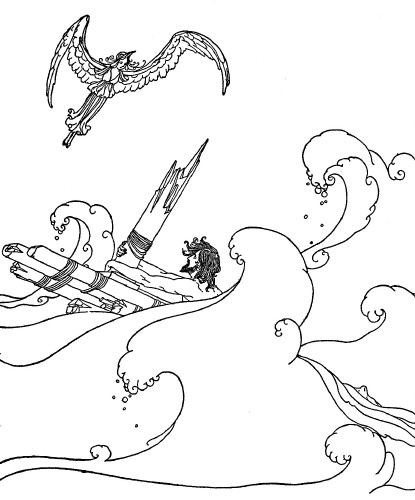
 ND
while he rested the goddess, Pallas Athene, went to the City of the
Phæacians, to whose land Odysseus had now come.
ND
while he rested the goddess, Pallas Athene, went to the City of the
Phæacians, to whose land Odysseus had now come. 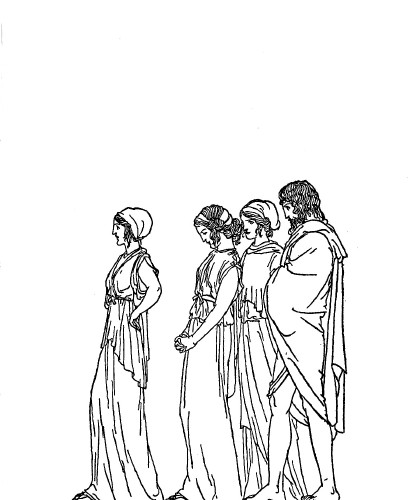
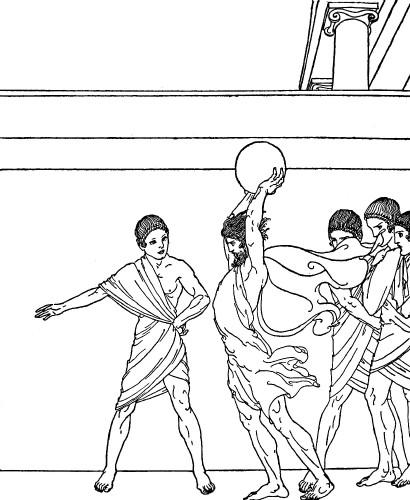
 HEN
Odysseus spoke before the company and said, 'O Alcinous, famous King,
it is good to listen to a minstrel such as Demodocus is. And as for
me, I know of no greater delight than when men feast together with
open hearts, when tables are plentifully spread, when wine-bearers
pour out good wine into cups, and when a minstrel sings to them noble
songs. This seems to me to be happiness indeed. But thou hast asked
me to speak of my wanderings and my toils. Ah, where can I begin that
tale? For the gods have given me more woes than a man can speak of!'
HEN
Odysseus spoke before the company and said, 'O Alcinous, famous King,
it is good to listen to a minstrel such as Demodocus is. And as for
me, I know of no greater delight than when men feast together with
open hearts, when tables are plentifully spread, when wine-bearers
pour out good wine into cups, and when a minstrel sings to them noble
songs. This seems to me to be happiness indeed. But thou hast asked
me to speak of my wanderings and my toils. Ah, where can I begin that
tale? For the gods have given me more woes than a man can speak of!'
 E
embarked and we came to the land. There was a cave near the sea, and
round the cave there were mighty flocks of sheep and goats. I took
twelve men with me and I left the rest to guard the ship. We went
into the cave and found no man there. There were baskets filled with
cheeses, and vessels of whey, and pails and bowls of milk. My men
wanted me to take some of the cheeses and drive off some of the lambs
and kids and come away. But this I would not do, for I would rather
that he who owned the stores would give us of his own free will the
offerings that were due to strangers.'
E
embarked and we came to the land. There was a cave near the sea, and
round the cave there were mighty flocks of sheep and goats. I took
twelve men with me and I left the rest to guard the ship. We went
into the cave and found no man there. There were baskets filled with
cheeses, and vessels of whey, and pails and bowls of milk. My men
wanted me to take some of the cheeses and drive off some of the lambs
and kids and come away. But this I would not do, for I would rather
that he who owned the stores would give us of his own free will the
offerings that were due to strangers.' 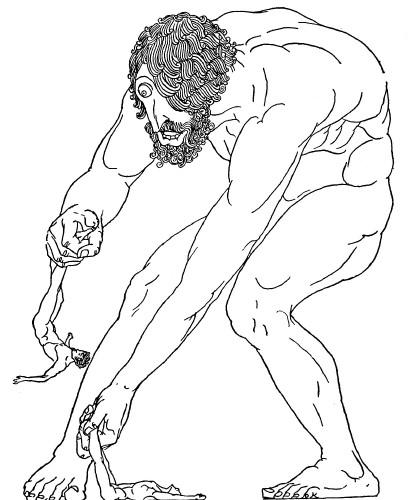
 IS
cries brought other Cyclôpes to the mouth of the cave, and
they, naming him as Polyphemus, called out and asked him what ailed
him to cry. "Noman," he shrieked out, "Noman is
slaying me by guile." They answered him saying, "If no man
is slaying thee, there is nothing we can do for thee, Polyphemus.
What ails thee has been sent to thee by the gods." Saying this,
they went away from the mouth of the cave without attempting to move
away the stone.'
IS
cries brought other Cyclôpes to the mouth of the cave, and
they, naming him as Polyphemus, called out and asked him what ailed
him to cry. "Noman," he shrieked out, "Noman is
slaying me by guile." They answered him saying, "If no man
is slaying thee, there is nothing we can do for thee, Polyphemus.
What ails thee has been sent to thee by the gods." Saying this,
they went away from the mouth of the cave without attempting to move
away the stone.'  UT
no sooner had we passed the Island than I saw smoke arising and heard
the roaring of the sea. My company threw down their oars in terror. I
went amongst them to hearten them, and I made them remember how, by
my device, we had escaped from the Cave of the Cyclops. I told them
nothing of the monster Scylla, lest the fear of her should break
their hearts. And now we began to drive through that narrow strait.
On one side was Scylla and on the other Charybdis. Fear gripped the
men when they saw Charybdis gulping down the sea. But as we drove by,
the monster Scylla seized six of my company — the hardiest of the
men who were with me. As they were lifted up in the mouths of her six
heads they called to me in their agony. But I could do nothing to aid
them. They were carried up to be devoured in the monster's den. Of
all the sights I have seen on the ways of the water, that sight was
the most pitiful.'
UT
no sooner had we passed the Island than I saw smoke arising and heard
the roaring of the sea. My company threw down their oars in terror. I
went amongst them to hearten them, and I made them remember how, by
my device, we had escaped from the Cave of the Cyclops. I told them
nothing of the monster Scylla, lest the fear of her should break
their hearts. And now we began to drive through that narrow strait.
On one side was Scylla and on the other Charybdis. Fear gripped the
men when they saw Charybdis gulping down the sea. But as we drove by,
the monster Scylla seized six of my company — the hardiest of the
men who were with me. As they were lifted up in the mouths of her six
heads they called to me in their agony. But I could do nothing to aid
them. They were carried up to be devoured in the monster's den. Of
all the sights I have seen on the ways of the water, that sight was
the most pitiful.'  DYSSEUS
finished, and the company in the hall sat silent, like men enchanted.
Then King Alcinous spoke and said, 'Never, as far as we Phæacians
are concerned, wilt thou, Odysseus, be driven from thy homeward
way. To-morrow we will give thee a ship and an escort, and
DYSSEUS
finished, and the company in the hall sat silent, like men enchanted.
Then King Alcinous spoke and said, 'Never, as far as we Phæacians
are concerned, wilt thou, Odysseus, be driven from thy homeward
way. To-morrow we will give thee a ship and an escort, and  EAR
the place where Odysseus had landed there lived an old man who was a
faithful servant in his house. Eumæus was his name, and he was
a swineherd. He had made for himself a dwelling in the wildest part
of the island, and had built a wall round it, and had made for the
swine pens in the courtyard — twelve pens, and in each pen there
were fifty swine. Old Eumæus lived in this place tending the
swine with three young men to help him, The swine-pens were guarded
by four dogs that were as fierce as the beasts of the forest.
EAR
the place where Odysseus had landed there lived an old man who was a
faithful servant in his house. Eumæus was his name, and he was
a swineherd. He had made for himself a dwelling in the wildest part
of the island, and had built a wall round it, and had made for the
swine pens in the courtyard — twelve pens, and in each pen there
were fifty swine. Old Eumæus lived in this place tending the
swine with three young men to help him, The swine-pens were guarded
by four dogs that were as fierce as the beasts of the forest.  T
was time for Telemachus to go into the City. He put his sandals on
his feet, and took his spear in his hand, and then speak ing to
the swineherd he said:
T
was time for Telemachus to go into the City. He put his sandals on
his feet, and took his spear in his hand, and then speak ing to
the swineherd he said: Web and Book design,
Copyright, Kellscraft Studio
1999-2007
(Return to Web Text-ures)